Every industry has people who step forward when it matters most, and healthcare often attracts those who feel a deep responsibility to serve. It is a field built on steady hands, clear decisions, and a desire to make life better for entire communities. In public service, that sense of duty becomes even more important. The work is not about titles. It is about influence, preparation, and the promise to show up when others are counting on you.
This is the world that shaped Dr. Jennifer Garrison. Her story did not begin with a single defining moment. Instead, it grew from years of commitment, curiosity, and a drive to understand how science can solve real human problems. Before she entered the private sector, she spent two decades in the federal government and the United States Air Force, where she held senior roles that required strong leadership and clear thinking. She served as both Group Commander and Squadron Commander, and her work took her to Jordan and Qatar during key deployments.
By the time she retired as a Colonel, her career had already shown a pattern: she stepped into roles where preparation, strategy, and care for people were at the center. That pattern continued when she became a Certified Emergency Planner through the International Association of Emergency Management. Later, after being selected for an 18-month Experienced Military Veteran Leadership Program (EMVLDP) fellowship, she moved into the private sector and joined Johnson & Johnson as the Director of Global Medical Affairs Strategy and Execution.
Today, she serves as Vice President of Federal Health at Maximus. The path that led her here was shaped by four powerful influences. First, she has always carried a strong commitment to helping others through healthcare, public health efforts, and community involvement. Second, her interest in science and medicine pushed her toward understanding human biology and disease, along with the systems that support medical innovation. Third, she cares deeply about improving community well-being and addressing gaps in public health. And finally, she believes in lifelong learning, which keeps her grounded and always growing. This combination of service, science, and continuous learning defines how she works and why her leadership matters.
Choosing a Mission-Aligned Culture
Jennifer’s move to Maximus grew from a sense of familiarity. After spending years in the Air Force, she understood the value of teamwork, shared purpose, and steady communication. When she looked at Maximus, she saw a culture shaped by many of the same qualities she respected in the military. The company places real weight on respect, compassion, accountability, and collaboration. These are not slogans for her. They are traits that guide how people work together and how they treat those they serve. She also recognized the company’s strong commitment to customer needs, which matched her own belief that people deserve clear support during complex moments.
She found that employees at Maximus are encouraged to solve problems together, think ahead, and offer new ideas. Programs like the Global Employee Engagement Survey and the Maximus Forward transformation showed her that the company takes learning seriously. It invests in its people and creates space for growth, which makes the organization feel like a natural fit for someone who values development as much as she does.
Her interest in federal health followed a similar path. She has always been drawn to work that strengthens public health and supports communities that often face barriers. Federal health roles allow her to contribute to policy, programs, and systems that shape care on a national level. It also gives her a chance to support mission-driven work that reaches individuals who need it most. For her, this space offers the right balance of purpose, challenge, and impact.
Leading Strategy and Care Delivery
In her role as Vice President of Federal Health, Jennifer focuses on guiding a strong team that supports federal agencies through medical exam services. Her work focuses on enhancing health outcomes for individuals receiving in-clinic coordination, medical examination services, logistics, cold chain management, dental treatment, dental services, public health, occupational health screenings, and virtual health. She also oversees efforts to expand access through mobile clinics and outreach programs that reach underserved communities. “We deploy advanced technology to reform healthcare and support greater efficiency and equity,” she says, summarizing a core part of her mission.
Balancing strategy, innovation, operations, and people leadership is a daily commitment. She sets clear goals, encourages collaboration, and stays open to new ideas that help her team move quickly and responsibly. She believes that strong leadership begins with investing in talent and giving people the tools they need to succeed. Performance tracking and customer focus also shape her decisions, ensuring that each step aligns with the needs of the communities they serve.
For her, maintaining this balance is an active process. “It is never static. You must constantly adjust and look for new ways to innovate,” she explains. This mindset drives her work to deliver safe and reliable assessments for Service Members, DoD Civilians, and Service Components.
Understanding the Maximus Mission
Maximus is built on a simple idea: help the government serve people in a clearer, faster, and more compassionate way. The company focuses on improving public programs by pairing human expertise with modern technology. Its mission reflects this focus, and its vision positions Maximus as a trusted partner that brings innovation and practical solutions to government agencies.
To carry out this work, Maximus uses tools like automation, artificial intelligence, and flexible communication systems that make it easier for individuals, caregivers, and providers to get the support they need. “We work to create personalized experiences that truly meet people where they are,” Jennifer explains. This includes helping Veterans access disability exams through mobile clinics and a broad network of qualified providers.
Federal health plays a central role in this larger mission. The team streamlines eligibility appeals and medical review processes by introducing digital workflows that improve accuracy and shorten wait times. They also support programs within CMS that help people move through the system more efficiently.
For Jennifer, the heart of the work is simple: improve care for real people, especially those in underserved communities. She sees Maximus as a place where whole-person care and innovative thinking come together to support better health outcomes across the country.
Navigating Transformation in Complex Systems
Large federal systems move slowly for a reason. They carry high responsibility, protect sensitive information, and support millions of people who depend on predictable access to services. This makes transformation both necessary and difficult. Jennifer notes that the biggest challenges often come from resistance to change, unclear strategy, and the complexity of modern technology. “You cannot move fast if people are unsure of the direction,” she says, highlighting the need for a clear vision from the start.
Technology integration is another hurdle. Older systems do not always pair easily with new tools, and many teams face gaps in technical skills. To move forward, Jennifer believes organizations must invest in training, make thoughtful technology choices, and keep user experience at the center.
She also stresses the importance of strong security and careful data protection, especially when working on programs that manage personal health information. These guardrails help build trust and keep transformation efforts on track.
For her, the key is creating a culture that supports learning and flexibility. Continuous improvement allows teams to adapt without losing focus. “Lasting change happens when people feel equipped and supported,” she explains, a mindset that guides how she approaches transformation at scale.
Keeping Innovation Human
For Jennifer, human-centric innovation begins with empathy. She encourages her team to understand people in the context of their daily lives, especially those who rely on federal services during difficult moments. “You have to see what needs are still unmet,” she says, emphasizing direct insight into behaviors and barriers faced by vulnerable groups.
She promotes collaboration across diverse teams and involves community voices early in the process to ensure solutions reflect real experiences. Transparency, ethics, and safety guide every decision so innovation supports public interest rather than convenience or speed.
Continuous learning also plays a major role. As her teams gain new insight, they adjust their approach to better serve those at risk. This mindset allows Maximus to design tools and services that are not only advanced but also compassionate and practical for the people who need them most.
Measuring Meaningful Impact
Jennifer looks at impact through a clear and practical lens. She focuses on a mix of performance indicators, outcomes, and measurable metrics that show whether a program is truly working. “Numbers matter, but they should tell a story about real people,” she says.
Her team tracks customer satisfaction, completion rates, accuracy, and access to services, since these reflect how well programs meet community needs. They also watch for outcomes that reveal long-term change, such as improved continuity of care or stronger engagement from hard-to-reach populations.
Metrics give structure to this work. They measure progress toward goals and help identify where adjustments are needed. By combining data with direct feedback, Jennifer ensures decisions stay grounded in both evidence and human experience.
For her, success is not only about efficiency. It is about whether the programs create positive, lasting results for the people they are meant to serve.
A Test of Leadership in a Global Crisis
Jennifer’s leadership was tested at the height of the COVID-19 pandemic. In November 2020, while serving as a Colonel in the Air Force Medical Service Corps and assigned to the Defense Health Agency, she was appointed to lead the Department of Defense’s COVID-19 Vaccine Distribution Operations. “We had one mission: protect our people and keep the nation’s defense strong,” she recalls. She led a planning team of nearly eighty-five representatives from every branch of the DoD, along with partners from HHS, CDC, and the Countermeasures Acceleration Group.
Her team built a detailed plan focused on safety, readiness, and coordinated response. They organized ten working groups and provided daily briefings to senior leaders across the military. After developing the initial strategy, they launched a pilot phase at sixteen domestic and international sites, testing logistics, storage, reporting, and distribution models. These exercises strengthened confidence in the DoD’s ability to deliver vaccines worldwide.
The plan moved into expanded distribution from January to May 2021, followed by a saturation phase as vaccine supply increased. “What made it work was unity. Every service, every partner focused on the same goal,” she says.
Their impact was profound. Together, they supported efforts that helped save an estimated 11.1 million lives while maintaining global mission readiness.
Looking Ahead to a More Advanced, Accessible Future
Jennifer’s next chapter centers on advancing innovation in operational medicine at Maximus. She aims to guide growth that uses emerging technologies to create smarter, faster, and more personalized care. “AI, machine learning, and data analytics are reshaping what healthcare can look like,” she says. These tools support earlier detection, stronger predictions, and more precise treatment decisions, all of which improve how patients experience care.
She is also focused on expanding telemedicine and remote monitoring, which help remove geographic barriers and reach communities with limited access. Real-time data tools are another priority, since they allow teams to respond early and tailor care more effectively.
Advances in 3D printing also inspire her, especially the ability to create custom prosthetics, implants, and anatomical models that support better surgical planning. For Jennifer, the goal is clear: build a more patient-centered system that strengthens prevention and delivers the quality all Service Members and families deserve.
Life beyond Leadership
Jennifer’s balance comes from the people and routines that ground her. She is a proud wife to Lt. Col. (Ret.) Greg Garrison, a mother to Samantha and Adam, and a grandmother to Allison and Mason. Family keeps her centered, no matter how busy her days become.
Fitness is another anchor. She starts each morning with an eight-mile run, followed by weights and core training. “It keeps me strong and focused,” she says. After work, she often reads to relax and learn, always looking for new ideas that help her grow as a leader and support her team at Maximus.
A Final Word on Leadership
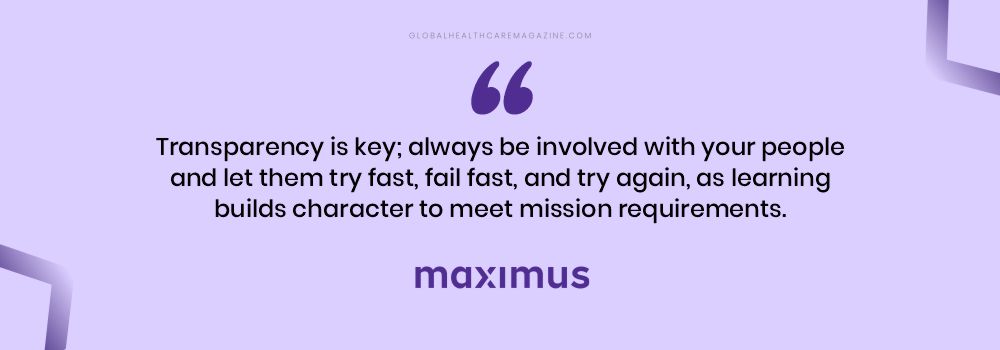
Jennifer’s leadership philosophy is simple and steady: think strategically, stay connected to your people, and remain adaptable. She believes teams grow strongest when they are encouraged to learn quickly, take risks, and recover just as fast. “Let them learn fast, fail fast, and try again,” she says. For her, mistakes are not setbacks. They are lessons that help people improve.
She aims to build a culture where individuals feel supported, motivated, and eager to contribute. When leaders create an environment people want to be part of, she believes real progress follows naturally, one decision and one lesson at a time.
Quotes
Also Read: The Most Inspiring Women Leaders in Healthcare, 2026