There is a specific memory that Dr. Nubia Lluberes carries with her, a fragment of time from when she was six years old in the Dominican Republic. It is a memory of a place that most people would try to forget, or perhaps never visit in the first place. It is a memory of a jail.
Her father was the director of La Victoria, a facility housing some 800 inmates in a town outside Santo Domingo. To a six-year-old girl, it did not look like a cage. It looked like a community. She remembers walking the rounds with her father. She remembers the vibrant gardens that the inmates tended with obsessive care. She remembers the police band playing the Dominican Anthem, the brass notes floating over the walls. It was a place of order, yes, but also a place that seemed to possess a strange, regulated harmony.
Years later, when she was fifteen, her school arranged a trip to a monastery near that same jail. Dr. Lluberes, driven by nostalgia, looked for the place she remembered. What she found instead was a nightmare. The gardens were gone. The music had stopped. The facility was overcrowded, bursting at the seams with human misery. She saw hands gripping the barred windows. She felt the palpable suffering radiating from the concrete.
It was a jarring collision of past and present, of the ideal and the reality. Most teenagers would have turned away. Dr. Nubia Lluberes stared at it. She decided then that she would not abandon her dream of medicine, but she would also not abandon the people behind those bars. She would find a way to do both.
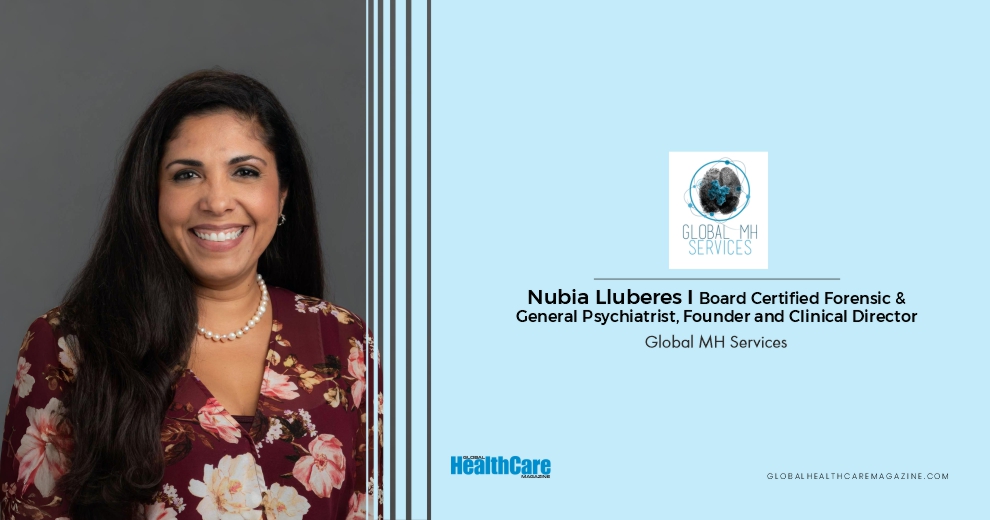
Today, Dr. Lluberes is a Board Certified Forensic and General Psychiatrist, the Founder and Clinical Director of Global MH Services. Her career has been defined by walking into the rooms that the rest of society locks and tries to ignore. Where others see a prisoner, she sees a patient. Where others see a broken system, she sees a puzzle waiting to be solved. And, occasionally, she looks at a tiny bonsai tree in her living room and finds a lesson in patience that applies to the human mind.
The Architecture of a Calling
The path to forensic psychiatry is rarely a straight line. For Dr. Lluberes, three distinct rivers converged to form her career.
The first influence came from Ms. Jeanie Pons, her fourth-grade teacher. A 25-year-old psychology student who did not believe in dumbing things down for children, Ms. Pons talked to a nine-year-old Nubia about the mind, psychological theories, and testing. Beaming with joy when she spoke of the university, she planted a seed.
The second was a book. At eleven, Dr. Lluberes read “God’s Crooked Lines” by Torcuato Luca de Tena. It is a novel about a woman who checks herself into a psychiatric hospital to solve a murder, but it also serves as a deep dive into the complexity of sanity. The story fascinated her.
The third was Dr. Jacobo Fernandez, a prominent psychiatrist and family friend. At eighteen, Dr. Lluberes shadowed him, watching him listen and attend to needs invisible to the naked eye. It became clear that medicine involved more than blood and bone; it was about the stories we tell ourselves.
Her medical career began in Internal Medicine in the Dominican Republic. This detail is crucial. Before becoming a psychiatrist, she was a doctor of the body, understanding the liver, the heart, and the lungs. You cannot treat the mind if the vessel carrying it is failing. When she eventually moved to the United States to train in General Psychiatry at the University of Texas in Houston, and later specialized in Forensic Psychiatry at the University of Pittsburgh Medical Center, that holistic, biological grounding traveled with her.
The Myth of the Expert Witness
A misconception often surrounds forensic psychiatrists. The public imagines them as hired guns, experts sitting in air-conditioned courtrooms giving testimony, completely disconnected from the gritty reality of patient care.
Dr. Lluberes rejects this model.
“A common misconception is that forensic psychiatrists do not practice general psychiatry or that their careers are limited to expert witness testimony,” she says. “In reality, maintaining clinical practice is essential.”
This philosophy drives Global MH Services, the private practice she founded in 2017. Created as a space to continue serving the community while honing her skills, the clinic allows her to maintain expertise in areas often absent from correctional settings.
In her clinic, evaluation takes a backseat to healing. Utilizing a biopsychosocial model, she employs psychopharmacology and psychotherapy. While she is trained in Electroconvulsive Therapy (ECT), having administered it extensively during her three years at Fairmont Hospital in West Virginia while completing the Conrad-30 program, her private practice focuses on office-based treatments. Her toolkit also includes Transcranial Magnetic Stimulation (TMS) and Esketamine for patients with medication-resistant depression.
“What sets my approach apart is a commitment to treating each patient with dignity and respect,” she says. “Regardless of their circumstances.”
It is a simple statement, but in her line of work, it represents a radical act. Whether treating a CEO in her private clinic or an inmate in a high-security unit, the standard of care does not waver. Humanity matters more than status.
Walking the Hallway
Dr. Lluberes spent years working inside the belly of the beast. She served as the Medical Director for Mental Health at the Harris County Jail in Houston, a facility that effectively functions as one of the largest mental health institutions in the state. Later, she took on the role of Clinical Director at the Wayne Scott Unit.
It is difficult work. The environment is harsh, the patients are often in crisis, and the security staff remains on high alert.
Dr. Lluberes recalls a specific day at the Harris County Jail. After meetings all morning, she was dressed in a sharp black suit, preparing to go to court to provide testimony for compelled medications for severely mentally ill patients refusing treatment. Deep in thought, with a serious face, she ran through the legal and medical arguments in her mind.
She walked down a hallway where a group of inmates waited to be seen. As she passed, a murmur broke out.
“Who is that, is she an attorney?” one asked.
“Is she a doctor?” another whispered.
“She is Wonder Woman!” the third declared.
The tension in the hallway broke. For a moment, the authority figure and the inmates dissolved into people sharing a joke.
“Needless to say, I burst into laughter,” she recalls. “Interestingly, there is a Wonder Woman named Nubia, and I will not confirm or deny if we are one, but we do share some thoughts about our mission.”
That mission is clear: advocating for the transformation of the correctional justice system. Through Global MH Services, she consults on correctional systems in other states, investigates wrongful death cases, and speaks at national forums. Her goal is to dismantle the “inhumane conditions” she saw as a fifteen-year-old girl and replace them with systems that prioritize rehabilitation.
The Teacher and the Student
Leadership, for Dr. Lluberes, centers on distribution rather than hoarding knowledge.
Recent years have seen her focusing on the design and implementation of the Forensic Psychiatry Fellowship Program at UT Houston. Guiding the next generation involves showing them that legal rigor and patient compassion can coexist.
Her team is multidisciplinary, including psychologists, nurses, and social workers. In the prisons, security staff join the fold. Treating a patient in isolation is impossible; one must treat the ecosystem.
“One of the most challenging moments in my leadership journey occurred during a significant policy change within a correctional system,” she notes. “It created uncertainty and apprehension.”
Rather than hiding in her office, she fostered open communication and advocated for resources, showing her team that she stood in the trenches with them.
The Full Circle
Life has a way of rhyming, if you listen closely enough.
In October 2025, Dr. Lluberes experienced a moment that she describes as the most fulfilling of her career. The President of the Dominican Republic, Mr. Luis Abinader, had created a new position to oversee the transformation of the country’s correctional system.
The man appointed to the role, Mr. Roberto Santana, invited Dr. Lluberes to speak. She returned to her home country. She stood alongside experts from around the world. The meeting led to the creation of a working group dedicated to fixing the very system her father once managed.
“This is my childhood dream come true!” she says. “I was 5 or 6 years old when I first visited a small jail called ‘La Victoria’… Being part of the official transformation initiative is, to me, a testament that the dreams we have for the sake of sharing are bound to bear fruit.”
The little girl walking the rounds has become the expert, the doctor. But in a way, she is still looking for that garden, trying to bring the music back to La Victoria.
Warriors of Change
In 2024, Dr. Lluberes faced a tragedy that deepened her connection to the human condition in a profound way: the loss of her daughter. Reflecting on this pain, she realized that while widows have a name, mothers who lose children often feel undefined.
“We do represent a unique group of people who have burnt feet from having walked through hell,” she wrote in a reflection on the experience. “The conviction of getting up every morning and walking our life’s mission… is, in itself, a testament to resiliency.”
She calls these women “Warriors of Change.” For Dr. Lluberes, this personal heartbreak has reinforced her professional resolve. She chooses to channel grief into service, viewing her return to work with incarcerated individuals as an act of love rather than anger. “The strength we have cannot be taught,” she notes, “but it can be modeled.”
The Art of the Bonsai
How does a woman who spends her days dealing with psychosis, trauma, and the legal system manage to keep her own sanity?
She grows things.
“I am energized by the opportunities to learn new skills,” Dr. Lluberes says. “From scientific work to the art of bonsai.”
Bonsai is an art of patience. It requires a vision of what the tree could be, years down the line. You cannot force a bonsai. You have to guide it. You have to prune it. You have to understand its roots.
It is not a coincidence that Dr. Lluberes loves this art form. She approaches her patients with the same mindset. Whether treating a mood disorder or helping a system reform itself, the focus remains on long-term growth and the shape waiting to emerge.
Her off-hours are filled with diverse pursuits. She knits, designs stained glass, and learns languages like Portuguese and Hebrew. From 2018 to 2020, she played in a women’s hockey league until the pandemic intervened. Today, her commitment to health has found a new outlet: joining a transformation challenge at Orange Theory.
She also championed the documentary “Madly Gifted,” directed and produced by graphic artist Gigi Polo, about Bipolar Disorder and creativity, which was presented at the American Psychiatry Association annual meeting.
“I prioritize time with family and friends,” she says. “I recognize when rest is not optional but necessary.”
Caring for others requires caring for oneself first.
The Verdict
Dr. Nubia Lluberes defies easy categorization. A scientist who loves the arts, a disciplinarian who believes in second chances, and a leader happy to be mistaken for Wonder Woman, she knows the real work is done without a cape.
Operating in the gray areas of society, where the law meets the mind and punishment meets treatment, is where she feels most at home. Most people find these places terrifying; Dr. Lluberes finds them essential.
“I aim to contribute to systemic reforms that prioritize rehabilitation and reintegration,” she says of her future vision. “Ultimately fostering a more humane and effective justice system.”
Dr. Nubia’s service extends to the forgotten and the misunderstood. She serves the memory of a six-year-old girl who saw a garden in a jail and has spent her entire life trying to ensure the flowers can grow there again.
Quote
Also Read: The 10 Most Visionary Forensic Psychiatrists of 2026