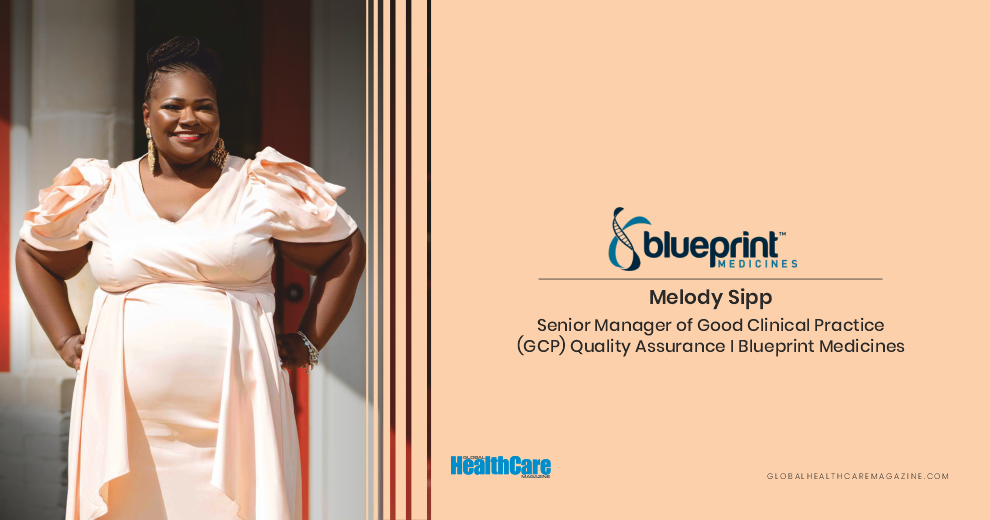
The world of clinical trials is often seen through a cold and monochromatic lens, focusing solely on data. This landscape is characterized by spreadsheets, regulatory acronyms, and binary outcomes: pass or fail. To an outsider, it may appear as a machine driven purely by logic, devoid of emotion. However, if you spend enough time talking to Melody Sipp, the Senior Manager of Good Clinical Practice (GCP) Quality Assurance at Blueprint Medicines (a Sanofi Company), you will realize that this perspective is fundamentally flawed.
For Melody, the complex language of regulatory guidelines and the stringent requirements of a quality audit are not simply administrative hurdles. Instead, they serve as a framework for something much more personal. When she examines a clinical trial, she doesn’t just see a protocol; she sees a promise. She envisions the invisible connection between a molecule in a vial and a grandmother in a hospital room, hoping for a little more time.
Melody works in the high-stakes world of global biopharmaceutical compliance, where a single oversight can derail years of research. Yet her approach is not driven by a fear of regulators. Instead, it is fueled by a profound sense of service. She is a leader who has navigated the sharp edges of personal grief and professional setbacks to arrive at one essential truth: quality is not just about checking a box. Quality is about protecting a life.
The Architecture of Ambition
To understand the leader Melody has become, one must trace the trajectory of her early ambitions. Her journey began at Rust College, a historically Black College and University (HBCU) in Mississippi, where she majored in biology. Back then, her path appeared clear, illuminated by a specific goal: she wanted to be a doctor, envisioning herself as either a cardiovascular surgeon or a gynecologist.
Her drive stemmed from a love for science, but her underlying motivation was always about people. She wanted to heal. Melody took the MCAT and scored well enough to secure admission to medical school; the door was open, and she was poised to step through.
However, life brought unexpected challenges, delivering a quiet tragedy that would reshape her future. Toward the end of her junior year, her grandmother fell seriously ill. Melody found herself spending time in the hospital, not as a student, but as an observer. She watched the doctors closely, but more importantly, she noticed the nurses. She saw how they engaged with patients, managing the day-to-day reality of suffering with compassion. This experience profoundly shifted her perspective on what care truly involved. She realized that while surgery could fix a heart, nursing involves holding a patient’s hand through difficult times.
Despite her strong academic record and test scores, Melody made a decision that confused some and surprised others: she pivoted. She chose to pursue nursing, believing it would allow her to provide the personal, compassionate care she had witnessed at her grandmother’s bedside.
This noble decision, however, led to her first significant setback. Melody entered nursing school, but, by her own admission, she struggled to maintain focus. The transition from the theoretical rigor of pre-med to the practical demands of nursing school proved jarring, and ultimately, she did not succeed.
For many, failing out of a program would be a stopping point. For Melody, it became a defining moment. She refused to let the setback determine her identity. Instead, she enrolled in a community college, taking a humble step back to rebuild her GPA and regain her academic momentum. This experience was a lesson in resilience. Her perseverance paid off, and she was accepted into another nursing program.
It was in this new program, amidst a curriculum she had fought so hard to rejoin, that Melody discovered her true calling. This realization did not come in a clinical setting; it blossomed in a classroom during a healthcare ethics course. The class introduced her to the concept of “grand rounds,” particularly the quality improvement aspects of clinical care. She became captivated by the process of identifying the root causes of clinical issues, engaging in a puzzle that united her love for science with her desire to improve patient outcomes.
She remembers the moment clearly when she told her professor that investigating quality and systemic improvements in care was the work she truly wanted to pursue. The professor recognized her talent and emphasized the importance of completing what one starts, encouraging her to finish the nursing program. Nevertheless, Melody realized she had found her true path. She made the difficult decision to leave nursing behind and pursue a master’s degree in healthcare management.
Finding the Niche
After earning her master’s degree, Melody expected to transition directly into hospital administration. She envisioned herself in the C-suite of a healthcare system, making decisions that would resonate throughout the organization. However, the industry often does not align with individual plans, and the opportunities in administration did not materialize as she had hoped.
Instead, she accepted a position in clinical operations at a Contract Manufacturing Organization (CMO). Although it wasn’t the destination she had envisioned, this role proved to be the gateway she needed. It introduced her to the intricate world of Good Clinical Practice (GCP).
During her journey in the industry, Melody faced personal losses, including the deaths of her father and brother. While these tragedies could have derailed her, they instead fueled her unrelenting drive. The grief she experienced transformed into a determination to achieve excellence. She recognized that her work in the pharmaceutical field was crucial to ensuring that life-saving products remained accessible to patients.
“I realized that my work plays a critical role in ensuring that life-saving products remain available to patients,” Melody explains. “That sense of purpose motivates me every day.”
She had found her niche. She wasn’t a surgeon wielding a scalpel, nor was she a nurse administering an IV. Instead, she acted as a guardian of the process, ensuring that the hope encapsulated in those medicines was safe, effective, and compliant.
The Blueprint for Quality
Today, Melody serves as the Senior Manager of GCP QA at Blueprint Medicines, a global biopharmaceutical company under Sanofi, dedicated to transforming patient care through precision medicine. Their ambitious mission is to develop life-changing therapies that target the root causes of diseases, with a focus on oncology and hematology, particularly genomically defined cancers and rare immunological diseases like systemic mastocytosis.
Blueprint utilizes a proprietary kinase inhibitor discovery platform that integrates genomics and chemical biology. They have developed approved medications, including AYVAKIT® for PDGFRA-mutant gastrointestinal stromal tumors (GIST) and systemic mastocytosis, and GAVRETO® for RET-altered cancers.
In this dynamic environment, Melody plays a critical role as the gatekeeper for compliance. She ensures adherence to Good Clinical Practice (GCP), International Conference on Harmonisation (ICH) guidelines, and global regulatory requirements across all clinical programs. Her responsibilities are vast; she provides strategic quality oversight, manages audits of clinical sites, Contract Research Organizations (CROs), and vendors, and prepares for inspections by regulatory authorities.
Melody also leads quality risk assessments, develops and maintains SOPs, and delivers training. However, merely listing her duties does not capture her approach to her work. Melody champions a risk-based quality framework.
“A risk-based quality framework strengthens compliance and operational efficiency by proactively identifying, categorizing, and prioritizing risks across programs,” she explains.
This represents a strategic shift from traditional practices, where quality assurance was often reactive, focusing on fixing issues after they occurred. Melody’s approach emphasizes foresight. By understanding the risks associated with a program holistically, she gains valuable insights into processes that allow for greater control. This ensures that limited resources are directed toward the highest-risk areas, thereby reducing the likelihood of critical errors.
Her proactive model transforms quality from a mere compliance function into a strategic partner. It minimizes redundancies and fosters data-driven decision-making. This shift is akin to strengthening a ship’s hull rather than just patching a leak.
The Culture of Readiness
One of the recurring challenges in Melody’s field is what she calls “audit panic.” In many organizations, the announcement of a regulatory inspection triggers a frantic scramble to clean up files and correct errors. Melody rejects this cycle.
“The key to staying audit-ready year-round is to ensure that everyone remains aligned with regulatory requirements and best practices,” she emphasizes.
She has observed that teams can become too comfortable over time. When processes become routine, compliance details may be overlooked. To combat this, she focuses on building strong relationships and fostering open communication. Melody aims to create a culture where feedback is welcomed, not feared.
She mentors her teams to shift their mindset from simply “passing the test” to embracing a mindset of inherent integrity.
“I often say, if we approach clinical trials as if they were for our own mother or child, quality becomes second nature,” Melody explains.
This is what she refers to as the “Mother Test.” It serves as a simple yet profoundly effective metric. When a team member views a clinical trial participant not as Subject 1024, but as a surrogate for their own loved one, their motivation for quality shifts significantly. It is no longer just about satisfying a regulator; it becomes about protecting a mother.
“While compliance with regulations is essential, real quality means doing the right thing even when no one is watching,” she adds. “And that stems from personal integrity.”
Leading through Influence
Leadership in the high-pressure environment of biopharma presents unique challenges. Melody, a minority woman in a leadership role, has experienced moments where her authority and ideas were questioned. She speaks candidly about the experience of rejection.
“One of the biggest lessons I’ve learned is how to manage rejection,” she says. “When an idea isn’t accepted, I take time to reevaluate the process, identify areas for improvement, and document the vision for future opportunities.”
Melody has learned that what one person rejects, another may embrace later. Her leadership style is characterized by humility and a focus on service. She believes that leadership is not about issuing demands from the front; rather, it is about collaboration and a spirit of humility.
“The key to leading is not giving people everything they want, but showing compassion and concern—even when the answer is ‘no,’” she advises.
This balance of firmness and empathy is the hallmark of her tenure at Blueprint Medicines, which is why she has been consistently recognized through the company’s internal honor systems. Since 2023, she has received numerous “Bravo Awards” for collaboration and leadership. Additionally, she has participated in the “G-Nome Award” cycle, which celebrates innovation, as well as the “Quality Culture Q-Nome Award” program.
However, the recognition that may resonate most deeply with her roots came from her alma mater. Melody was recently honored as one of Rust College’s “28 Pillars of Excellence.” This distinction recognized not only her professional success but also her significant influence and commitment to community leadership.
Measuring What Matters
In an industry focused on metrics, Melody has her own approach to measuring success. While she considers standard KPIs, such as audit findings, cycle times, and error rates, she looks beyond these numbers to assess the real-world impact of her work.
“I measure the real-world impact of my programs by looking at outcomes that truly matter,” she says. “Seeing products gain approval and remain on the market is a key indicator of success.”
Melody reads patient testimonies and listens to feedback from healthcare professionals. When a patient shares how a therapy like AYVAKIT® has improved their quality of life, or when a clinician expresses confidence in a Blueprint product, those are the metrics that truly count. These insights validate the long hours she spends reviewing standard operating procedures and conducting vendor audits, confirming that the system works effectively.
Beyond the Office
Melody Sipp values balance and intentional living. She manages her life through her calendar, giving equal importance to both her professional and personal commitments. Melody invests in professional coaching and therapy, understanding that maintaining mental resilience is just as crucial as any other aspect of life. She believes in the restorative power of vacations, the soothing warmth of a sauna, and the importance of a regular workout routine. She holds several leadership roles in community and faith-based organizations. Despite the pressures of her role in global compliance, Melody consistently makes time for her family, which remains her foundation.
In her free time, she spends meaningful moments with her mother and cherishes quality sibling time with her brother, valuing their bond as a source of strength, laughter, and shared history. She also prioritizes spending time with extended family and close loved ones, believing that shared meals, conversations, and simple presence are essential to staying grounded. She often reflects on the legacy of her late father, who, along with her mother, was instrumental in shaping her success. Additionally, Melody finds joy in coaching and developing her niece and nephews, and her faith continues to guide her as an active Pentecostal believer. These connections keep her grounded and aligned with her purpose.
Melody is dedicated to mentoring young women and is a successful entrepreneur, owning three LLCs. She serves as the Chaplain for the DeSoto County Alumnae Chapter of Delta Sigma Theta Sorority, Incorporated, and as the Jurisdictional Youth Chairlady for the Mississippi Northwest Ecclesiastical Jurisdiction of the Church of God in Christ.
Her vision for the future is broad and ambitious. She is committed to advancing her education and currently plans to pursue a doctorate in regulatory and clinical research management while continuously seeking new learning opportunities. She also embraces her creative side with plans to write and publish two books within the next year to share her insights and experiences with others.
“My bigger vision is to contribute meaningfully to organizational excellence while creating platforms that empower individuals and communities,” she expresses.
A Legacy of Integrity
As the interview comes to an end, Melody offers a reflection on the true essence of leadership. Her insights are not technical; they do not mention FDA regulations or European Medicines Agency guidelines. Instead, they focus on the human spirit.
“Leadership is not about standing in front of people, making demands or seeking grandeur,” she explains. “It’s about collaboration, humility, and guiding others with purpose.”
She emphasizes the importance of being a lifelong learner, of reading books, and attending workshops. Leadership, she notes, is about influence, not control. It is about inspiring trust.
“Finally, never underestimate the power of humility,” she concludes. “The best leaders recognize that leadership is a privilege, not just a position.”
In a world that often rewards the loudest voices, Melody Sipp has chosen a different path. She leads with a quiet, unshakeable intensity. She ensures that the medicine we trust is worthy of that trust. Driven by the memory of the family she loved and lost, she works for the patients she may never meet. She embodies the human heartbeat within the machinery of clinical quality, ensuring that when we seek a cure, it is safe, effective, and genuine.
Quotes

Also Read: The 10 Most Influential Clinical Quality & GCP Leaders of 2026