In the vast realm of modern oncology, there is a significant distinction between having data and having answers. We are currently overwhelmed by the former. Every day, laboratories sequence genomes, hospitals update electronic health records, and clinical trials generate vast amounts of information. Yet, for the patient sitting in the exam room, the person waiting for the doctor to deliver life-altering news, that mountain of data often feels distant, cold, and abstract. They are not concerned with population statistics; they are focused on their own situation.
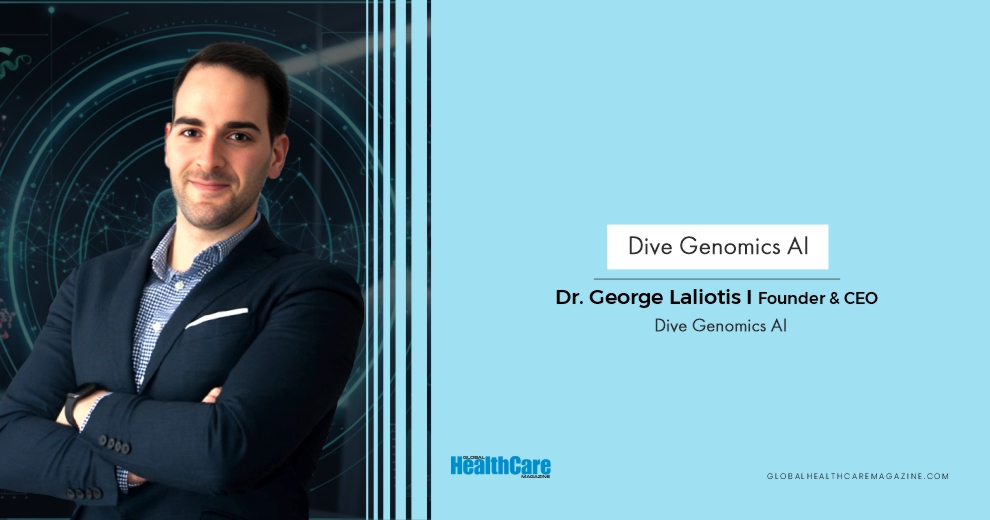
Dr. George Laliotis occupies a unique position between the anxious patient and the vast collection of medical data. Throughout his life, he has earned various credentials (MD, MPH, MHA) not merely for the sake of the titles, but to develop a comprehensive understanding of healthcare and medicine. As a physician-scientist, he grasps the intricacies of cellular biology; as a healthcare administrator, he understands the complexities of the healthcare system. Now, as the Founder and CEO of Dive Genomics AI, he is dedicated to bridging the gap between these two worlds.
Founded in 2025 in Boston, Massachusetts, the heart of global biotech innovation, Dive Genomics AI represents the culmination of a career spent grappling with a single, persistent question: Why are we still guessing?
Dr. Laliotis is a person of quiet intensity. He does not use the hyperbolic language often found among tech founders. When he discusses “revolutionizing” healthcare, he means it in the literal sense of shifting the perspective, moving away from the “one-size-fits-all” approach of the past toward a future where every patient has a “Digital Patient Twin.” He is dedicated to proving that the individual who has been labeled as just average is, in fact, completely unique, both chemically and biologically.
The Education of a Physician-Scientist
To understand the architecture of Dive Genomics, you must look at the architecture of Dr. Laliotis’s mind. It was built on a foundation of rigorous curiosity, starting thousands of miles away from Boston.
“My journey began in Greece at the University of Crete Medical School,” Dr. Laliotis says. It was a research-intensive environment, the kind of place that doesn’t just teach you how to treat a patient, but forces you to ask why the disease exists in the first place. This instilled in him a deep curiosity for cancer biology. But medicine alone wasn’t enough. He sensed early on that being a good doctor required understanding the machinery of healthcare itself.
So, he pursued a multi-disciplinary path. He earned a Master of Public Health (MPH) and a Master of Health Administration (MHA). “I wanted to understand healthcare from both clinical and systemic perspectives,” he explains. Most people specialize to narrow their focus; Dr. Laliotis specialized to widen his.
This hunger for a holistic view took him from Greece to the United States, landing him at some of the premier institutions in the world. He engaged in postdoctoral work at Johns Hopkins School of Medicine and Ohio State University. There, he didn’t just study cancer; he studied the molecular whispers that drive it, specifically PI3K/AKT signaling and RNA regulation in solid tumors.
“I was fascinated from a young age by the potential of science to transform lives on a global scale,” he recalls. But the transition to the U.S. was not without its friction. “Early in my career in the U.S., I had to navigate the transition from a clinical environment to a highly technical graduate research setting in a new country,” he admits. He was starting from scratch in a hyper-competitive environment.
How did he respond? Not with arrogance, but with radical accountability. “I responded by dedicating myself to continuous education……… focusing on radical accountability and collaboration with my peers.” This resilience didn’t just get him through the program; it forged the leadership style he uses today. It allowed him to eventually lead teams of scientists and manage complex clinical programs, proving that the best leaders are often the most dedicated students.
The Era of Big Data
Before founding Dive Genomics AI, Dr. Laliotis stood at the helm of Oncology Lifecycle Management at Natera. It is a vantage point that offers a breathtaking view of the state of cancer care.
“My tenure….. was incredibly rewarding,” he says. He directed medical strategies for a portfolio of over 150 studies. He contributed to the launch of industry-leading genomic products. He saw the sheer scale of what was possible, dealing with vast amounts of multimodal data, involving “over thousands tumor exomes and millions of data points.”
It was here, amidst this ocean of information that the “Why” of his next venture began to crystallize. He realized that while the industry had become excellent at detection, it was still lagging in prediction.
“My journey to this point was defined by a realization that while we have entered an era of ‘big data’ in oncology, the ability to translate that data into individual patient outcomes remained a significant hurdle,” he says. He saw that we were collecting millions of data points, but for the patient sitting on the exam table, the treatment plan was often still based on general population statistics.
“The ‘one-size-fits-all’ approach is no longer sufficient,” Dr. Laliotis asserts. “I am driven by the belief that every patient’s cancer has a unique molecular signature that can—and should—be decoded.”
The Digital Patient Twin
This conviction led to the birth of Dive Genomics AI in 2025. The vision was transformative:to bridge the gap between high-dimensional biological data and bedside clinical practice.
The core of this vision is the “Digital Patient Twin.” It sounds like science fiction, but Dr. Laliotis explains it with the grounded practicality of a clinician. “These digital models allow us to simulate patient responses to specific therapies and predict the risk of disease progression,” he says.
The platform mines Next-Generation Sequencing (NGS) and longitudinal clinical records. It creates a computational mirror image of the patient. By running simulations on this twin, doctors can see which treatments might fail and which might succeed before a single drop of chemotherapy enters the patient’s vein.
“We are moving toward a future where AI foundation models, trained on hundreds of thousands of tumor exomes and clinical timepoints, can predict therapeutic responses with high statistical confidence,” Dr. Laliotis explains.
This is not about replacing the doctor. Dr. Laliotis is adamant about that. He sees AI as the “physician’s co-pilot.” It is a tool that allows the human provider to see around corners. “By identifying molecular residual disease (MRD) earlier than traditional imaging, we can intervene when the cancer is most treatable,” he notes.
The Triple-Helix of Collaboration
Dr. Laliotis knows that innovation cannot happen in a vacuum. A new technology, no matter how brilliant, is useless if it doesn’t fit into the existing workflow of hospitals and insurers.
“Our mission relies on ‘Triple-Helix’ collaboration between academic medical centers, biotechnology partners, and patient advocacy groups,” he says. He has been busy. In a short time, he has established over 20 collaborative relationships with leading cancer centers and key opinion leaders (KOLs).
His goal is specific and strategic: to ensure these AI models are integrated into standard-of-care guidelines like NCCN (National Comprehensive Cancer Network) and ASCO (American Society of Clinical Oncology). He understands that to truly serve the patient, you must convince the system.
This is where his background in Health Administration (MHA) shines. He isn’t just building a gadget; he is building a dossier. “Securing Medicare reimbursement dossiers for various solid tumors has ensured that these innovations are accessible to the patients who need them most,” he says, referencing his past successes. He knows that accessibility is the final, crucial step of innovation.
The Daily Practice of Innovation
So, what does the CEO of a company trying to predict the future actually do all day?
“My day-to-day involves high-impact decision-making,” Dr. Laliotis says. He is drafting evidence dossiers for clinical guidelines. He is collaborating with R&D and marketing teams. He is designing investigator-initiated studies.
But the part that excites him, the thing that likely gets him out of bed in the Boston morning gray, is the moment of discovery. “The moment of ‘clinical utility’….. when a data-driven insight directly changes a patient’s treatment plan for the better,” he says. “I am incredibly excited by the accuracy of sophisticated computational tools and their ability to find ‘signals’ in genomic data that the human eye might miss.”
It is a demanding role. He admits that he doesn’t believe a “scientific mind” ever truly switches off. But he manages the weight of it through a dedication to learning that borders on the spiritual.
“I find balance through continuous learning and reading,” he says. He plays sports and video games, but he is just as likely to be found tinkering with statistical software like R Studio or reading philosophy. He cites The Saviors of God by Nikos Kazantzakis as a favorite, a dense, philosophical text about the struggle of the human spirit. It is a fitting choice for a man wrestling with the complexities of life and death.
The Future is Predictive
Dr. Laliotis’s vision for the future is clear. “I want to build a platform where every patient’s treatment is guided by a personalized AI algorithm that forecasts their specific journey,” he says. “The bigger vision is a world where we don’t just treat cancer; we predict and preempt it.”
He has the resume to back up the ambition. He has Board Certification in Internal Medicine and AI in Medicine. His research on immunotherapy response signatures has been published in Nature Communications and Annals of Surgery. He has designed over 10 Phase II-III clinical trials. He understands Good Clinical Practice (GCP) and EMEA regulations, as well as code.
But despite the accolades, the degrees, and the CEO title, Dr. Laliotis remains fundamentally a student. When asked for a message to the next generation of leaders, he does not offer a platitude about success or grinding. He offers a warning and a blessing.
“To the next generation of leaders: never stop educating yourself,” he says. “In a field as fast-moving as AI and genomics, your ability to remain a student is your greatest professional asset.”
Dr. George Laliotis is building the future of oncology, but he is doing it with the humble, rigorous, and observant heart of a lifelong learner. He is serving the patient by ensuring that when they face the unknown, they don’t have to face it alone; they have a digital twin, a physician co-pilot, and the accumulated wisdom of millions of data points walking beside them.
Visit Us:
LinkedIn: https://www.linkedin.com/in/georgelaliotis/
https://www.georgelaliotis.com
https://www.dive-genomics-ai.com/team
Quote
Also Read: The 10 Most Innovative Leaders in Oncology & Precision Medicine to Watch in 2026