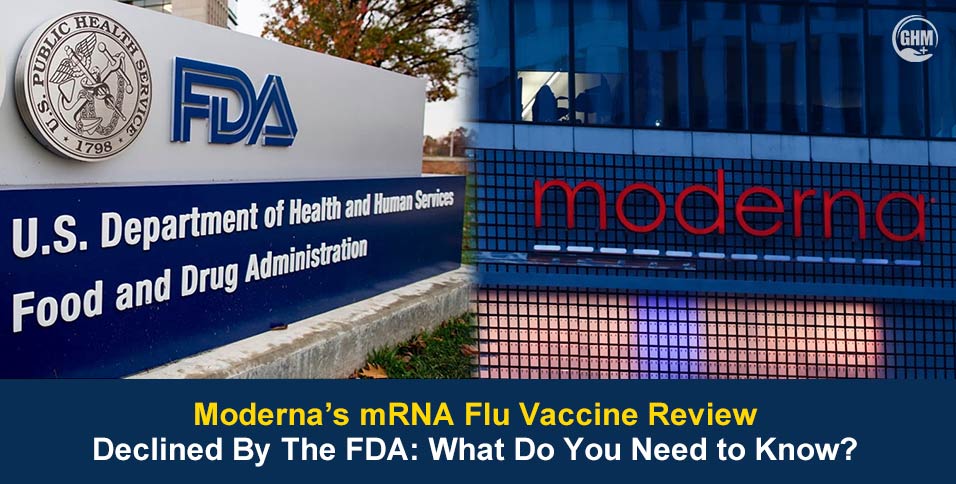
According to the biotech industry giant, Moderna’s mRNA Flu Vaccine Review application was declined by the U.S. Food and Drug Administration (FDA). This development halts the progress of the company’s lead influenza candidate, mRNA-1010, in the United States. Many health industry leaders and investors expected a smooth path for this innovative shot, but federal regulators recently issued a “Refusal-to-File” (RTF) letter.
Interestingly, the agency did not cite safety or efficacy concerns in its decision. Instead, the move centers on complex regulatory standards and clinical trial design. This unexpected roadblock raises vital questions about the future of seasonal immunization and the stability of the biotech sector.
Why the FDA Declined to Review Moderna’s Flu Vaccine
The “Refusal-to-File”:
An RTF letter is a specific regulatory tool used when the FDA determines an application is incomplete or fundamentally flawed on its face. Essentially, the agency refuses to even begin the formal evaluation. For Moderna’s mRNA flu vaccine review, this means the clock has stopped before it even started.
The Comparator Conflict
The primary reason for the refusal stems from the “comparator” used in Moderna’s clinical trials.
- The FDA argued that Moderna compared its mRNA flu shot to a standard-dose vaccine (Fluarix) that does not reflect the current “best-available standard of care.”
- The agency’s Center for Biologics Evaluation and Research (CBER) stated that Moderna’s study was not “adequate and well-controlled.”
- The agency now demands comparisons against high-dose or adjuvanted vaccines, particularly for older adults, where high-dose vaccines are often preferred.
- Moderna claims the FDA previously agreed to this design in April 2024.
“The complete stunner here is that at no point in any of this did anybody say that it was not adequate,” stated Dr. Stephen Hoge, President of Moderna.
Dr. Vinay Prasad, Director of the FDA’s Center for Biologics Evaluation and Research (CBER), noted that the agency expects developers to prove their products against the highest bar possible.
This stance highlights a stricter regulatory environment under the current administration, focusing on decisional volatility that has rattled the industry.
Can the mRNA-1010 Vaccine Pass Through Global Regulations
While Moderna’s mRNA flu vaccine review is stalled in the United States, the global outlook remains surprisingly bright. Different countries often weigh clinical data through various lenses, and this case is no exception.
- Approved Filings: Health authorities in the European Union, Canada, and Australia have already accepted Moderna’s application for mRNA-1010.
- Timeline for Launch: Analysts expect these regions could grant approvals as early as late 2026 or early 2027.
- Cross-Jurisdiction Learning: Successful rollouts abroad may eventually pressure the FDA to reconsider its current standard of care requirements.
- Innovation at Risk: Industry leaders worry that if the U.S. remains the sole outlier, it could delay the arrival of faster-to-manufacture mRNA influenza vaccines for American citizens.
How Did the Stock Market Respond To Moderna’s FDA Refusal
As soon as the news of Moderna’s mRNA flu vaccine review got out, investors reacted to it swiftly. On the day of the announcement, Moderna stock fell significantly, reflecting concerns over delayed revenue streams.
Key Financial Takeaways:
- Immediate Decline: Shares dropped nearly 9% following the RTF letter notification.
- Revenue Forecasts: Market analysts suggest this delay could cost the company hundreds of millions in potential seasonal sales.
- Sector Volatility: This decision creates a ripple effect, making biotech investors more cautious about other mRNA-based flu shot developments.
“This decision by CBER… does not further our shared goal of enhancing America’s leadership in developing innovative medicines,” stated Stéphane Bancel, CEO of Moderna, in their official press release.
What Is The Future of Flu Prevention With Public Health At Stakes
As the FDA refuses Moderna’s mRNA flu vaccine review, it will affect public health significantly. If mRNA technology offers a way to adapt to seasonal mutations faster than traditional egg-based vaccines, this delay could hinder US preparedness.
- Innovation Stall: The refusal to engage with the current data may slow the development of combination vaccines (Flu + COVID-19).
- Vaccine Availability: US patients may lack access to next-generation influenza protection that citizens in Europe and Canada might receive sooner.
- Public Confidence: Confusing regulatory signals can sometimes erode trust in new medical technologies.
Looking forward, Moderna has requested a Type A meeting with the FDA to clarify the necessary steps for resubmission. The company maintains that its trial design was previously discussed and agreed upon with the agency, making the refusal especially frustrating for the development team.
To Conclude
The decision to decline Moderna’s mRNA flu vaccine review highlights the complex dance between innovative biotech and federal oversight. While the decision does not question the safety of the mRNA-1010 candidate, it places a heavy burden on the company to redesign its clinical comparisons. Navigating these high-stakes regulatory hurdles is essential for maintaining the integrity of public health, though it undoubtedly slows the pace of innovation.
As Moderna continues its dialogue with the FDA and advances through international reviews, the medical community will be watching closely to see if mRNA technology can eventually conquer the seasonal flu.