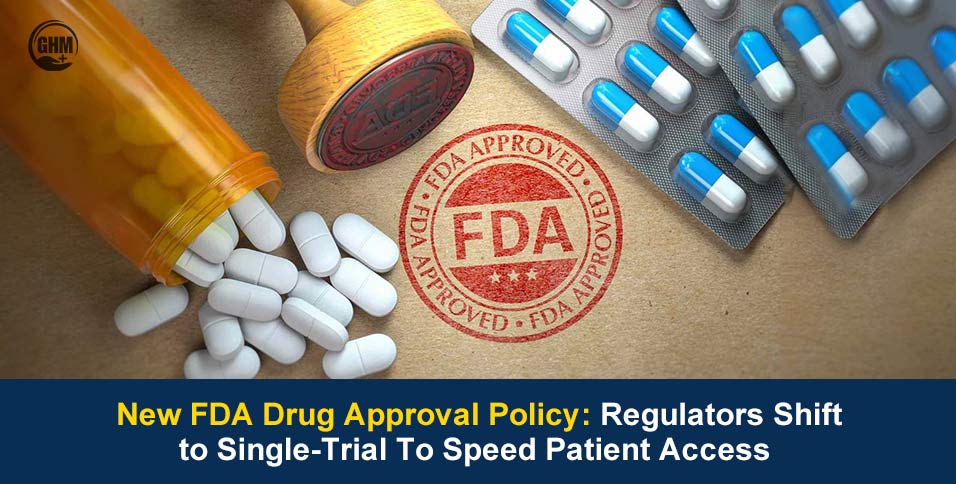
The Food and Drug Administration (FDA) is formally abandoning its decades-old requirement for two pivotal clinical trials to greenlight new medicines. On February 18, 2026, federal health regulators announced the new FDA drug approval policy, where the agency’s default position will now favor a single, robust clinical study for the authorization of new drugs and novel health products.
Leading this overhaul is FDA Commissioner Dr. Marty Makary, who detailed the move in a co-authored piece in the New England Journal of Medicine. This pivot aims to slash long bureaucratic procedures and accelerate the delivery of life-saving treatments to the American public.
Consequently, the FDA’s New rule for drug approvalnow aligns more closely with modern precision medicine and advanced biological insights.
What Is The New FDA Drug Approval Policy
For nearly 60 years, the “two-trial rule” served as the gold standard for scientific rigor. This practice, rooted in the 1962 drug regulation reforms, required two independent, well-controlled investigations to ensure results were reproducible and not a statistical fluke.
The Core Policy Shift
Under the updated new FDA drug approval policy, the agency will typically accept one high-quality pivotal trial if supported by a totality of evidence.
This evidence may include:
- Real-world data from electronic health records.
- Biological markers (biomarkers) that predict clinical outcomes.
- Advanced analytics and AI-driven data modeling.
“In 2026, there are powerful alternative ways to feel assured that our products help people live longer or better than requiring manufacturers to test them yet again,” said Dr. Makary.
Why FDA Regulators Are Changing Approval Rules
The push for a more flexible new FDA drug approval policy stems from a need to balance scientific diligence with the urgency of patient care.
1. Faster Patient Access
By removing the need for a second trial, the FDA expects to significantly shorten review timelines. This is especially critical for patients facing aggressive, non-rare conditions that previously required years of additional testing.
2. Reducing R&D Costs
Clinical trials represent the most expensive hurdle in drug development, often exceeding $117 million per study. The single-trial approach could drastically reduce these costs, potentially lowering the price of entry for smaller biotech firms and fostering a surge in drug development.
3. Leveraging Technological Progress
Modern research tools allow for “super-pivotal” studies. These trials are designed with such precision that they achieve the same statistical power as multiple traditional studies combined.
Which Treatments Are Most Affected By Clinical Trial Rule?
While rare diseases and oncology have frequently received single-trial approvals in the past, the new FDA drug approval policy expands this flexibility to more common conditions.
- Common Conditions: Drugs for diabetes, heart disease, and chronic pain may now benefit from the streamlined path.
- The Vaccine Exception: Interestingly, the agency is maintaining a stricter stance on vaccines and certain gene therapies. Some officials, including Dr. Vinay Prasad, have recently rejected applications for mRNA products, citing a need for more definitive evidence in older populations.
How Did The Critics React To The New FDA Policy
The medical community remains divided over the long-term implications of the new FDA drug approval policy.
The Supportive View
Former FDA drug director Dr. Janet Woodcock noted that the shift reflects the agency’s natural evolution. “The scientific point is well taken that as we move toward greater understanding of biology and disease, we don’t need to do two trials all the time,” she stated.
The Critical View
Conversely, some experts worry about the erosion of the “substantial evidence” standard. Critics argue that a single trial may not always uncover rare side effects or long-term safety risks.
Fewer trials may lead to more “surprise” Complete Response Letters (CRLs) if a single study fails to convince reviewers.
Some question if this policy strictly adheres to statutory requirements for adequate and well-controlled investigations.
Conclusion
The revised new FDA drug approval policy signals a new era for pharmaceutical companies. Success will no longer depend on the volume of data but on the precision of evidence.
Pharma Companies must now focus on “administrative perfection” and integrated data packages. Doctors will need to rely more heavily on post-market surveillance and real-world monitoring to ensure long-term efficacy.
As the industry adapts to this “one-trial standard,” the focus shifts toward robust pharmacovigilance. The FDA is expected to levy a “heavy tax” on the back end, requiring aggressive long-term monitoring to confirm that drugs approved today remain safe for years to come.