Think about the last time you stood inside a large crowd. Maybe it was a music festival. The kind where the bass vibrates through the soles of your shoes before your ears have fully registered the sound. Maybe it was a marathon finish line, or a packed stadium during the final minutes of a game. You were probably thinking about the person beside you, or the food stand across the field, or whether the weather would hold.
You almost certainly were not thinking about the first aid tent thirty meters away. About whether the person staffing it was trained. About whether anyone had actually sat down with the event organizer beforehand and asked the harder questions: What is the medical risk profile of this event? What is the plan if someone collapses in the middle of that crowd? Who is in charge, and what do they actually know?
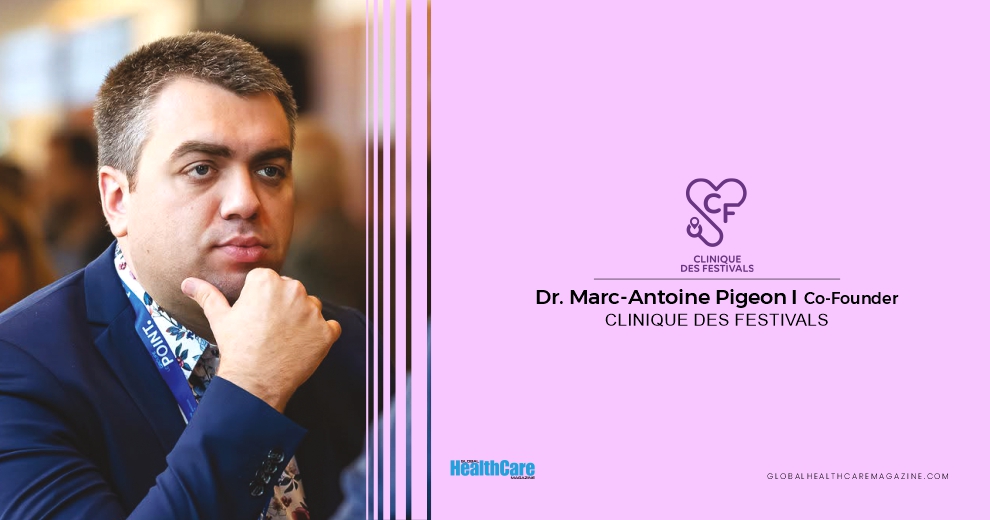
Dr. Marc-Antoine Pigeon has been thinking about all of it for years. And in 2025, he did something about it. An emergency physician, mass-gathering and prehospital medicine specialist, disaster medicine fellow, PhD candidate, co-founder of Clinique des Festivals, and, on quieter evenings, a violinist in a live orchestra, Dr. Marc-Antoine Pigeon is the kind of professional whose résumé reads less like a career path and more like a series of deliberate yes-es spoken into the unknown.
Before the Degree, There Was the Field
Dr. Pigeon’s journey into emergency medicine did not begin in a lecture hall. It began in the field.
In 2011, before completing a single year of formal medical training, he started volunteering as a medical first responder. This detail is not incidental. It says something essential about how he has always operated: drawn to the work before the credentials arrived, learning with his hands and his instincts while the academic foundation was still being laid.
His formal medical training and emergency medicine residency took place at Université Laval in Quebec City, between 2012 and 2022. A full decade of formation. And throughout all of it, the volunteer work continued, running parallel, not paused.
“Developing academic knowledge alongside practical work in the field has always been my motivation to continue moving forward,” he reflects.
That dual track, the theoretical and the practical, held in tension, shaped everything that would come after.
In 2022 to 2023, he completed a fellowship in disaster medicine at the BIDMC/Harvard program, one of the field’s most rigorous offerings. He carries the designations of MD, FRCPC, and OStJ. And today, he is a PhD candidate at CRIMEDIM, at the Università del Piemonte Orientale in Novara, Italy, one of the foremost research centers in disaster medicine in the world.
The arc is long, and it is still in motion.
The Problem Nobody in the Industry Wanted to Name
Anyone who has walked through a large public event has, at some point, passed a first aid station without a second glance. The assumption is natural: that whoever is there knows what they are doing, that somebody, somewhere, has thought this through.
Dr. Pigeon spent years discovering just how fragile that assumption was.
Through years of volunteering at mass gatherings, he moved through the industry with the eyes of someone trained to assess risk. What he found was not reassuring.
“It became quite clear to me that the ‘mass gatherings medical services’ industry was lacking standards, and that there was no real understanding of the risks of various events, by promoters, while critical decisions and care delivery were often delegated to volunteers with heterogeneous backgrounds and sometimes no real training on the matter.”
The industry, in other words, had been operating largely on goodwill and assumption.
Part of the problem was psychological. Dr. Pigeon observed a pattern of thinking he describes with a phrase that is both clinical and quietly damning: magical thinking. The belief, held sincerely and persistently by event organizers and institutional leaders alike, is that because something bad has never happened at an event, it therefore never will.
He has a response to this that is both practical and persuasive.
“There is a strong parallel to make between buying insurance for your house or your healthcare and preparing for disasters or planning thoroughly for a mass gathering. I still, after many years, think this is the best way to get through to people who do not take this seriously.”
Nobody buys home insurance expecting their house to burn down. They buy it because the risk is real, however unlikely, and because the cost of being unprepared is catastrophic. The logic is identical in mass gathering medicine. The message, however, had not been delivered with enough clarity, or by voices with enough authority, for long enough.
Dr. Pigeon decided to become one of those voices and then to build something that would carry the message further than a single voice could.
Ten Thousand Hours, and the Weight of a Decision
Before Clinique des Festivals existed, there was another organization. One to which Dr. Pigeon gave, by his own account, over 10,000 hours of volunteer work throughout the years.
That number is worth sitting with. Ten thousand hours is not a rounding figure. It is years of evenings and weekends, events staffed, crises managed, knowledge shared, all freely given in service of a mission he genuinely believed in. And then something shifted.
He rose to a position of high leadership within the organization. His expertise was visible enough to lend the organization credibility. But when his expertise pointed toward difficult decisions, it was set aside.
“My expertise and the advice I gave to the directorship of the organization were not aligned with their vision and were therefore ignored. I felt like my name and expertise were being used for their advancement, while being ignored when it would have led them to make difficult decisions.”
It is the kind of professional impasse that tests not just strategy but character. For someone whose guiding value is integrity, the dissonance was not something that could be quietly managed over time.
“Since integrity is one of my core values, I had to act this way and therefore decided to move forward with the creation of my own organization, Clinique des Festivals.”
Leaving was not easy. He had grown up professionally within that organization. The decision carried real weight.
“Although quitting this organization was very difficult, it turned out to be the biggest opportunity for me in the end, and I do not regret sticking by my principles and values.”
There is something quietly instructive in that passage. The moment that felt most like a rupture turned out to be the foundation of everything that came next. Sometimes the best thing an organization can do for you is fail to listen.
Clinique des Festivals: Built on Principle, Designed for the Crowd
Clinique des Festivals was founded in 2025, with its headquarters in Brossard, Quebec, Canada. It was established as a not-for-profit organization, a detail that reflects the motivation at its core. This was not built to capture a market. It was built to fill a gap that was leaving people vulnerable.
Co-founded alongside Anne-Julie Demers, the organization was designed with a clear and specific mandate: to provide accessible, credible, and tailor-made medical services for mass gatherings, and to accompany event promoters through the process of genuinely understanding the medical risks that their events carry, and planning for them accordingly.
The word “tailor-made” is not decorative. It is the philosophical spine of everything Clinique des Festivals does.
“Every event is different, every event organizer is different, and every situation requires a different approach. Therefore, there is no one-size-fits-all.”
A multi-day music festival in an open field carries a different risk profile than an urban marathon or an indoor sporting event. The medical response plan for each must reflect that difference. This seems obvious in retrospect. And yet, for years, the default was a uniform model applied across wildly different contexts.
Dr. Pigeon’s approach insists on specificity, on reading the particular event, understanding the particular crowd, and building a response that is genuinely fit for purpose. The team assembled to deliver on this is deliberately composed.
It includes nurses, respiratory therapists, and doctors, most of whom come from emergency department and critical care backgrounds. The first responders and paramedics on the team work in major urban settings, managing critical cases on a regular basis. Some are also firefighters, bringing with them both the technical skills and the deep team culture that high-pressure emergency response demands.
“Together, they act as a big family where everyone has a place and is happy to share experiences and profit from the experiences of others.”
In emergency medicine, team cohesion is not a soft skill. It is a clinical asset.
A Schedule With No Room for Routine
Describing Dr. Pigeon’s daily life requires a willingness to hold several different professional realities at once.
On any given day, he might be in the emergency department. Or deep in a research project. Or seated across from an event promoter, walking them through a risk assessment for an upcoming event. Or deployed on the ground at a mass gathering, directing medical care in real time. Or standing in front of a room of medical students, teaching.
“Days are very different, depending on whether I’m working the emergency department, working on research projects, meeting with event planners, or actually offering care during a mass gathering. Add to this teaching duties, conferences, and other non-clinical duties, and you end up with a changing schedule where no days are the same and where routine does not exist.”
It is the kind of schedule that, described on paper, would give most people pause. He meets it with a characteristic lightness.
“I am lucky enough not to require a lot of sleep to function!”
The humor is telling. He does not speak of his workload as a burden to be managed. He speaks of it the way a musician might speak of a particularly demanding piece: something that requires everything, and is therefore deeply satisfying.
The Measure of What Has Been Built
Dr. Pigeon speaks of achievement in a way that is personal and a little disarming.
“Being recognized, on a daily basis, as a reference in mass gatherings medicine and emergency care, both by seasoned professionals of the industry as well as newcomers and medical students, is the biggest achievement, so far.”
He also reflects with a kind of honest bemusement on the distance between the future he once imagined and the one he actually inhabits.
“If you asked 25 years old me where he thinks he’ll be in 5-7 years, he most certainly would not respond by: Co-founding a non-profit organization, working a busy emergency department while teaching and completing a PhD.”
The PhD he is completing is at CRIMEDIM, at the Università del Piemonte Orientale in Novara, Italy. The co-founded organization is Clinique des Festivals, a non-profit headquartered in Brossard, serving the province of Quebec and beyond. The busy emergency department is real. The teaching duties are real. And he holds all of it simultaneously, not as a juggling act performed under duress, but as something he has, with characteristic self-awareness, chosen.
“My biggest achievement is to actually juggle them all, while knowing where the limit is.”
The Vision: A Road Paved as It Is Walked
When Dr. Pigeon speaks about the future, he does so with a directness that is neither boastful nor vague. He speaks of a professional landscape where event planners genuinely understand the medical risks of the events they organize. Where patients receive quality care regardless of the setting. Where the standard of mass gathering medicine is not left to chance or to the improvised goodwill of undertrained volunteers.
“Paving the road I am walking on is what makes me the proudest, and it is where I’m headed.”
He is careful to note that this vision is not about positioning Clinique des Festivals above its peers.
“I do not have the pretension to think that my team and I are better than others working in this industry.”
What he is after is something larger: a rising tide. A field that asks harder questions of itself, trains its people more rigorously, and treats the medical planning of a mass gathering as the serious and consequential undertaking that it is.
“I do not know what opportunities will be offered to me over the next few years, but I know I’ll cherish every single one of them and will make sure my team and I can grow from them.”
That orientation, toward the unknown as possibility rather than threat, is perhaps the clearest signal of who he is.
The Orchestra, the Violin, and the Art of Staying Whole
Somewhere between the research papers, the festival deployments, the emergency department shifts, and the PhD coursework in Novara, Dr. Pigeon plays the violin.
He is a member of an orchestra. He performs in concerts every year. It is, in many ways, the detail that best illuminates the texture of his character: the emergency physician who also inhabits a world that demands patience, sustained rehearsal, and the discipline of listening as much as leading.
He speaks of his supportive family and girlfriend as foundational to the balance he maintains, and frames making time for them not as a concession to the demands of his schedule, but as a deliberate expression of leadership values.
“Since great leaders lead by setting an example, I make it one of my top priorities to keep time for friends and family as often as I can.”
And near the end of the conversation, he says something that carries, in its simplicity, the full weight of how he has built his professional life.
“I never thought I would actually do half of what I’m doing on a daily basis. That’s because instead of following the initial plan, I said yes to different opportunities offered to me along the way, and walked from there towards the unknown. I seem to thrive in chaos, both in the emergency department as well as in my agenda, and will forever be thankful to my friends and family for bearing with me in that way!”
Some people build their lives around a plan. Others build them around a willingness to be surprised, and a deep enough confidence in their own values to know that the surprises can be trusted. Dr. Pigeon is, clearly and deliberately, the second kind.
A Crowd, a Risk, and Someone Who Thought It Through
This summer, as every summer, the crowds will gather. Across the fields and stadiums and city blocks of Quebec and beyond, people will come together by the thousands for music and sport and the particular electricity of collective experience. The medical risk in those moments is real, as it has always been.
What is different, now, is that someone has thought carefully about it. Has trained rigorously for it. Has built an organization around the principle that health and safety are, as he puts it, the most precious thing human beings can have. Has assembled a team of nurses, respiratory therapists, doctors, paramedics, and first responders who work together not as a collection of contractors, but as something closer to a family. That is the work of Clinique des Festivals. That is the work of Dr. Pigeon. And by all indications, the road he is paving is far from finished.
Quotes
Also Read: Leaders Advancing Disaster Medicine & Emergency Care 2026