There is a particular kind of person who arrives at a field like medicine not simply to practice it, but to keep asking what lies just beyond its current borders, and then to walk through. Someone for whom the operating room is not the end of the story, but merely the first chapter of a much longer one.
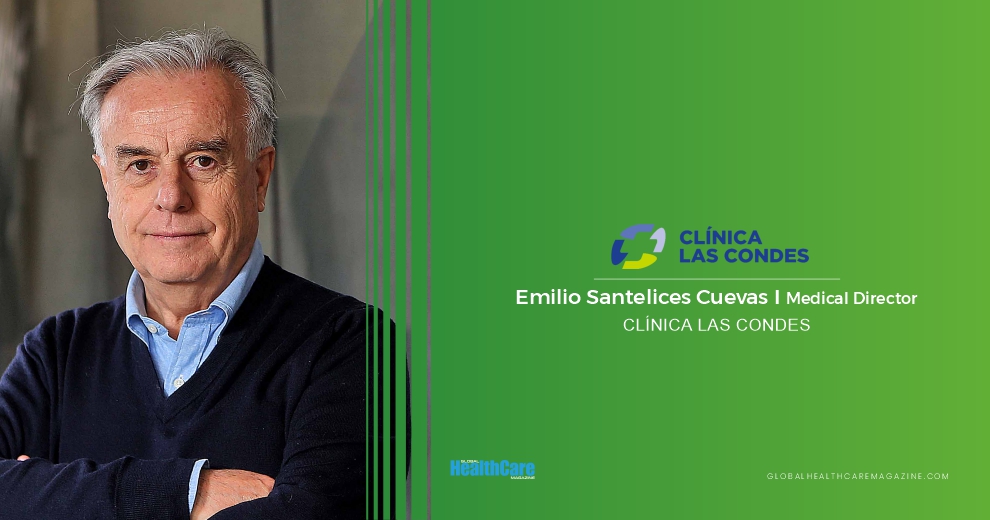
Emilio Santelices Cuevas is that person.
He is the Medical Director of Clínica Las Condes, Chile’s first private hospital, founded in 1982 and today operating across three campuses in Santiago’s Metropolitan Region: Estoril, Chicureo, and Peñalolén. He is a cardiovascular anesthesiologist and subspecialist in multi-organ transplantation. He holds an MBA jointly from the University of Chile and Tulane University, and a Doctorate in Public Health, also from the University of Chile. In 2018, President Piñera personally invited him to serve as Chile’s Minister of Health during his second administration.
He has been a student leader, a professor, a researcher, a policy architect, and an anesthesiologist and intensivist who once helped rescue patients from conditions medicine had no answer for.
To simply list the credentials is to describe the map and miss the territory entirely.
An Anesthesiologist and Intensivist’s First Steps
Emilio’s entry into medicine was not tentative. He began with anesthesiology, then pushed further into cardiovascular surgery and multi-organ transplantation, a subspecialization that places a physician at the most consequential edge of human physiology. His training carried him to universities in the United States and France, years that shaped not only his technical mastery, but his sense of what medicine could look like when imagination and resources were properly aligned.
When he returned to Chile, he did not ease himself back in gradually.
He helped establish cardiac surgery programs in various hospitals across the country. He joined Clínica Las Condes in the development of its programs for multi-organ transplantation and cardiac surgery. And then, in a moment that would mark the early arc of his career, his team carried out the first interventions in Chile using new extracorporeal circulatory support techniques, a technology that made it possible to rescue patients experiencing catastrophic respiratory failure, those for whom conventional medicine had, until that point, offered no adequate response.
That bears pausing on.
These were patients at the absolute limit of what was survivable. Emilio and his colleagues moved that limit.
That impulse, to move the edge rather than accept it as fixed, would define almost everything that followed.
The Architecture of a System
The operating room is a complete world. But it is also, for those who think in systems, just one room inside a much larger building. Emilio understood early that the conditions inside that room were shaped by forces far beyond its walls: policy decisions, institutional design, funding models, and the broader national ecosystem of a country trying to take care of its people.
“Healthcare organizations are defined as complex systems, where causal relationships in most cases are not linear,” he observes. “To deal with this reality, it helps to have experience in the clinical, administrative, and now also technological domains.”
This understanding sent him back into sustained, serious study. He completed his MBA at the University of Chile and Tulane University, and then his PhD in Public Health, also at the University of Chile. These were not credentials gathered for a shelf. They were intellectual tools for a larger project.
“We are immersed in a national ecosystem that responds to a population that also challenges our work,” he explains. “Having knowledge of this environment and the development of public policies facilitates the integration of our institution as part of the system.”
That integration became concrete action in 2010, when Emilio led the implementation in Chile of risk-adjusted payments, known internationally as DRGs (Diagnosis-Related Groups). This was not a minor administrative update. The DRG model reimburses providers based on the complexity and clinical profile of each patient, rather than a flat fee-for-service logic. It was a structural intervention in how Chilean healthcare allocated its resources, and it carried a clear underlying belief: that patients, regardless of who was paying for their care, should be able to access public or private providers without financial walls standing between them and the help they needed.
In 2019, DRGs were formally established in Chile as a mechanism for resource transfer for both public and private providers. Nearly a decade after Emilio began building the architecture, the structure became part of the system.
One of the persistent misconceptions he encounters is the idea that public and private healthcare exist in opposition to one another. He is patient with this misreading, but firm about the correction.
The demand and complexity of health problems are rising. Healthcare costs are increasing at a rate that far exceeds countries’ capacity for economic growth, creating widening gaps between what is needed and what is possible. The answer, in his view, is not a retreat to one model or the other. It is a structured public-private collaboration, where resources follow real requirements, and patients move between different types of providers based on clinical need rather than the accident of which system they happen to pay into.
Then came 2018, and a phone call that changed the course of his work again.
President Piñera invited him to serve as Chile’s Minister of Health in his second administration. During his tenure, one of the significant initiatives implemented was the Digital Hospital, an advancement in the country’s healthcare infrastructure toward a new era of data, technology, and connected care.
The Institution That Started It All
Clínica Las Condes was founded in 1982 as the first private hospital in Chile, and today operates under the leadership of current CEO Pablo Yarmuch. Over more than four decades, it became the institution Chileans turned to for the cases no one else could solve: transplants, cardiac surgery, functional neurosurgery, oncology, and spine surgery. And the people who came for those solutions arrived from both the public and private systems. That was never incidental. It was the institution’s defining character.
“Everyone at CLC understands that, as an institution dedicated to solving complex problems in these areas, we are available to all patients, whether from the public or private system,” Emilio says.
When he stepped into the Medical Director role, the clinic was entering a new stage of growth and development. The scope of work before him was significant: reorganize specialist teams, recruit new talent, and redeploy the organization through the creation of Centers, Programs, and Units, all of it supported by a digital agenda and the development of data science to underpin decision-making.
It was, in the most practical sense, a rebuilding project conducted at full operating speed.
It also required someone who understood, from lived experience across multiple professional domains, how to hold a vision steady while doing the gritty, daily work of making it real.
Three Hundred Reasons
One year into his tenure, the numbers carry weight.
Emilio and his team rebuilt high-performance teams across every specialty at the clinic. They recruited 300 highly regarded specialists who speak not just to the scale of the effort, but to its quality. These were not positions filled out of necessity. They were leaders in their respective fields, drawn into a shared and deliberate project.
The clinic also established a strategic alliance with Universidad Andrés Bello, the institution holding the largest university enrollment in Chile. This partnership connects Clínica Las Condes to the academic development of the country’s next generation of healthcare professionals, extending the clinic’s influence into the future of the field.
In several areas of clinical activity, growth has exceeded double digits.
But behind these metrics, Emilio consistently returns to what actually produces them. And what produces them, in his accounting, is not strategy frameworks or performance management systems. It is something more elemental.
“Working with a multidisciplinary high-performance team, with diverse personalities and interests, represents a leadership challenge to align wills around a shared purpose. The key is to build trust and participatory dialogue,” he says.
His conception of what a leader’s primary function actually is deserves careful attention.
“The main attribute of a leader is to contribute to the construction of a vision, which is ultimately agreed upon with the Board of Directors and senior management, and then to communicate it and translate it into actionable tasks across the entire organization, each of which must have a clear purpose that contributes to achieving the shared vision.”
And the mechanism that makes all of it functional?
“All of this is possible to the extent that we build, on the basis of trust, high-performance teams.”
He has said it multiple times, in different framings, across different questions. It is not a talking point. It is a conclusion he has arrived at through decades of work in settings where the stakes of broken trust were measured not in quarterly results, but in whether patients got well.
When asked about the greatest challenge of this period, Emilio’s answer does not reach for budgets, regulatory complexity, or market competition. It reaches for something far more foundational.
“The greatest challenge in this period has been to rebuild trust and organize high-performance teams that allow us to grow institutionally and propose a renewed value offering to the community.”
Trust. Again and always, trust.
From Curing to Healing
There is a phrase Emilio uses that carries the full weight of where he is taking this institution.“From curing to healing.” It is a small linguistic shift that describes an enormous conceptual one.
Curing is what hospitals have always done. You arrive broken. Medicine fixes the problem. You leave. Healing is something larger, something that involves the whole person, the whole family, the entire arc of a life lived across years and decades.
The model Emilio is building toward is one that accompanies families throughout their entire life cycle, organized around what he describes as a preventive, personalized, predictive, and participatory approach. Four words. Four directions that together describe a fundamentally different kind of institution: one you do not visit only when something has already gone wrong, but one that walks alongside you through time, using data and technology to anticipate problems before they arrive, personalizing care to the individual rather than just the diagnosis, and inviting the patient and family into the process as genuine participants rather than passive recipients.
“In its beginnings, Clínica Las Condes marked a before and after in private healthcare in Chile,” he reflects. “It drove technological development and innovation as part of its DNA. Today, the challenge is to move toward care models that accompany families throughout their entire life cycle.”
Clínica Las Condes was already, at its founding more than forty years ago, a moment of transformation for Chilean healthcare. The next chapter, under Emilio’s direction, is to carry that DNA forward into a conception of medicine that looks not just at the next appointment, but at the next generation.
The Man Behind the Mission
There is a question that follows people who have done as many things as Emilio has, across as many domains. Where does the energy come from? How does someone sustain this across decades, across administrations, across institutions?
His answer is immediate and unguarded.
“I have lived healthcare with passion. I do not hide the love for what I do. I believe that medicine must be lived with a commitment that goes beyond delivering knowledge through a medical act. Patients need to feel heard and accompanied.”
It would be easy to read this as the kind of thing a person says when they want to sound good. But in the context of everything Emilio has actually done, the cardiac surgery programs he built from scratch, the policy frameworks he designed, the specialists he has recruited, the teams he has assembled, these words are not decoration. They are the reason for everything else.
He finds his equilibrium in his children and family, in sports, in reading, and in good music. He was a student leader and a Trainer of the Federation of Private Students, early evidence of an instinct, long predating his formal career, toward organizing others and building something collective.
He has maintained teaching and research roles at multiple higher education institutions throughout his career, developing the next generation of practitioners and administrators in medical and hospital management. The commitment to education is not a side project. It is part of the same logic that governs everything else: build people, build teams, build systems, and outcomes follow.
Accountable to the Patient
There is a particular quality to the way Emilio ends a conversation. He does not close with ambition, or metrics, or the competitive positioning of Clínica Las Condes in the Chilean healthcare market. He ends with the patient.
“Those of us who work in the healthcare industry must understand that we are accountable to patients, and they must be the ones who inspire us to improve and to deliver excellent care. We must extend an invitation to our teams and contribute to creating conditions of trust so that everyone commits to the Mission and Vision we uphold.”
Accountability. Trust. The patient is at the center of everything.
Emilio Santelices Cuevas has built cardiac surgery programs where none existed in Chile. He has designed policy frameworks that structurally reformed how the country allocates its healthcare resources. He has led a national ministry through a period of significant transformation. He is now rebuilding one of Latin America’s most consequential healthcare institutions, with 300 newly recruited specialists, a strategic university alliance, double-digit growth across key areas of clinical activity, and a vision of medicine that looks not just at the next fiscal year, but at the next generation of families who will need to be accompanied through their lives.
He has carried high ethical standards through every chapter of this work. He has been proactive, creative, and oriented toward solutions in domains that do not generally reward creativity. And through all of it, the operating rooms, the ministry, the lecture halls, the boardrooms, the thing that has remained constant, the thing that appears to be the actual source of the energy, is the patient in the room. That is what a visionary looks like in 2026.
Quotes