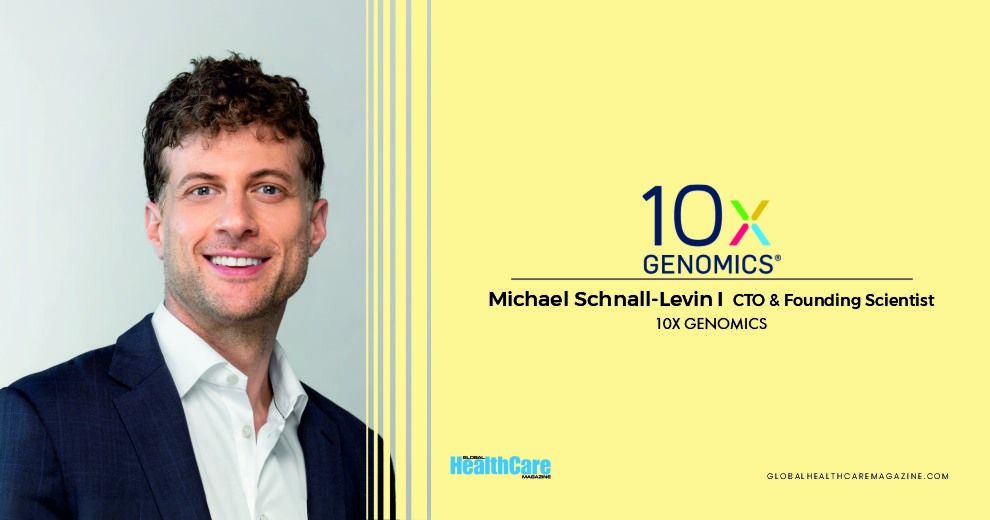
Some companies change an industry. Fewer define one from the moment of their founding. 10x Genomics is one of the latter, and Michael Schnall-Levin, its Chief Technology Officer and Founding Scientist, has been at the center of that definition since the beginning.
The designation of “Founding Scientist” is not, in the biotechnology world, a ceremonial title. It places a person at the table at the moment when a company is still, in the most literal sense, a hypothesis. At that stage, the technology is unproven, the competitive landscape has not yet formed, and the decisions made in the earliest months will determine, in ways that often cannot be fully seen at the time, everything that follows.
Michael has occupied precisely that position at 10x Genomics, a company whose platforms for single-cell and spatial genomics have become foundational tools of modern biology, deployed across research institutions, hospitals, and pharmaceutical laboratories around the world.
The Weight of the Founding Role
To understand what it means to be both a founding scientist and the Chief Technology Officer of a company like 10x Genomics, it helps to understand what 10x Genomics has done to science. The company’s platforms sit at the intersection of two of the most transformative capabilities in contemporary biology: the ability to profile the molecular state of individual cells, rather than averaging across millions of them at once, and the ability to preserve the positional context of those cells within intact tissue.
Together, these capabilities have given biology a level of resolution it had never previously possessed. They have changed what researchers are able to ask about development, disease progression, immune response, and therapeutic intervention.
As Chief Technology Officer, Michael oversees the technical direction of a company operating at the leading edge of that transformation. The role combines the discipline of a scientist with the long-range vision of a technology executive, a pairing that the history of successful biotechnology companies suggests is both rare and deeply consequential.
The platforms developed under 10x Genomics have become some of the most widely used technologies in modern genomics research, a quiet measure of the reach that the work Michael helped initiate has achieved.
Technology That Changed How Biology Is Studied
The field that 10x Genomics helped pioneer is now, by any measure, one of the fastest-moving areas in science. Single-cell genomics, the ability to read the molecular identity of one cell at a time rather than blending its signal with thousands of neighboring cells, has fundamentally altered the study of cancer, developmental biology, immunology, and neurological disease.
The previous approach, which pooled signals from millions of cells, often averaged away precisely the heterogeneity that matters most in biology: the rare cell type that drives disease, the transitional state that explains a developmental process, or the resistant cellular population that survives therapy.
To have been an early architect of the company that placed these capabilities into the hands of researchers worldwide is a contribution that will continue to shape biomedical science for decades. The platforms developed under Michael’s technical leadership do not simply answer existing questions more efficiently. They make it possible to ask entirely new questions.
That shift is particularly significant in the era of high-plex tissue analysis and spatial genomics. Researchers are no longer limited to understanding which molecules are present inside a tissue sample. They can now examine where those molecules exist, how cells interact within their native environments, and how disease evolves across tissue architecture in real biological space.
An Architecture for the Future
There is something distinctive about the companies that manage to define a field rather than merely compete within one. They share, almost without exception, a foundational clarity about what problem they are solving and why the world requires a fundamentally new approach rather than a marginal improvement on an older one.
10x Genomics has demonstrated clarity through its platforms, its research collaborations, and its engagement with the global scientific community since its founding. Sustaining that clarity at scale, however, requires constant technical and strategic alignment. Part of Michael’s responsibility as Chief Technology Officer is ensuring that the company’s scientific direction remains connected to the larger biological questions that justified its existence in the first place.
The field of high-plex tissue analysis in 2026 bears little resemblance to what existed only a decade earlier. The tools available to researchers today have transformed the scale, precision, and dimensionality with which biology can be studied. That transformation has many contributors. Michael Schnall-Levin stands among the most consequential of them.
Read More: Global Leaders Driving AI & High-Plex Tissue Analysis 2026