There is a particular kind of pressure that quietly inhabits a struggling hospital. It does not announce itself in press releases or show up on a balance sheet until it is almost too late. It lives, instead, in the slow accumulation of deferred decisions, fragmented data systems, and finance teams stretched so thin that genuine strategic thinking becomes a luxury nobody can quite afford.
Derrick Hollings has spent more than 25 years inside that pressure, not as an observer, but as the person called in, trusted, and expected to do something about it.
He is the kind of financial leader who understands that behind every budget line is a bed, a nurse, a patient, and a community counting on someone to get the math exactly right. And in 2025, after decades of navigating the financial complexities of major health systems across the United States, he founded Hollings Consulting Group (HCG) in Washington, DC, determined to take that expertise somewhere it had rarely been before: to the mid-sized hospital system, community health organizations, and emerging healthcare platforms that needed it most but had the least access to it.
Where It All Began
Derrick did not set out to spend his career in healthcare. He began, as many finance professionals do, in traditional finance. But something shifted early on, with the kind of quiet permanence that only reveals itself in hindsight.
“Healthcare was the one industry where financial leadership directly influences human outcomes,” he reflects. “Early roles in hospital finance exposed me to the operational realities behind every budget line: the staffing shortages, the regulatory pressures, the mission-driven urgency to serve communities.”
What he encountered in those early years was not simply a set of financial problems waiting to be solved. It was an entire world where numbers carried moral weight, where a miscalculated budget or a mismanaged revenue cycle could ripple outward into real harm for real people.
Over time, Derrick found himself drawn not just to the spreadsheets but to the people and systems behind them. That combination of complexity, purpose, and impact anchored him in healthcare finance and ultimately shaped his path to the highest levels of executive leadership.
It is an original story that sounds straightforward in the telling. But it represents years of deliberate choices, difficult assignments, and a deepening commitment to an industry that never stops demanding more from the people who lead it.
The Gap Nobody Was Filling
After decades in senior financial roles at prominent health systems nationwide, Derrick began to notice something that genuinely troubled him.
The organizations that most needed sophisticated financial leadership, the mid-market hospital systems, public safety net hospitals, and community health systems serving everyday Americans, were also the ones least likely to have access to it. Large health systems had entire finance divisions, experienced teams, and the resources to weather almost any storm. Mid-sized organizations, however, were navigating identical complexities with a fraction of the support.
“Many organizations were drowning in data but starving for insight,” he says, and in those nine words lives the entire founding philosophy of Hollings Consulting Group.
His goal was never to build another management consulting firm that parachutes in, produces a polished report, collects a fee, and disappears. He wanted to build something that functions as a true partner, one that brings executive-level financial leadership directly to organizations facing what he calls CFO capacity constraints. This constraint highlights the challenge of balancing time and resources between setting strategic goals and managing performance systems to achieve them.
When the Margin Runs Out
To understand what Derrick sees when he looks at the landscape of mid-sized American healthcare, it helps to sit with a particular set of conditions that he describes, without drama or exaggeration, as a perfect storm.
Mid-sized hospital systems across the country are simultaneously absorbing rising labor costs and declining payer reimbursement rates. Their infrastructure is aging, and the capital required to modernize it is simply unavailable to many of these organizations. Regulatory demands, meanwhile, multiply faster than the capacity of already stretched finance teams. These organizations operate on margins so thin that a single unexpected disruption can quickly escalate from a management challenge into an existential one.
The limited capital they carry makes meaningful investment in modernization difficult at best, and structurally out of reach at worst. They often know precisely what needs to change. The resources to change it are another matter entirely.
But the challenge that troubles Derrick most is not any single one of those pressures in isolation. It is the fragmentation that sits beneath all of them: fragmented data, fragmented processes, and fragmented decision-making that prevent even talented leadership teams from seeing the full picture clearly enough to act on it before the window closes.
“Without integrated financial and operational visibility,” he says, “even strong leadership teams struggle to make timely, strategic decisions.”
That observation, spare and precise, contains much of the rationale for the work he now does. And it explains why, in his view, simply having data is never enough. Data without integration is noise. Insight is what organizations actually run on.
The 75 Percent Problem
To understand why the fractional CFO model matters, it helps to sit with a number that Derrick returns to often: nearly 75% of a CFO’s day is consumed by management meetings, routine transactions, and administrative tasks.
That figure is striking. It means that the person most responsible for an organization’s financial strategy is spending the vast majority of their time on work that, with the right structure in place, could be handled by other capable members of the team.
The consequence, Derrick explains, is a kind of self-inflicted organizational vulnerability. Without the bandwidth for genuine strategic leadership, organizations begin to experience what he describes as “volatility in operating margins and wide performance swings that could be avoided with the right approach.”
The fractional model is designed to correct precisely that.
By serving as a capacity extender for the existing CFO, or by stepping in as a fully integrated executive leader, Derrick and his team bring focused, strategic financial thinking to an organization precisely when and how it is needed.
“The fractional executive remains an integral part of the leadership team,” he explains. “They are responsible for shaping financial strategy, driving financial operations, and enhancing internal capabilities.”
It is a model built for flexibility, depth, and results that can be measured.
Truth-Telling as Strategy
If there is a single phrase that captures Derrick’s approach to performance improvement, it is this: performance improvement starts with truth-telling.
Before any roadmap can be drawn, before any recommendation can be made, there must be an honest, unflinching account of where an organization actually stands. To establish that baseline, Derrick maps what he calls the financial ecosystem, a seven-point diagnostic that moves systematically through the revenue cycle, labor, supply chain, service lines, budget process, variance management systems, and performance monitoring.
Each of those areas, in his view, is a potential site of value leakage. The work is to identify, with precision, “what is happening versus what should be happening,” and then translate those findings into a clear, prioritized roadmap where every recommendation ties directly to a financial outcome, an operational behavior, or a leadership decision.
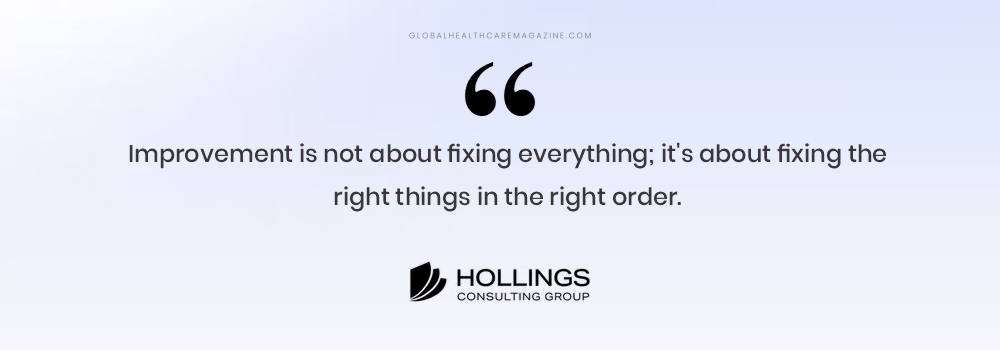
“Improvement is not about fixing everything,” he says simply. “It’s about fixing the right things in the right order.”
That discipline, the willingness to prioritize ruthlessly rather than scatter effort in all directions, is one of the things that distinguishes genuinely transformative financial leadership from the kind that produces activity without meaningful progress.
Revenue Cycle as a Strategic Asset
Among the many areas where hospitals consistently leave value unrealized, Derrick is particularly focused on the revenue cycle. He makes the argument, with the conviction of someone who has watched it go wrong in too many organizations, that hospitals routinely underestimate the strategic importance of this function.
His framework is organized around three fundamentals that must all perform well simultaneously.
The first is front-end accuracy: eligibility verification, prior authorizations, and proper clinical documentation established from the very first moment of the patient encounter.
The second is mid-cycle integrity: coding accuracy, clinical documentation improvement, and ensuring that charge capture faithfully reflects the care actually delivered.
The third is a back-end discipline: denial management, timely follow-up, and payer escalation when circumstances require it.
“When leaders treat the revenue cycle as a strategic asset rather than a back-office function,” he says, “margins improve, and financial stability follows.”
It is a clear prescription. But implementing it requires cultural change as much as operational adjustment, and cultural change, as anyone who has attempted it knows, is never simple or fast.
Leading Through the Fire
One of the most revealing chapters of Derrick’s career came when he was called in to lead a financially distressed hospital through a multi-year turnaround. The organization was experiencing chronic losses. The path forward demanded restructuring the revenue cycle, redesigning labor models, and renegotiating payer contracts from the ground up.
But it also required something that does not appear anywhere on a balance sheet: the ability to guide an entire leadership team through sustained high-pressure situations without allowing crisis to collapse into paralysis.
“Creating a successful financial recovery requires a fundamental shift in organizational thinking and culture,” he reflects. “Leaders must embrace a forward-looking, solution-oriented mindset that prioritizes transparency, accountability, and collaboration.”
What Derrick brought to that situation was what he describes as a collective psychological reset: a deliberate, carefully managed effort to move the management team beyond shame and toward a shared commitment to the organization’s mission and financial health. He helped leaders set aside personal grievances, move past embarrassment, and see the crisis not as a failure but as an opportunity to rebuild something more durable.
He also worked to integrate quality and financial standards into a single, cohesive philosophy, one that erased the perceived conflict between clinical excellence and fiscal sustainability. Every initiative was designed to improve clinical outcomes while simultaneously reinforcing financial stability.
The hospital moved from chronic losses to sustained positive margins. And perhaps most importantly, it preserved access to care for a vulnerable community that had nowhere else to turn.
“That experience reinforced why I do this work,” Derrick says quietly.
When Clinicians Learn to Speak Finance
One of the less visible but no less important parts of Hollings Consulting Group’s practice is its executive coaching work with clinical leaders, including chief nursing officers and physician executives, helping them develop genuine financial literacy.
Clinical leaders are responsible for the majority of a hospital’s spending. Yet many of them were never trained in financial management, never taught to read a budget, never shown how a clinical decision they make at the bedside connects to the cost structure of the entire institution.
That gap has real, compounding consequences.
“When nursing and physician executives understand budgets, productivity, and cost drivers, they become powerful partners in organizational performance,” Derrick says. “Financial literacy empowers them to reallocate resources, lead service line growth, and improve patient care through better operational decisions.”
His coaching is grounded in the belief that bridging the clinical and financial worlds is not a compromise; it is a multiplier. And the culture required to sustain that bridge must be one that values financial discipline, transparency, and accountability throughout the entire financial year, not merely at budget season.
He is clear and direct about what that looks like in practice: physicians, nurses, clinical care teams, and administrative departments working in genuine collaboration, not in parallel silos that happen to share a building.
Compliance Without Fear
Healthcare finance operates under some of the strictest and most rapidly evolving regulations in American business. For many organizations, compliance functions less like a system and more like a threat, an audit perpetually waiting to happen.
Derrick sees it differently, and that difference in perspective is itself a strategic advantage.
His approach is built on a core conviction: properly embedded compliance becomes an operational strength rather than an administrative burden. Rather than treating regulatory requirements as external impositions to be endured, he works to weave them into the daily workflow of finance operations, as well as the controls, documentation practices, and revenue integrity systems that teams engage with every day.
“When compliance is embedded into daily operations, organizations can innovate with confidence,” he says.
That confidence, he argues, is precisely what allows organizations to modernize, adopt new technologies, and take considered strategic risks without the constant fear that a regulatory misstep will unravel everything they are building.
Building Teams That Think Beyond the Numbers
For Derrick, the quality of a finance team ultimately comes down to culture and mindset, not just technical proficiency.
He is direct about what he believes finance professionals should aspire to become.
“True financial leadership is rooted in an operating philosophy that informs decisions not only with data but also with a deep understanding of the organization’s mission and day-to-day operations,” he says.
He encourages his teams to move well beyond the spreadsheet, to engage actively with the departments they support, to ask thoughtful questions, listen carefully, and translate complex financial analysis into insights that non-financial leaders can act on with confidence.
The goal, in his words, is for finance teams to see themselves as collaborative partners genuinely invested in the organization’s success. When that happens, he believes the entire enterprise is elevated and better positioned to create lasting impact.
The Restoration of Balance
It would be easy, given the scale and intensity of the work Derrick does, to picture a man who rarely steps away from it. But balance, he is quick to clarify, is not something that happens by accident. It is a practice, chosen and protected deliberately.
He plays golf and speaks about it with a warmth that makes it clear it is far more than a pastime. It is a conscious disconnection from the pace of executive life, a space for reflection, for family, and for the kind of unhurried thinking that high-pressure work tends to crowd out. He writes. He explores new places. He mentors emerging leaders.
“These moments of restoration make me a better advisor and a more grounded leader,” he says.
There is something almost counterintuitive about a man who manages financial crises for a living placing such disciplined value on stillness. But it makes its own kind of sense. The clarity that allows him to cut through organizational complexity and find the right path forward requires a mind given genuine room to breathe.
What Visionary Financial Leadership Actually Looks Like
When asked what true visionary financial leadership in healthcare means to him, Derrick does not reach for abstractions. He reaches for the forces actively reshaping the industry and for the kind of leader capable of navigating them without losing sight of what the work is ultimately for.
Healthcare today is being remade by technology, workforce transformation, consumer expectations, and global health trends. The CFO of tomorrow will need to understand all of it, and more importantly, will need to be able to communicate it in ways that move organizations forward rather than paralyzing them.
“The next generation of CFOs must be storytellers, strategists, and systems thinkers,” he says.
His advice to those emerging leaders is as direct and unadorned as everything else about him:
“Stay curious, stay courageous, and never lose sight of the people behind the numbers.”
Inside that instruction lives everything that has defined Derrick Hollings’ career across more than two and a half decades: the belief that finance, at its highest expression, is not about managing money. It is about protecting people, sustaining communities, and building organizations capable of serving their missions not just this year, but for generations to come.
That is what he built Hollings Consulting Group to do. And in 2025, from Washington, DC, he began doing it at scale.
Quotes
Also Read: The Most Visionary Healthcare Financial Leaders of 2026