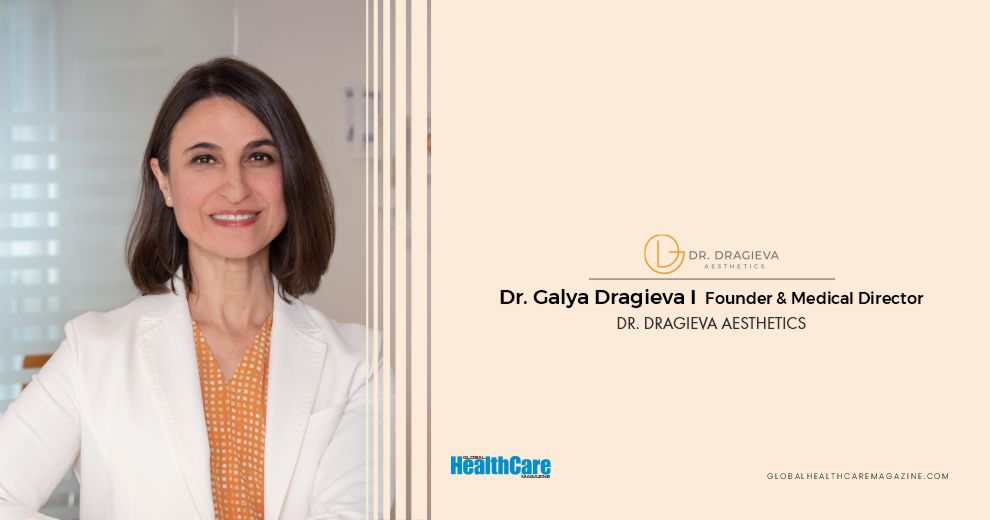
There is a growing shift in aesthetic medicine toward approaches that work with the patient’s own biology. Dr. Galya Dragieva is part of this movement. She is the Founder and Medical Director of Dr. Dragieva Aesthetics in Zurich, Switzerland, a dermatologist and dermatosurgeon specializing in regenerative medicine, and the developer of a nanofat-based protocol that is currently the subject of a patent application.
Over three consecutive years, from 2024 to 2026, eight of her clinical cases have been selected as finalists at the Aesthetic Medicine World Congress Awards in Monaco, all of which were treated using this regenerative nanofat protocol. Her course on nanofat transfer has been included in the online library of the San Diego Academy of Regenerative Therapies and Science (SDARTS). She presents at international congresses and is actively involved in clinical research and physician training in regenerative aesthetics. Yet what is most striking is not the accolades, impressive as they are:
It is the way she approaches the skin — as an organ with a unique intrinsic capacity for regeneration, one that, given the right conditions, can restore and improve its own function.
The Rose and the Skin
Dr. Dragieva completed her specialization at the University Hospital of Zurich, where she had the privilege, in her own words, of working with “outstanding mentors.” She subsequently gained extensive experience in dermatosurgical procedures, particularly in reconstructive defect closure, a field in which functional and aesthetic aspects are closely connected.
In this work, she became increasingly aware of the skin’s capacity for regeneration. That fascination was not purely clinical. Her interest in regeneration was also influenced by her roots.
“The Bulgarian rose has long been valued not only for its fragrance but also for its therapeutic effects,” she said. “A flower so fragile that it wilts within hours can be transformed into an oil that lasts for decades.”
The parallel to the skin, she found, was almost too precise to ignore.
“The skin is similar to a rose petal, delicate, yet capable of constant renewal. This idea that fragility and resilience belong together has always fascinated me.”
What might sound like a poetic metaphor in another context reflects, in her work, something closer to a scientific principle, a way of seeing that would go on to shape an entire practice.
The Patient Who Changed Everything
Every physician can identify a patient who has influenced the course of their work.
For Dr. Dragieva, that patient appeared during her early experience with autologous fat transfer. The patient had severe atrophic acne scars and had undergone multiple laser treatments without satisfactory results. “The laser had even worsened her condition”, leaving depigmented areas on her cheeks.
Dr. Dragieva performed micro- and nanofat transfer. What followed was not simply an improvement in the scars. There was a visible change in overall skin quality and facial appearance, and crucially, this improvement continued over time.
“This experience led me to explore the regenerative potential of adipose tissue,” she has reflected, “and to develop my own approach to nanofat-based facial rejuvenation.”
It was, by any measure, a turning point.
Around the same period, other physicians, including Dr. Sophie Menkes in Switzerland, were conducting research in this field, independently confirming many of the clinical observations Dr. Dragieva had made.
These developments provided both encouragement and scientific grounding, ultimately leading her to found Dr. Dragieva Aesthetics, with a special focus on regenerative aesthetics.
A Philosophy Built on Identity
To understand what makes Dr. Dragieva’s approach distinctive, it helps to understand what she is explicitly trying not to do. She is not trying to make patients look different.
“Patients usually do not want to look different, but healthier and more balanced,” she said.
This is the cornerstone of what she describes as her philosophy of preservation of identity, a treatment ethos that asks not how much can be added, but how patients can look more like themselves, only healthier and more balanced.
Most conventional minimally invasive treatments, she observes, address facial aging only partially and frequently require multiple sessions. Autologous fat offers a different perspective. It allows not only volume restoration, but also the stimulation of tissue regeneration, meaning that several aspects of aging can be addressed simultaneously, often within a single session, and without the use of synthetic materials.
“For me, regeneration is a principle; the goal is to create the conditions where the skin can restore its own function.”
It is also, she is careful to emphasize, a proactive rather than reactive approach. The focus sits firmly on tissue quality and on supporting the skin’s biology, rather than intervening after deterioration has already taken hold.
There are misconceptions in the field, and she addresses them directly. Some patients and practitioners assume that regenerative treatments are unpredictable or experimental. She points to the science: since Patrick Tonnard introduced nanofat grafting in 2013, there has been a growing body of evidence supporting its regenerative potential. Others assume the results are subtle. Clinical experience, she says, tells a different story: consistent improvement in skin texture, tone, pores, and facial contour, with many patients also reporting that they feel more comfortable and confident in their own skin.
The Protocol That Sets Her Apart
The technical centerpiece of Dr. Dragieva’s work is her Nanofat Protocol, a method she has developed, refined, and is now patent pending in Europe.
The protocol combines subcutaneous nanofat injections with nanofat microneedling, performed using an oscillating electronic device. This combination is deliberate: nanofat and microneedling act through complementary mechanisms at different tissue levels, creating what she describes as a synergistic effect.
The choice of an oscillating electronic device is not incidental. Unlike manual needling with tapping or rolling devices, which have previously been described for the uniform delivery of nanofat, electronic devices produce more microchannels with less trauma. The result is minimal downtime for the patient.
When clinically indicated, the protocol can be combined with fractional CO₂ laser treatment, which may further enhance regenerative stimulation and facilitate intradermal nanofat delivery.
One of the most striking aspects of the protocol is its efficiency. It is designed to address multiple aspects of facial aging in a single, relatively short session with minimal downtime, using low volumes of autologous nanofat, as little as 10 mL. If adopted more widely, Dr. Dragieva believes such approaches could reduce the need for synthetic materials and repeated procedures, representing a meaningful step toward more sustainable aesthetic medicine.
“If we can create the conditions where fewer industrial products are needed to achieve natural, lasting results, then doing more with less will not feel like giving up; it will feel like a better choice.”
It reflects both a clinical argument and a broader perspective on the future of aesthetic medicine.
A Practice Built on Precision
Dr. Dragieva works with a small, highly dedicated surgical team that shares the same commitment to precision, safety, and high-quality results.
The close collaboration between dermatology and facial surgery within the practice allows for a truly individualized approach to each patient, particularly in complex aesthetic and reconstructive cases. Many organizational processes are managed by trusted external partners, allowing her to remain focused on what she considers her core work: patient care, research, and teaching.
A typical day at Dr. Dragieva Aesthetics moves fluidly between consultations, surgical procedures, and scientific work. It is a rhythm she has deliberately designed.
“What I enjoy most is the connection between patient care and innovation, and the process of translating clinical observations into research and, in turn, back into practical treatments.”
She is also involved in the development of regenerative topical formulations designed to support healing after procedures, created in collaboration with partners who share her commitment to quality and sustainability. It is a detail that reflects how she thinks: comprehensively, across the full arc of a patient’s experience.
Recognition Built on Evidence
Recognition in medicine is rarely simple, and Dr. Dragieva has earned hers with something more durable than publicity.
Eight clinical cases treated with her nanofat protocol have been selected as finalists at the Aesthetic Medicine World Congress Awards in Monaco over three consecutive years: 2024, 2025, and 2026. She has presented at international congresses, sharing her clinical experience with peers across the global aesthetic medicine community.
Her course has been included in the online library of the SDARTS, a milestone she regards as a reflection of the growing international interest in regenerative aesthetics.
The Dr. Dragieva Academy extends this commitment to education, providing a structured framework for teaching regenerative approaches to practitioners seeking a different path forward.
The recognition is meaningful to her not as an endpoint, but as evidence that the clinical observations she has been making for years are finding their place within the broader scientific conversation.
The Longer Vision
When Dr. Dragieva speaks about where the field is headed, her tone shifts slightly. It becomes less clinical and more considered, in the way of someone who has been thinking about a question for a long time and has arrived at an answer she believes in deeply.
Her vision is a shift from purely corrective procedures to regenerative therapies. Not incremental. Not peripheral. A shift.
She asks, with genuine curiosity rather than rhetoric: “Isn’t that the kind of innovation aesthetic medicine needs today?”
The question is worth sitting with. In a field that has long measured progress in units of product and procedure, she is proposing something different, a model in which the body’s own capacity for healing becomes the primary resource, and where doing more with less is not a compromise but an advancement. It is a vision that extends beyond her clinic walls, beyond Switzerland, and beyond any single protocol.
Outside the clinic, she finds what sustains her in nature, in books, in music, in travel, and in time with her family. These are not afterthoughts. They are part of how she maintains the perspective her work requires: the ability to step back, to see clearly, and to return with fresh eyes.
What the Skin Already Knows
Dr. Galya Dragieva’s work is based on a simple idea: the skin has an intrinsic capacity for regeneration.
“Regenerative medicine shows that the body has more capacity for healing than we once believed,” she said. “Often the best results come not from adding more, but from supporting the body’s own biology.”
The skin is both fragile and resilient. It renews when the right conditions are created. So does medicine.
Quotes

Also Read: Global Leaders Advancing Regenerative Aesthetic Medicine 2026