There is a particular kind of knowledge that can only be gathered from a living room. Not a clinical setting. Not a conference room. A living room, with the television on and a child mid-meltdown and a parent sitting across the coffee table, exhausted in a way that has nothing to do with sleep.
Khaliah Moody has been in those living rooms. She has sat across from those parents. She has stood in the back of classrooms where teachers carried the weight of a child they did not know how to reach. She has worked inside systems that were, in her words, “not designed to truly collaborate.”
She was a personal care assistant once. A mobile therapist. A registered behavior technician. She has held nearly every role the behavioral health field offers, each one closer to the ground, each one adding another layer to what she could see.
And what she saw, over years of doing this work, was a field with real gaps. Real failures. Families were left overwhelmed. Children supported in one setting, struggling in another. Services that looked good on paper and felt hollow in practice.
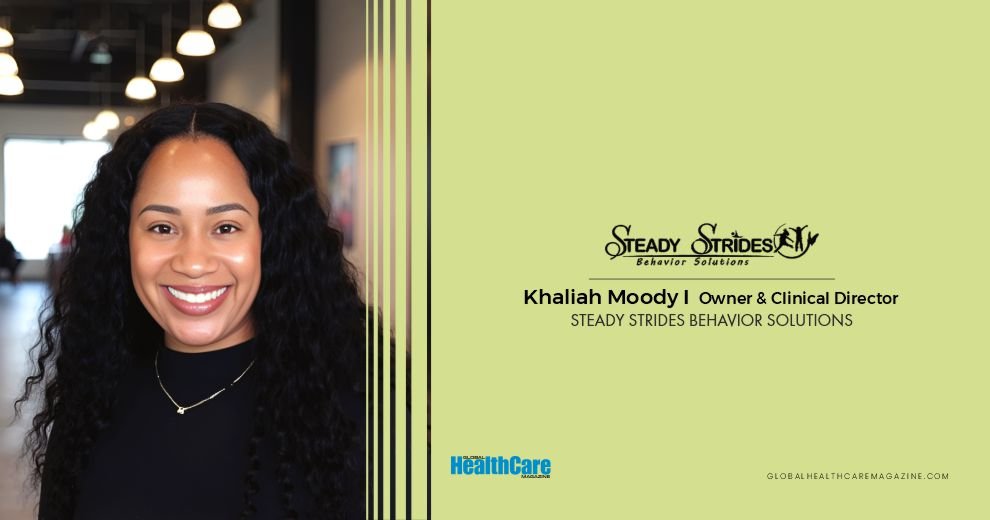
So in 2020, she did something about it. She founded Steady Strides Behavior Solutions, a Philadelphia-based behavioral health agency providing Applied Behavior Analysis (ABA) therapy in home, school, and community-based settings. She serves as its Owner and Clinical Director.
What she built was not just an agency. It was a correction.
A City, A First, A Foundation
Khaliah Moody grew up in Philadelphia, in a neighborhood where, as she describes it, “resources weren’t always accessible,” giving her early, firsthand experience with real-life challenges.
She was the first of her parents’ children to go to college. That fact, simple as it sounds, is not a small thing. It is the kind of experience that reshapes how a person understands opportunity, responsibility, and what communities are owed.
Her career did not begin in the behavioral health world. It began in the juvenile justice system, working with young people on probation. Then came a few years in social work. Then, an introduction to behavioral health that would change the direction of everything.
She did not move quickly into management. She stayed close to the work.
She became a personal care assistant. A mobile therapist. A registered behavior technician. She worked directly in homes and schools, accumulating something that no credential fully captures: the experience of seeing how systems actually function, from the inside.
“I wasn’t just learning the science,” she has said. “I was seeing the gaps. I was in living rooms with families who were overwhelmed, in classrooms where teachers didn’t feel supported, and in systems that weren’t designed to truly collaborate.”
The pivotal moment arrived when she realized she didn’t just want to be a part of a flawed system; she wanted to build a space where families felt supported rather than judged. Those years became the architecture of what came next.
Built Out of Frustration and Vision
If Steady Strides has an origin story, it begins with a word Khaliah uses without hesitation: frustration.
She saw families receiving services that felt clinical, detached from the rhythm and texture of real life. She saw providers who focused exclusively on the child, while parents were left standing on the outside of their own family’s care, overwhelmed, unsupported, and sometimes, she observed, feeling honestly blamed for the very problems they were seeking help to solve.
There was also a structural problem. A child could make genuine, measurable progress during therapy hours and then struggle at home or at school, because no one across those environments was aligned. The work was happening in isolation.
“I created Steady Strides to fill that gap,” she explains, “to bring a more connected, family-centered approach to ABA. We focus not just on behavior reduction, but on real-life functioning, independence, and long-term success.”
The agency is headquartered in Philadelphia, Pennsylvania. Its website, www.ssbehaviorsolutions.com, reflects the clarity of its purpose: steady, forward-moving, solutions-oriented. Founded in 2020, it has grown into a trusted resource for families across home, school, and community-based settings.
The name, it turns out, says exactly what it means.
What ABA Therapy Actually Is
One of the first conversations Khaliah often finds herself having is one that should not have to happen as often as it does: explaining what ABA therapy actually is, because the misconceptions run deep and wide.
The most persistent one is that ABA is rigid, even robotic. That it exists to “fix” children, to sand down their edges until they conform to a neurotypical standard. It is about compliance rather than capability.
Another misconception is that autism itself is something requiring a cure, rather than understanding and support.
“We actively work to shift that narrative,” Khaliah says. “We focus on building skills that improve quality of life: communication, independence, emotional regulation, while respecting each child’s individuality.”
Shifting that narrative is not a passive project. It requires consistent, intentional education of families and communities, because the way people understand behavior shapes the way they respond to it.
“When people understand the ‘why’ behind behaviors,” she observes, “everything changes.”
Modern, ethical ABA, in her view, is not about erasing a child’s identity. It is about building on it.
The Holistic Difference
What sets Steady Strides apart is not a proprietary technique or a trademarked model. It is an orientation, a consistent, genuine commitment to centering the family that shows up in practice rather than just in mission statements.
“What makes our approach different is that we truly center the family,” Khaliah says plainly. “Not just say it.”
The agency collaborates with parents, teachers, and other service providers so that strategies remain consistent across every setting a child inhabits. Progress that lives only inside a therapy session, in Khaliah’s view, is not the goal. The goal is skills that transfer into everyday life.
Parent coaching is a cornerstone of the model. Therapy, after all, accounts for only a few hours per week. Families are present every day.
When parents feel confident and genuinely supported, outcomes improve. This is not incidental. It is the animating logic behind much of what Steady Strides does.
The agency also curates events specifically designed to give parents continued education and to give children the experience of community outings, because isolation is its own barrier to development.
The model is holistic in the truest sense of the word. Steady Strides pays attention to sleep, routines, transitions, communication, and emotional needs because all of these elements intersect with behavior.
“That’s where real change happens,” Khaliah says.
The Work of Leading
Being both Owner and Clinical Director means Khaliah occupies a role that is constantly shifting between the immediate and the strategic.
On any given day, she is reviewing treatment plans, supporting her clinicians, problem-solving complex cases, managing client relationships, and building partnerships for the agency’s continued growth. There are a great many meetings. She also continues to take business-related coursework, because she believes in the practice of ongoing learning: courses, books, podcasts, whatever keeps the thinking current and the leadership sharp.
“I’m deeply involved in making sure our clinical quality stays high,” she says, “but I’m also focused on building systems that allow us to scale and serve more families.”
The team she has assembled reflects the culture she has worked to create. The clinicians and behavior technicians at Steady Strides are selected not only for their technical skill, but for something harder to quantify: compassion, collaboration, and a genuine willingness to keep learning. This work demands patience, consistency, and a deep understanding of behavior. She has also shared these executive strategies publicly, authoring articles for The Insider at KNOW, including “Building a team you can trust so you can step away without losing your mind” and “The Most Undercounted Asset in Every High-Growth Company Is the Founder’s Leadership Capacity.”
“Our team understands that they are not just implementing programs,” Khaliah says. “They are part of a child’s development and a family’s support system.”
That distinction, small as it might seem from the outside, shapes every interaction.
The Tests That Reveal a Leader
Leadership, in Khaliah’s experience, is rarely defined by a single dramatic moment. More often, it is revealed in the sustained, grinding work of growth.
As Steady Strides expanded, she had to make difficult decisions around staffing, expectations, and the systems needed to preserve quality at scale. There were moments when accountability required conversations that were uncomfortable, but that the mission made necessary.
“Leadership isn’t about being liked,” she says. “It’s about being clear, consistent, and aligned with your mission.”
She leads with transparency and structure. She also leads with empathy, because the people doing this work are human, and the work is genuinely hard. Both things are true simultaneously. She holds them together.
The Milestones That Mean the Most
External recognition for Khaliah’s work has arrived in meaningful form. She has received the Diversity in Business Award honoree recognition through the Philadelphia Business Journal, been named an Enterprising Women 2026 honoree, and been selected as an Employer of Choice for 2026 through the City of Philadelphia. Her commitment to providing exceptional care was also recognized early on when she was named a Philadelphia Family award honoree for 2020’s best autism services. These honors are significant, she acknowledges, not merely personally but for what they represent: visibility for mission-driven, community-based businesses that are growing and leading at a high level.
Her academic and professional affiliations are equally substantial. She is a graduate of the Goldman Sachs 10,000 Small Businesses Program and the Yale School of Management’s Women’s Leadership Program. She sits on the Board of Directors of Crossroads Programs, is the Founding Member of the Philadelphia Chapter of the Women Presidents Organization, and is an active member of both KNOW Women and Philadelphia 250.
As a Board Certified Behavior Analyst (BCBA), a Licensed Behavior Specialist (LBS) in Pennsylvania, and an Authorized Continuing Education (ACE) Provider through the Behavior Analyst Certification Board, she brings more than a decade of direct experience with children and families to every decision she makes.
But the milestones she returns to most readily are smaller and more personal, rooted entirely in the trust she has built within the community. “Families know that we are not just an organization providing a service,” she explains. “We are a team that genuinely cares about the progress, growth, and overall well-being of their children.”
A child communicating for the first time. Behaviors are decreasing, and the relief that washes over a family that had almost stopped expecting relief. A parent who says, “I finally feel like I understand my child.”
“Those are the milestones that matter the most,” she says.
Paint the Puzzle: The Advocacy Beyond the Clinic
In building Steady Strides, Khaliah arrived at a realization that has since reshaped the scope of her work: providing excellent clinical services, on its own, is not enough.
The world that families return to after therapy is rarely designed with them in mind.
So she created Paint the Puzzle, the non-profit advocacy arm of Steady Strides. It is, she acknowledges, still in its very early stages. But the vision behind it is fully and carefully formed.
Paint the Puzzle exists to address what clinical services cannot: the broader, more persistent challenges of awareness, access, and inclusion for individuals with disabilities and their families. It will work toward creating more sensory-friendly environments within the community, offering training and education to businesses and organizations, and building spaces where families feel supported well outside the boundaries of any therapy session.
The goal is to bridge the gap between what happens inside clinical care and what happens in the world. The everyday world. Grocery stores. Community events. Public spaces.
“The long-term vision,” Khaliah says, “is to create meaningful change at a community level, not just within the families we directly serve, but across the environments they interact with every day.”
What Comes Next
The future of Steady Strides, as Khaliah envisions it, is one of deliberate, quality-driven expansion.
The agency is moving into center-based services, building programs for early learners, and developing more varied ways for families to access support. The training and consulting work is also growing, with schools and community organizations as key partners in that reach.
Her long-term ambition is larger still. She wants to contribute to a fundamental shift in how ABA therapy is delivered and perceived, toward a model that is more collaborative, more inclusive, and more meaningfully family-centered in practice and not just in language.
The balance between that ambition and the rest of a human life is something she is still figuring out, she says honestly. She travels when she can. She makes time for friends. She has learned, in the way that only direct experience teaches, that burnout serves no one.
“I can’t pour into others if I’m running on empty,” she says simply.
Progress Is Not Linear
The story of Steady Strides is, in many ways, the story of what it actually takes to build something from nothing.
Khaliah built this agency without investors. She did it while holding down a full-time job. There were stretches of time when she was not paying herself.
She stayed anyway. Consistent. Focused. Aligned with her purpose.
“Progress is not linear, and success doesn’t happen overnight,” she says. “Leadership is not about having all the answers; it’s about being willing to figure it out, adapt, and keep going.”
What she has built in Philadelphia is more than a behavioral health agency. It is a proof of concept. That care can be both clinically rigorous and deeply human, that a business built on mission can also be built to last. That the families who have spent years feeling unsupported, unseen, and underserved deserve better, and that better is possible.
For the child who communicates for the first time. For the parent who finally feels understood. For the family that no longer faces the world alone.
For them, the milestones are not numbers or awards. They are mornings that feel different from the ones before.
And that, Khaliah Moody, would tell you, is the whole point.
Quote
Also Read: Global Women Leaders Advancing ABA Therapy & Autism Advocacy in 2026