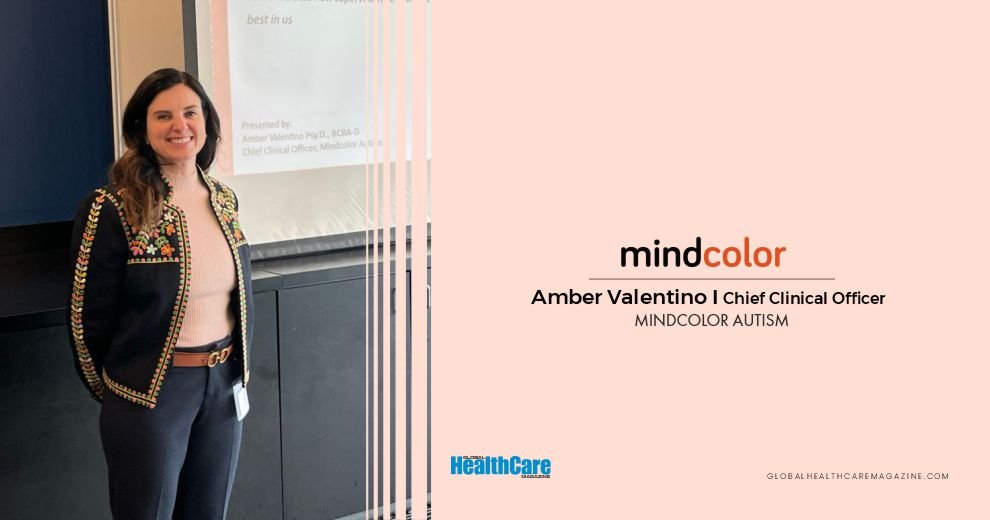
There is a particular kind of intelligence that knows how to move between worlds. Between the journal article and the therapy room. Between the academic symposium and the child sitting across from a clinician on a Tuesday afternoon, Amber Valentino has spent more than twenty years developing that intelligence, refining it, and helping others build it too.
She describes herself as an empathetic leader, a community builder, an enthusiastic researcher, and a dedicated author. None of those descriptions feels aspirational in her case. They describe work she has consistently done over time, through practice, leadership, scholarship, and sustained commitment to the field of behavior analysis.
The Role She Was Built For
As Chief Clinical Officer of Mindcolor Autism, Amber occupies one of the organization’s most influential leadership roles.
She oversees clinical processes and compliance across the organization, a responsibility that spans a remarkably broad range of operational and strategic priorities. Her work includes developing and implementing clinical initiatives, establishing standards of care, overseeing regulatory compliance, directing clinician education and training, monitoring treatment quality and outcomes, and building high-performing clinical teams.
It is a demanding portfolio by any measure. What makes it particularly significant is that she carries it alongside more than two decades of direct experience in applied behavior analysis, giving her leadership a level of practical depth that cannot be taught through administration alone.
More Than Twenty Years in the Field
Amber is a doctoral-level Board Certified Behavior Analyst (BCBA-D), one of the field’s most advanced professional designations. Over the course of her career, she has worked across a wide variety of healthcare and clinical settings, an experience that has shaped the comprehensive approach she now brings to leadership at Mindcolor Autism.
The diversity of those settings matters. It means she understands not only what evidence-based practice looks like in theory, but how it must adapt across the complex realities of different clinical environments, families, teams, and systems of care.
“With over 20 years of experience in the field of applied behavior analysis, I have worked in a variety of healthcare settings,” she explains.
Experience of that depth is never built quickly. It accumulates gradually: case by case, family by family, year after year.
Closing the Research-to-Practice Gap
Amber’s influence extends well beyond the clinical walls of Mindcolor Autism. She is the author of a book examining the research-to-practice gap in behavior analysis, an issue that remains one of the field’s most important ongoing conversations. The challenge is straightforward but significant: research often advances faster than everyday clinical implementation.
Her work focuses on narrowing that distance. She has also authored dozens of peer-reviewed journal articles and book chapters, contributing to the evidence base that shapes modern behavior analytic practice. Her scholarship reflects both technical expertise and a clear commitment to making research clinically meaningful rather than academically isolated.
Her editorial contributions are equally substantial. She has served as Associate Editor for two prominent journals within the field of behavior analysis, roles that require deep subject-matter expertise, careful judgment, and responsibility for maintaining scholarly standards. She continues to contribute through editorial board service, peer reviewing, guest associate editing, and guest editing across several behavior analytic publications.
That kind of work often happens quietly behind the scenes, but it plays a critical role in shaping the quality and direction of an entire discipline.
On Stages, in Classrooms, and Across the Profession
As an invited speaker and keynote presenter at conferences across the country, Amber brings her work into direct conversation with clinicians, researchers, educators, and organizational leaders. There is a difference between publishing research and standing in front of a room of practitioners tasked with applying it in real time. She does both effectively.
That combination of scientific credibility and practical communication has expanded her influence throughout the field. Every clinician who leaves one of her presentations with a clearer understanding of evidence-based care carries that knowledge back into practice, extending its impact to children and families far beyond the conference itself. It is one of the ways systems change actually happens: incrementally, through people equipped with better tools and a better understanding.
The Life That Grounds the Work
Perhaps most striking about Amber is the extent to which she has refused to let professional achievement eclipse the rest of life. She is a mother and speaks openly about how much she values time with her young son and supportive husband. Outside of work, she and her family travel the California coast in their RV, creating intentional space away from the demands of leadership and clinical responsibility.
She also finds balance through CrossFit, indoor cycling, travel, and fiction reading. That balance is not incidental. A leader who models sustainable engagement with life outside of work often brings greater perspective, empathy, and resilience into the work itself. In a field where burnout is common and emotional demands are high, that matters.
Making the Science Matter
The most consequential leaders in healthcare are not always the loudest voices or the most publicly visible. They are often the people who understand that knowledge without application remains incomplete, that systems without humanity eventually fail, and that improving lives requires long-term commitment rather than momentary attention.
Amber Valentino has spent more than two decades helping ensure that the science of behavior analysis translates into meaningful outcomes for the individuals and families who depend on it most. That is not abstract work. It is deeply practical. Deeply human. And for countless children and clinicians alike, deeply consequential.
Read More: Global Women Leaders Advancing ABA Therapy & Autism Advocacy in 2026