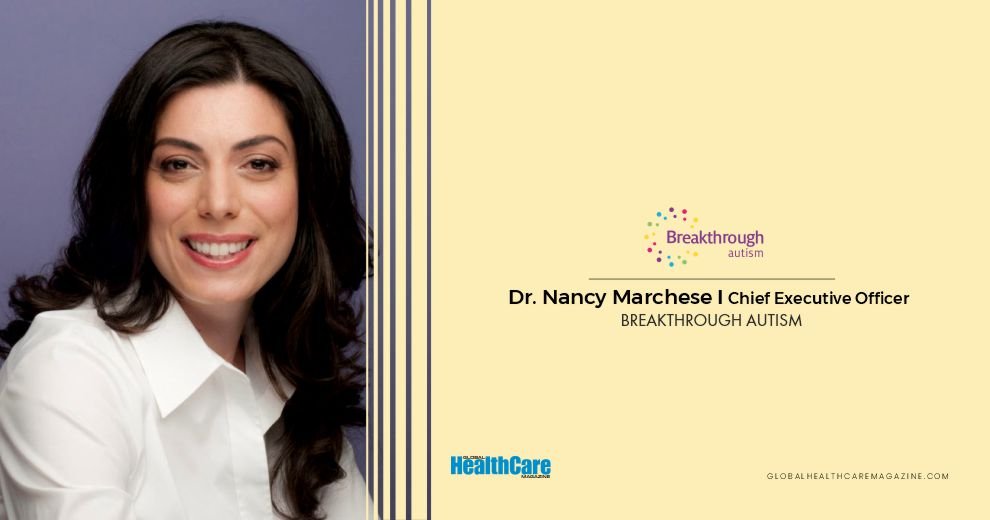
Somewhere in Ontario, a child who once sat in silence is speaking now. The path from that silence to that voice is rarely simple, rarely quick, and never traveled alone. For Dr. Nancy Marchese, it is a path she has walked alongside children and families for more than two decades.
She does not describe what she does as a job. She describes it, with quiet certainty, as her life’s work. That is not a figure of speech.
The Beginning of a Life’s Work
Dr. Marchese did not stumble into this field. She entered it with intention. Since 1998, she has worked directly with children with autism and their families across Ontario, building her practice not on theory alone, but on years of clinical experience, observation, research, and sustained commitment.
Today, she serves as Chief Executive Officer of Breakthrough Autism, an organization dedicated to improving outcomes for children with autism and supporting the families navigating that journey alongside them.
The work itself is not glamorous in the conventional sense. It is patient, methodical, and deeply personal. It requires someone capable of holding complexity without losing focus, and someone willing to return, session after session and year after year, with the same level of care and consistency. Dr. Marchese has spent her career doing exactly that.
The Credentials Behind the Conviction
Her credentials are, by any professional standard, substantial. Dr. Marchese is a Registered Behaviour Analyst (Ont.) and a Board Certified Behaviour Analyst at the Doctoral Level (BCBA-D), the highest certification within the field of applied Behaviour analysis. She is also a Psychologist registered with the College of Psychologists of Ontario, giving her a combination of expertise relatively uncommon within the profession.
She earned her Doctor of Philosophy (Ph.D.) in Behaviour Analysis from Endicott College in Massachusetts, where she focused on advancing evidence-based approaches to autism intervention and behavioral science. But for her, education was never intended to be a finishing point.
She has remained consistently engaged with emerging research throughout her career, integrating current evidence directly into clinical programming and service delivery. In a field where best practices continue to evolve, that commitment matters. It is often the difference between care shaped by outdated assumptions and care shaped by current understanding.
Building Systems That Extend Beyond the Therapy Room
The scope of Dr. Marchese’s work extends far beyond individual therapy sessions. Over the years, she has supervised Applied Behavior Analysis (ABA) programs across both nonprofit and private-sector organizations, helping shape systems of care that impact children and families at scale.
Equally significant is her work in clinician training and supervision. Teaching professionals how to implement ABA effectively creates a multiplier effect: one highly trained clinician can positively influence dozens of children and families over the course of a career. She has understood that dynamic from the beginning.
Much of her impact exists not only in the children she has worked with directly but in the practitioners she has mentored, supervised, and helped develop over decades in the field.
A Lasting Voice in Research and Scholarship
Dr. Marchese’s contributions extend into the research literature as well. In 2012, she co-authored a peer-reviewed study published in the Journal of Applied Behavior Analysis alongside Carr, LeBlanc, Rosati, and Conroy. The research examined the effects of the question “What is this?” on tact-training outcomes for children with autism, reflecting her interest in practical, clinically relevant behavioral interventions.
Her scholarly engagement has also included consistent participation in professional conferences and industry events.
In 2011, she conducted a symposium at the Association for Behavior Analysis International Annual Convention in Denver, Colorado, focused on the effects of vocal instructions during tact training. The year prior, she participated in a panel discussion on conducting research in non-university settings at the same international convention in San Antonio, Texas.
Also in 2010, she presented a workshop in Markham, Ontario, on instructional methods for children with autism during the Behavior Analysis Summer Conference: Assessment, Instruction, and Transitions. Taken together, these contributions reflect something important about her professional philosophy: research should not exist separately from practice. It should actively inform it.
Connecting the Science to the Child
What distinguishes Dr. Marchese after more than two decades in the field is not simply experience. It is sustained curiosity. She continues to present at both provincial and international conferences, ensuring that the knowledge gained through clinical work is shared outward into the broader professional community rather than confined within organizational walls.
That willingness to contribute publicly to the field reflects a larger sense of responsibility. The work, in her view, is collaborative by nature. There are healthcare leaders driven primarily by professional ambition.
And then there are those driven by something deeper: a long-term commitment to improving the lives of people who depend on systems functioning better than they often do. Nancy Marchese belongs firmly in the second category.
For more than two decades, she has helped children find communication, confidence, structure, and support. She has built systems designed to outlast any individual session and trained clinicians who will continue that work for years to come. That is more than a career. It is a sustained act of service.
Read More: Global Women Leaders Advancing ABA Therapy & Autism Advocacy in 2026