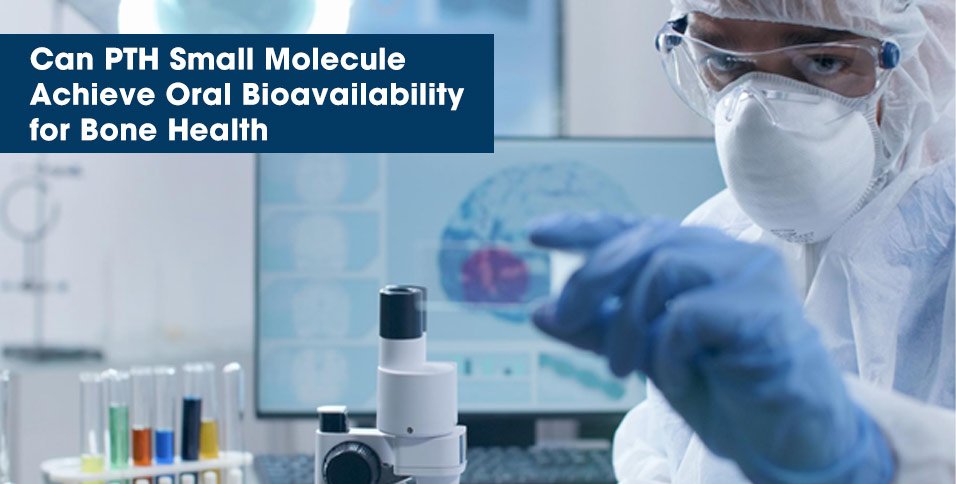
Parathyroid hormone (PTH) is the only drug known to stimulate bone formation, making it invaluable for treating osteoporosis. Unfortunately, PTH is only effective when dosed by injection because it has no oral bioavailability.
PTH is a peptide, an 84-amino acid chain. The peptidic nature and poor oral bioavailability of PTH have limited its use, since daily subcutaneous injection of PTH is required clinically for treating severe osteoporosis.
Your digestive system destroys it. Stomach acid breaks it apart. Enzymes in your intestines degrade it before it can reach your bloodstream. A pill form of PTH is theoretically possible but practically pointless because nothing makes it to where it needs to go.
Why Class B GPCRs Were Considered Impossible
PTH does its work by attaching to a receptor called PTHR1. Biological actions of PTH are mediated via stimulation of the PTH type 1 receptor (PTHR1), a member of the class B family of G protein-coupled receptors (GPCRs).
Here is the problem. Small molecules that activate class A GPCRs are common. They are used in clinical practice every day. But class B GPCRs are different.
Although small molecules that activate class A GPCRs are used in clinical practice, a small molecule agonist for class B GPCRs, which include PTHR1, is not yet available.
Although a few papers report the discovery of small molecule agonists of class B GPCRs, to our knowledge, none of them has been developed for clinical use, possibly due to insufficient oral bioavailability or to their characteristics as only partial agonists.
The Breakthrough: A True PTH Small Molecule
Then something changed. Researchers identified a novel, orally active small molecule that acts as a full agonist of PTHR1, called PCO371.
PCO371 activated PTHR1 without interacting with the N-terminal extracellular domain of the receptor, suggesting that it bypassed the classical two-domain model of peptide binding for class B GPCRs.
In other words, the PTH small molecule found a different way into the receptor. A path that peptides do not use. A path that survives the digestive system and delivers activation where it counts.
What Does Oral Activity Actually Mean?
In early research, the relative bioavailability of oral PTH was 2.1% relative to subcutaneous administration. However, the bone formed following oral PTH administration was comparable to that formed following PTH injections.
That 2.1% bioavailability sounds low. But surprisingly, it worked. The orally absorbed PTH was biologically active in animal models of bone disease.
With the PTH small molecule, results were different. Oral administration of PCO371 to hypocalcemic rats restored serum calcium levels without increasing urinary calcium, and with stronger and longer-lasting effects than PTH injections.
The Bone Formation Question
For bone health, the real test is whether bone actually forms. Oral administration of PCO371 to osteopenic rats provoked a significant increase in bone turnover with limited increase in bone mass.
That phrase matters: limited increase in bone mass. The PTH small molecule activated bone turnover, the process by which old bone is removed and new bone is laid down. But the mass gain was constrained.
This is not failure. It shows that a PTH small molecule can reach the bone tissue and trigger the right biological response. But the magnitude differs from injection therapy. That difference might matter for some patients and not for others.
Calcium Homeostasis Without The Kidney Side Effect
One advantage stands out. In hypocalcemic rats, PCO371 restored serum calcium levels without increasing urinary calcium, and with stronger and longer-lasting effects than PTH injections.
PTH normally tells your kidneys to reabsorb calcium that would otherwise be excreted. When PTH therapy works poorly or triggers side effects, urinary calcium rises, forcing your body to waste the mineral you are trying to restore.
The PTH small molecule avoided this problem. It maintained calcium balance while not forcing your kidneys into overdrive.
What This Means for Patients
Chronic diseases demand chronic compliance. Pills are easier than injections. People take them consistently. That consistency compounds into better outcomes over months and years.
The science confirms what patients have been hoping for: oral activation of PTH pathways is achievable. A PTH small molecule can deliver that activation with effects strong enough to matter.
For researchers working on PTH therapies or trying to understand PTHR1 activation, validated research tools and reference materials are essential. Explore options for parathyroid hormone-related reagents at AAA Biotech.