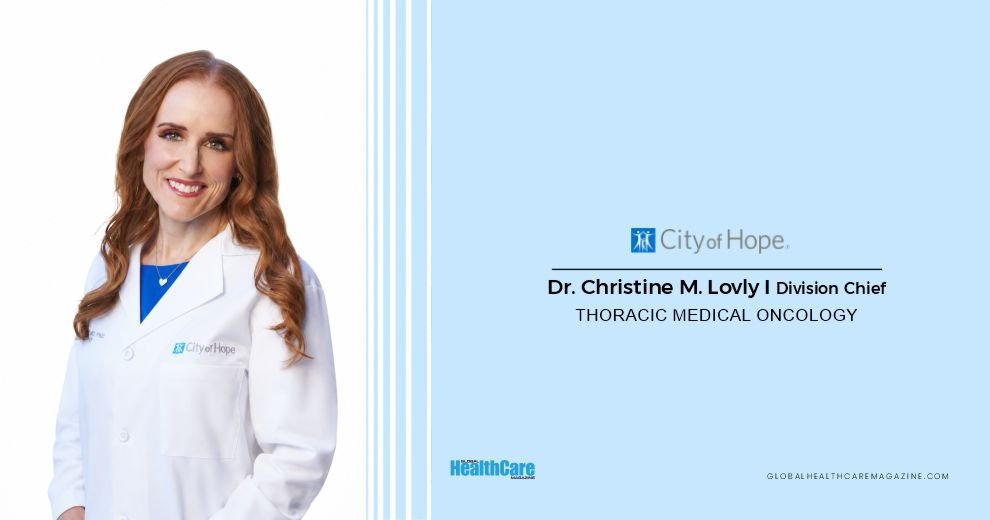
Dr. Christine M. Lovly made a move in January 2026 that surprised no one who had followed her career closely, even if it surprised the city of Nashville. After more than fifteen years at Vanderbilt University Medical Center, she joined City of Hope National Medical Center as Division Chief of Thoracic Medical Oncology, co-lead of the Lung Cancer Disease Team, and Professor in the Department of Medical Oncology and Therapeutics Research.
She also assumed the Dr. Norman and Melinda Payson Professorship in Medical Oncology, an endowed chair that accompanied the transition west.
“I am a physician-scientist and academic leader in thoracic oncology with deep expertise in lung cancer, precision oncology, translational research, and clinical trials,” Dr. Lovly has said of her work, which focuses on developing and translating biomarker-driven therapies for molecularly defined subsets of lung cancer. Her research centers on accelerating drug development while improving outcomes for patients whose cancers are driven by highly specific genetic alterations.
The Long Road Through Nashville
Before joining City of Hope, Dr. Lovly built virtually her entire academic career at Vanderbilt. She first joined the institution as an instructor in medicine in July 2012 and steadily advanced through the academic ranks, becoming associate professor of medicine with tenure in January 2019, a position she held until her departure in early 2026.
She simultaneously served as the Ingram Associate Professor of Cancer Research at the Vanderbilt Ingram Cancer Center and, within the division of hematology and oncology, held leadership responsibilities as section chief for basic and translational research.
From January 2017 through March 2023, she co-led the center’s Translational and Interventional Oncology Program before continuing in a broader co-leadership role through the remainder of her Vanderbilt tenure.
Her earliest Vanderbilt faculty appointment came as assistant professor of medicine and cancer biology, a role she held from July 2013 through December 2018.
Trained Across Three Institutions
Dr. Lovly’s scientific training moved through three major academic institutions. She studied chemistry at Johns Hopkins University before entering the Medical Scientist Training Program at Washington University in St. Louis, where she earned both her MD and PhD.
She later completed residency and fellowship training at Vanderbilt University Medical Center, where she specialized in internal medicine and medical oncology before ultimately joining the faculty.
Those experiences combined three distinct academic cultures into a single physician-scientist. Chemistry provided the molecular framework. The combined MD and PhD training allowed her to move fluidly between laboratory research and patient care. Vanderbilt, in turn, provided the clinical environment, tumor biology, and research infrastructure that enabled her to build a career centered on precision lung cancer therapy.
That training is reflected in a research portfolio supported by organizations including the Damon Runyon Foundation, the V Foundation, LUNGevity, Uniting Against Lung Cancer, the American Association for Cancer Research, and the Conquer Cancer Foundation of the American Society of Clinical Oncology. The diversity of funders reflects the broad scientific and clinical importance of advances in lung cancer research.
A Seat at the National Table
Her national standing is evident in the leadership roles she has accumulated across oncology. She was elected to the American Society for Clinical Investigation in 2017 and has served on the editorial boards of Cancer Discovery, JCO Precision Oncology, and Clinical Cancer Research.
She also contributes to the National Comprehensive Cancer Network guidelines for non-small cell lung cancer, recommendations used by oncologists nationwide to guide treatment decisions for one of the deadliest forms of cancer.
From April 2023 through April 2026, she additionally served on the Board of Directors of the American Association for Cancer Research, helping shape strategic direction for one of oncology’s most influential professional organizations.
Two journal editorships almost perfectly bookend her Vanderbilt years. Beginning in January 2011, she served for more than three years as deputy editor of My Cancer Genome, a genetically informed cancer medicine resource. In May 2014, she became co-editor-in-chief, a role she continued to hold for nearly twelve years, including throughout her transition to California.
It is the kind of sustained editorial leadership that rarely attracts public attention yet profoundly shapes how a field organizes, validates, and shares knowledge.
What emerges across the professorships, journal leadership roles, translational research programs, and eventual move to California is a scientist who has never drifted far from the biology itself. Molecularly defined subsets of lung cancer remain, more than two decades after she first entered a research laboratory, the central problem she continues to pursue.
At City of Hope, she has simply chosen a new place and a larger platform from which to pursue it.
Quote
“Every biomarker we identify gives us another opportunity to match the right therapy to the right patient at the right time.”