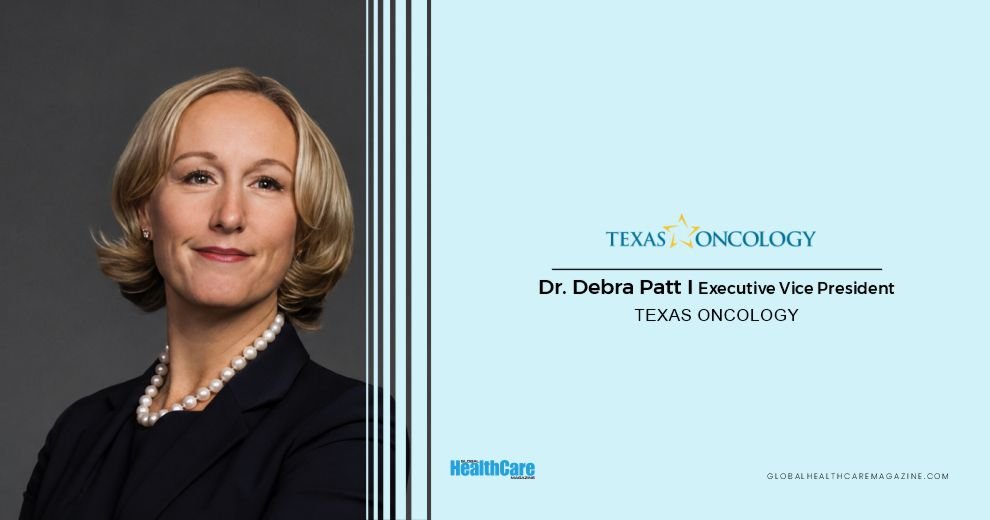
Dr. Debra Patt is board certified twice over, once in medical oncology and once in clinical informatics, and she has spent nearly two decades proving that the two disciplines belong together.
She began seeing patients at Texas Oncology in August 2006, following a fellowship at MD Anderson Cancer Center, where she trained from July 2003 to July 2006. During that period, she earned recognition as the program’s Research Fellow of the Year, alongside receiving an ASCO Young Investigator Award and the Jesse Jones Award for Education.
She built her clinical identity as a breast cancer specialist, leading clinical trials in a community oncology setting, an area of cancer care that rarely receives the research attention traditionally directed toward academic centers.
“I am excited about the innovation and change we are driving in cancer care through progress in cancer therapeutics and in clinical informatics,” Dr. Patt has said of the work, which now spans artificial intelligence, telemedicine, electronic patient-reported outcomes, and remote symptom monitoring, all aimed at making digital tools genuinely useful inside cancer clinics.
Two Decades Inside Texas Oncology
Dr. Patt’s tenure at Texas Oncology now spans nearly two decades. Since December 2015, she has served as Executive Vice President for Policy and Strategic Initiatives, directing public policy, academic affairs, and strategic planning for one of the largest community oncology practices in the United States.
Before assuming that executive role, she served as Director of Public Policy from 2013 through December 2024 while simultaneously practicing as a medical oncologist and hematologist. In December 2025, she also became Physician Lead of the organization’s Transformation team, a position she continues to hold.
Her informatics career developed in parallel with her clinical practice. From 2008 through November 2015, she led Healthcare Informatics for the US Oncology Network, overseeing a team of approximately 30 subspecialty oncologists supporting outcomes research across a network of nearly 1,000 physicians.
From March 2007 through 2021, she chaired the breast cancer committee of McKesson Specialty Health’s Pathways Task Force, helping evolve the Level 1 Pathways System into Clear Value Plus, a clinical decision-support platform developed in collaboration with the National Comprehensive Cancer Network. The system was designed to evaluate efficacy, toxicity, and cost at the point of care.
She later served as McKesson’s Medical Director of Analytics from April 2016 to March 2021 and as Medical Director of its Publications and Outcomes Committee from 2011 to 2018.
Leading Community Oncology Nationally
In December 2024, Dr. Patt became president of the Community Oncology Alliance after previously serving as vice president beginning in January 2023. The organization advocates for independent oncology practices, which collectively treat the majority of cancer patients in the United States outside major academic medical centers.
Her national leadership within American Society of Clinical Oncology runs even deeper. Since October 2023, she has chaired ASCO’s AI Task Force and has served on the organization’s Board of Directors since June 2023.
Earlier in her career, she chaired ASCO’s Clinical Practice Committee from 2014 to 2017, co-chaired its Payer Provider Initiatives Workgroup from 2015 to 2020, served on its nominating committee from 2017 to 2020, and contributed to the Education Committee’s Breast Track from 2014 to 2024.
She also spent six years as founding Editor in Chief of the Journal of Clinical Oncology Clinical Cancer Informatics, helping establish one of oncology’s leading platforms dedicated specifically to digital health and clinical informatics.
Policy, Teaching, and the Texas Cancer Registry
Since April 2021, Dr. Patt has also served part-time as Medical Director of Public Policy for the US Oncology Network. In addition, since December 2017, she has held an appointment as Clinical Professor at Dell Medical School.
From August 2006 through December 2024, she served on the Advisory Council to the Texas Cancer Registry, a tenure spanning more than eighteen years. Between 2019 and 2021, she chaired the Texas Medical Association’s Council on Legislation after previously chairing its Cancer Committee from 2011 to 2013. She also served on the organization’s Committee on Science and Public Health from 2015 to 2016.
Between 2011 and 2013, she additionally directed Seton’s Breast Center in Austin, advising on program strategy, operations, and fundraising initiatives.
It is an unusually broad portfolio for a single oncology career, and Dr. Patt has consistently moved between policy, clinical practice, informatics, and research leadership without separating one from the other. The same physician shaping legislative policy in Texas has, in the same span of years, reviewed outcomes data for national oncology networks, advised cancer registry initiatives, and continued treating breast cancer patients in clinic.
A Career Measured in Systems Change
Add together the appointments and a clear pattern emerges: Dr. Patt gravitates toward the places where healthcare decisions shape how cancer care is delivered, then stays long enough to influence those systems directly.
Nearly two decades on a state cancer registry advisory board. Years leading oncology informatics initiatives supporting almost 1,000 physicians. A journal platform dedicated to advancing clinical cancer informatics globally. Now, as president of the Community Oncology Alliance and chair of ASCO’s AI Task Force simultaneously, she stands at the precise intersection her career has steadily been building toward, where community oncology, national policy, and emerging technology converge.
Across every role runs the same conviction: that informatics tools, electronic health records, outcomes data, and decision-support systems matter only if they improve care for the patient sitting in the exam room. It is a philosophy that has carried Dr. Debra Patt from a single oncology practice in Austin to one of the most influential leadership positions in American cancer policy.
Quote
“Technology should never add complexity to cancer care. Its purpose is to help physicians make better decisions and help patients feel better sooner.”