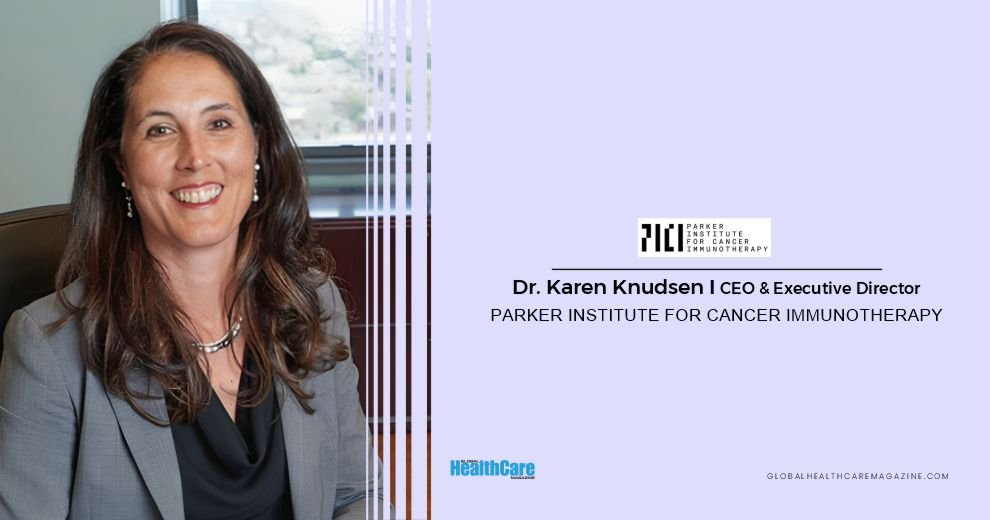
Dr. Karen Knudsen keeps a number in her head that would rattle most executives: seventeen. That is how many biotech companies the Parker Institute for Cancer Immunotherapy has launched since she became its Chief Executive Officer and Executive Director in March 2025, ventures that have collectively raised more than four billion dollars to chase down cancers that resist everything else medicine has thrown at them.
PICI, under her direction, operates what she describes as an end-to-end model, one that spans bold scientific discovery, clinical development, and company formation, and it coordinates one of the most expansive immuno-oncology networks of cancer centers in the United States. The organization’s stated mission, distilled from her own leadership priorities, is to collapse the timeline between discovery and cure by aligning the right science, the right capital, and the right people at the same moment.
A Boardroom Regular
Dr. Knudsen’s influence is defined by the impressive spaces she leads and the sheer number of executive rooms she is asked to sit in at once. Since April 2025, she has served on the board of AstraZeneca, where she holds seats on both the Science Committee, advising on research and development strategy across oncology, biopharmaceuticals, and rare diseases, and the Sustainability Committee.
In December 2024, she joined the board of ExaiBio, an AI-driven molecular diagnostics company built on RNA-based liquid biopsies designed to catch cancer earlier. Three months into the PICI role, she added a board seat at Paradigm Health, where she also sits on the Audit Committee, and by November 2025, she had joined the board of 3T Biosciences, a company developing next-generation T-cell receptor therapies for solid tumors.
Elsewhere, she advises rather than governs. She has been a board advisor to ArteraAI since 2023, a company using artificial intelligence and digital pathology to personalize cancer treatment decisions. Since March 2025, she has served as a strategic advisor to Transcarent, where she is leading the formation of a national Cancer Advisory Council. She sits on the advisory board of CellCentric, which is developing inobrodib, a first-in-class epigenetic inhibitor for hard-to-treat cancers, and she has held a seat on Genentech’s Scientific Review Board since May 2019, a tenure now stretching past seven years.
Quietly, she is also building something of her own. She co-founded Patient Agent, an AI venture still in stealth mode, aimed at giving patients and their care teams faster, more personalized tools for making decisions.
The CEO Who Rebuilt the American Cancer Society
Before PICI, Dr. Knudsen ran the largest cancer nonprofit in the country. She became CEO of the American Cancer Society and its advocacy arm, ACS CAN, in June 2021, and over three and a half years, she pulled the organization out of a federated structure, one that had scattered its efforts state by state, and ran it as a single, unified entity.
Revenue rose by approximately 30 percent under her leadership, funding record investments in research and patient services. She launched a partnership with Color Health to widen patient access, built the ACS LION patient navigator certification program, and reshaped BrightEdge, the Society’s impact investment arm. In 2024, the American Cancer Society earned its first-ever top rating from Charity Navigator.
She remained for five more months as executive strategic advisor, steadying the leadership transition before departing in March 2025, the same month she took the reins at PICI.
Two Decades at Jefferson
Her academic roots run through Thomas Jefferson University, where she now holds the title of Professor Emerita, granted in June 2020, and where she has been an endowed professor of cancer biology, radiation oncology, urology, and medical oncology since December 2007, an appointment now spanning nearly two decades.
From 2015 to August 2021, she chaired the Department of Cancer Biology as the Hilary Koprowski Professor, and beginning in January 2015, she served simultaneously as Executive Vice President of Oncology Services and Enterprise Director of the Sidney Kimmel Cancer Center, helping guide Jefferson Health’s growth from three hospitals to sixteen across two states.
Earlier, from January 2012 to January 2015, she was the cancer center’s deputy director, and in 2014 she became Jefferson’s first-ever Vice Provost, a role built specifically around her to expand the university’s research and faculty infrastructure.
A National Voice, Built in the Lab
Her policy footprint extends deeply across American oncology leadership. She served on the National Cancer Institute’s Board of Scientific Advisors from 2018 to 2024, sat on the Board of Directors of the American Association for Cancer Research from 2019 to 2021 while chairing its nominating committee, and led the Association of American Cancer Institutes as president from 2020 to 2021 after previously serving as president-elect.
In that role, she represented 106 NCI-designated and academic cancer centers during the height of the COVID-19 pandemic. She also served on the board of Research! America from March 2023 to October 2025, including service on its audit committee.
Her scientific training began at the bench. As a postdoctoral fellow at the Ludwig Institute for Cancer Research in La Jolla from 1996 to 1999, she developed the foundation for a career that would later bridge research, policy, and executive leadership. She later joined the University of Cincinnati, first as an assistant professor and eventually, in 2005, as a tenured associate professor of cancer biology, where she led the Cell Stress and Signaling Program at the university’s cancer center.
The honors from that era, including the Endocrine Society’s Richard E. Weitzman Award, the Ron Ross Award from the Pacific Rim Breast and Prostate Cancer Foundation, the Sophie Yen Award, and the Society of Basic Urologic Research Excellence Award, now sit alongside more recent recognitions from Forbes and CNBC. She is also a member of the CNBC CEO Council, the Wall Street Journal CEO Council, and the Milken Institute Executive Circle.
What ties all of it together – the boardrooms, the laboratories, the policy councils, and the seventeen ventures – is Dr. Karen Knudsen’s refusal to let cancer science remain trapped inside academic timelines. Nearly three decades after her first postdoctoral fellowship, she now leads an institution designed to move discoveries faster, connect researchers more deliberately, and bring therapies to patients with far greater urgency.
At the Parker Institute for Cancer Immunotherapy, she is not simply funding innovation. She is building the infrastructure that allows innovation to reach people before time runs out.
Quote
“The future of cancer care depends on how quickly we can move discoveries out of the laboratory and into the lives of patients who need them.”