There is a kind of medicine that demands more than clinical precision. It asks for patience, resourcefulness, and something harder to articulate but immediately recognizable in the people who practice it. It is the medicine of the overlooked, the chronically ill, the underserved. It is the medicine of wounds.
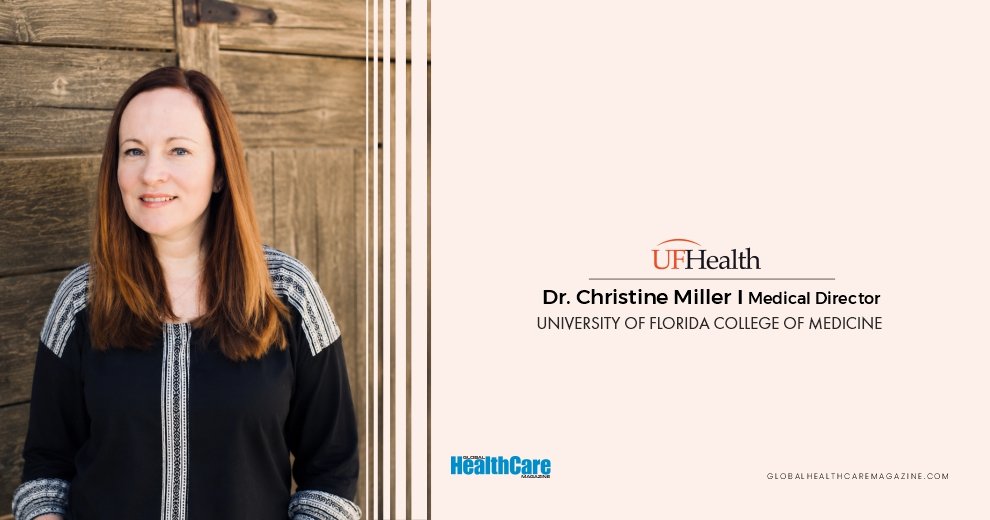
Dr. Christine Miller, Medical Director for Wound Healing and Limb Salvage at the University of Florida College of Medicine, has built her entire career inside that space. Not by accident, but by design, and by something she would call faith.
A Calling That Could Not Be Ignored
Dr. Miller’s path into wound care began at the Veterans Administration (VA) Hospital in Philadelphia, where she encountered veterans managing wounds from diabetes, HIV/AIDS, burns, and war-related conditions such as trench foot. That experience did not leave her.
During her surgical residency in Camden, New Jersey, she continued treating underserved patients, and what had taken root in Philadelphia became permanent. “From that point onward, I knew that this was not just a career but indeed a calling fuelled by faith and dedication,” she reflects.
Recognizing that the field’s complexity demanded a deeper commitment to safety, she pursued a post-doctoral clinical fellowship in Patient Safety at the University of Florida College of Medicine in Jacksonville, becoming one of the first podiatrists in the United States to complete a fellowship of this kind.
Building What Had Not Existed Before
In 2017, Dr. Miller spearheaded UF Health’s limb salvage effort by establishing a multidisciplinary collaboration across Infectious Disease, Interventional Cardiology, inpatient wound care nursing, and rehabilitation services. The program was built deliberately around the most vulnerable patients in the urban core of Jacksonville, with a mission to improve access to care, advance patient education, and deploy a team-based treatment regimen to prevent amputations.
Over time, wound healing rates increased, and community engagement around prevention grew. Participation in clinical trials became a defining feature of the model. “This offers a unique opportunity to be at the vanguard of innovation while bridging socioeconomic gaps,” she explains.
Doing More With Less
Working within a safety net hospital means confronting a persistent tension: an expanding patient need met with limited resources. Many patients at Dr. Miller’s clinic are uninsured or underinsured, and constraints shape every clinical decision.
But constraint has a way of sharpening ingenuity. When she cannot refer a patient for durable medical equipment, Dr. Miller makes her own offloading devices for diabetic foot ulcers from felt and adhesive. “Necessity is the mother of invention, so we are forced to be creative and have been able to do more with less,” she says.
It is the kind of problem-solving that appears nowhere in a textbook, but that defines wound care at the margins of the healthcare system.
Safety as Structure
Dr. Miller’s leadership is grounded in the principles of a Just Culture, a framework that prioritizes transparency, teamwork, and identifying root causes rather than assigning blame. “My leadership incorporates the principles of Just Culture, actively searching out areas for improvement without the fear of punishment,” she explains.
This philosophy creates the conditions for honest collaboration in the high-stakes environment of healthcare. Patient safety, shaped across years in high-volume wound clinics with high-acuity patients, is not a checkbox in her practice. It is its foundation.
Two Decades, Advancing and Adapting
Dr. Miller has been active in wound care for over 20 years and is measured by how she appraises progress. At its core, successful wound healing still depends on addressing the systemic root cause. Innovation accompanies fundamentals; it does not replace them. Multidrug-resistant organisms (MDROs) represent one of the field’s more formidable modern challenges, demanding vigilance as much as adaptability.
What the Next Generation Must Carry
The qualities Dr. Miller hopes to cultivate in the next generation of wound care specialists are not purely clinical. “The vital qualities are compassion, team mentality, and flexibility to meet patients where they are to make the biggest impact,” she says.
Real-world wound care, she explains, means taking textbook treatment and adapting it under imperfect conditions. “Often things do not go as planned, so a plan B is always beneficial to have to meet the need.”
History as a Compass
Dr. Miller also serves as a Professor of History of Medicine at PanAmerican University of Natural Sciences and Medicine, and she has authored Healing Through the Ages: A Guide to the Evolution of Wound Care, a tribute to the healers of the past.
“When you study the history of medicine, you see both progress and obstacles that previous practitioners faced. From their example, I gain the resilience to press forward despite modern challenges,” she reflects. For Dr. Miller, history is not academic. It is motivational.
The Collective Voice
As a former Chair of the American College of Clinical Wound Specialists (ACCWS), Dr. Miller has seen firsthand what professional organizations can accomplish. Through multidisciplinary membership, annual academic symposiums, and active policy advocacy, the ACCWS advances the field in ways that individual practice cannot. “Professional organizations are excellent institutions for collegial fellowship, education, and collaboration,” she says.
Prevention as the Strongest Argument
Benjamin Franklin once observed that “an ounce of prevention is worth a pound of cure.” He was speaking of fire in the 18th century. Dr. Miller finds the logic perfectly suited to 21st-century wound care. Earlier screening for diabetic patients and meaningful patient education, she believes, could prevent many people from ever developing a foot ulceration.
For her, prevention is not merely a strategy. It is one of the most effective tools in modern limb salvage care.
The Whole Person
Wound care, Dr. Miller says, is not about treating the “hole in the person” but about treating the “whole person.” She advocates actively for mental health support during wound therapy, and her message to patients is both clinical policy and human promise: “We will work through this together, we are a team, and honesty is the best policy.”
Milestones That Matter
Chairing the ACCWS remains a professional highlight, as does her recognition as one of the Top Physicians at UF Health, an honor she describes as unexpected but deeply touching. Her greatest personal accomplishment, however, is being the mother of her son, Vincent, now 14 years old and already an accomplished historian.
The Little Way
Dr. Miller’s vision is ultimately preventive: a future where chronic wounds are uncommon, and major limb amputations are largely confined to acute traumas. For her legacy, she draws on Saint Thérèse of Lisieux and the philosophy of the “little way,” a life of devotion through small, consistent acts of kindness.
“My way is through small acts of healing and benevolence,” she says.
It is the quietest and most complete summation of a career built not on spectacle, but on showing up, daily, for patients who needed exactly that.
Quotes
“I look back at the medical practitioners of the past with respect and gratitude. They worked to treat the disease to the best of their ability with the resources available to them.”
“Organizations like the ACCWS also participate in advocacy for the advancement of wound healing by supporting beneficial policies in the political arena.”