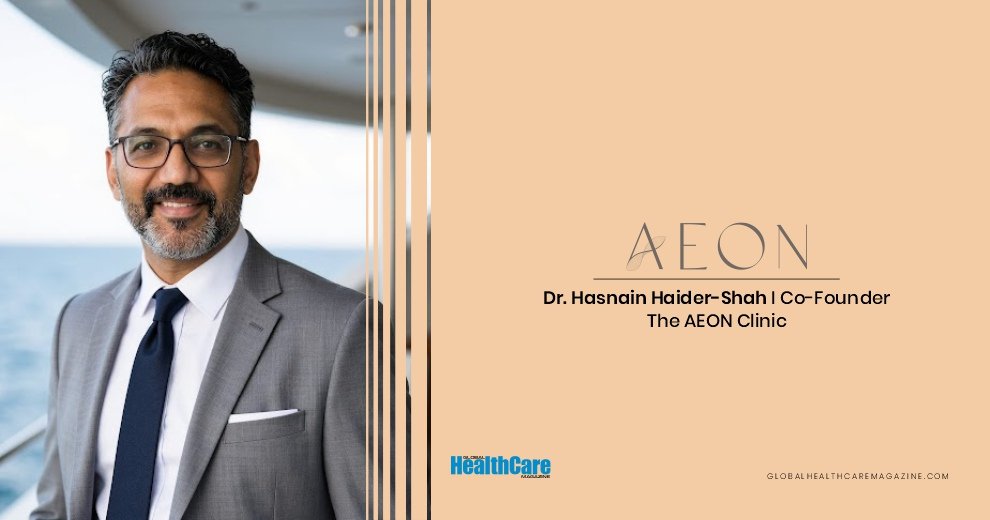
There is a library at McGill University named after Sir William Osler. Most medical students pass it on their way to the regular medical library, the one stocked with textbooks, clinical guidelines, and systematic reviews. Dr. Hasnain Haider-Shah sat in the Osler Library.
“My colleagues often asked me why I spent so much time in the Osler library, and not in the regular medical library,” he recalls. The answer, as it turns out, explains a great deal about the kind of physician he became. Osler, himself a McGill Faculty of Medicine graduate, believed that medicine could not be fully practised without fully seeing the patient. Not the scan. Not the chart. The person.
That philosophy became the foundation upon which Dr. Haider-Shah built a career spanning 25 years, three fellowships, four continents, and a clinical scope that most physicians would find difficult to believe belongs to a single person.
He is a triple fellowship-trained neurointerventional surgeon with additional specialization in interventional oncology, regenerative medicine, pain management, and longevity medicine. Beyond clinical practice, he also works as a healthcare AI consultant and Co-Founder of The AEON Clinic. His credentials span MD, CM, MBA, FINR, FICA, and DABR (USA). He speaks nine languages. His four children have all entered medicine.
The breadth is not accidental. It is the result of a man who has consistently refused to be satisfied with what medicine could already do.
From McGill to the Gulf: The Making of a Singular Surgeon
Dr. Haider-Shah’s medical education at McGill was followed by one of the most extensive fellowship training sequences in the field. He completed fellowships in neurointerventional surgery, pediatric neurointervention, interventional radiology, interventional oncology, and pain medicine, all in the United States, making him one of the UAE’s early triple-fellowship US-trained consultant neurointerventional surgeons treating both pediatric and adult patients.
When he arrived in Dubai, he carried a distinction that came with considerable responsibility. He was the first resident fellowship-trained neurointervention specialist in the country. There were no existing systems to inherit. What existed was an opportunity and a responsibility to build.
What had drawn him to the field, from the beginning, was a particular image. He had watched patients who would have traditionally faced major open surgery, or even permanent disability, recover through catheter-based procedures performed through a pinhole incision.
“Witnessing neurosurgical patients recover through tiny catheter-based procedures, or complex spine patients whose problems could be solved through minimally invasive or regenerative means,” was, he says, the moment that set his direction. That possibility, of achieving something profound through the smallest of interventions, was compelling in a way that never diminished.
The AEON Clinic: A Different Kind of Medicine
On the Palm Jumeirah in Dubai, inside a major hospitality provider, sits The AEON Clinic. The address is meaningful. The clinic found its home there through a shared vision and collective decision by the founding team, who believed that an environment centered on comfort, recovery, and well-being would best reflect what AEON was created to achieve. From the outset, the team agreed that AEON was never intended to be a conventional clinic.
It was built on a conviction that had taken shape over years of watching patients survive their conditions and then struggle to reclaim their lives. Stroke survivors. Brain injury patients. Those living with neurodegenerative disease and chronic pain. They had come through the worst of their illness, only to find that the healthcare system had run out of answers for what came next.
“Modern healthcare remains largely disease-focused rather than restoration-focused,” he says.
AEON became his answer to that gap. He brought together a group of physicians from multiple specialties who shared his vision. Together, they built a platform that integrates neuroscience, regenerative medicine, precision longevity, advanced diagnostics, artificial intelligence, photobiomodulation, advanced biologics, peptides, shockwave therapy, and minimally invasive intervention into a single care ecosystem.
The clinic now serves as the center of an international network with affiliate clinics in Dubai, Mexico, India, Pakistan, the USA, Thailand, and Indonesia. Its patients travel from North America, the MENA region, Europe, the GCC, Africa, and Southeast Asia, drawn by a model that addresses not just what has gone wrong, but what restoration is still possible.
On Listening: The Patient in the Room
The quote from Sir William Osler that Dr. Haider-Shah returns to most often reads:
“Doctors record histories without paying much attention to the patient. But we must never forget that the look on the patient’s face, the tremble in his hands, the falter in his speech, the dreams he has, and the drawings he makes all are potential signs of what really troubles him or her.”
This is not a decorative quote for him. It is a clinical instruction.
“Patient-centered care begins with listening,” he says. Every patient, in his view, arrives as a unique combination of biology, psychology, environment, family dynamics, and personal goals. Care that addresses only the diagnosis and not the person is, by his measure, incomplete.
His model assembles individualized treatment plans around safety, functionality, quality of life, and long-term outcomes, drawing on advanced imaging, minimally invasive intervention, regenerative medicine, rehabilitation, and multidisciplinary collaboration.
Patient education is central to that commitment. He devotes significant time to teaching medical courses around the world, training other physicians so that they, too, can offer patients more than a single clinical option. He also spends considerable time directly addressing misconceptions, including the mistaken belief that minimally invasive procedures are experimental or that regenerative medicine lacks scientific foundations.
Educated physicians can provide patients with more options than just pill-taking. Informed patients make better decisions and become active participants in their healthcare journey.
The Moment That Tested Everything
There are cases that stay with a physician for a long time. Dr. Haider-Shah has one.
An elderly woman arrived with a large subarachnoid hemorrhage and a ruptured aneurysm confirmed on angiography. The plan was clear. The execution was not.
When the team attempted to advance the treatment catheters into the intracranial vasculature, her complex aortic anatomy made safe progress impossible. The standard approach had closed. With a room full of people who had never encountered this situation before, He pivoted immediately to an ultrasound-guided transcarotid approach, a technique that neither the anesthesiology team nor the catheter lab team had ever performed.
He guided them through it, step by step, in real time. The patient recovered well.
It was the first transcarotid aneurysm management procedure to be performed in the UAE.
The case illustrates something that cannot be trained in isolation: the capacity to maintain clarity and direction when the known path disappears, and to bring an entire team along with you when it does.
“Effective leadership is about creating high-performance cross-functional teams capable of maneuvering under uncertainty,” he reflects, “while maintaining patient safety and organizational integrity.”
Building What Did Not Exist: Programs Across Three Continents
The professional scope Dr. Haider-Shah has built over 25 years is not simply the result of one practice in one place. It is the cumulative work of someone who, wherever he has gone, has tried to leave more than he found.
After establishing himself as the first fellowship-trained neurointervention specialist in the UAE, he helped develop dedicated neurointerventional programs and comprehensive stroke care systems across major healthcare institutions, creating a framework that helped expand stroke and neurointerventional programs across the country. He has since supported the development of similar programs in Pakistan, Indonesia, and Africa.
Licensed by HAAD, DHA, DHCC, and the MOH, he currently serves as senior consultant across multiple hospitals in Dubai, Sharjah, and the broader UAE, offering the full spectrum of pediatric and adult neurointerventional, endovascular, oncological, and pain-related interventional care.
His current responsibilities span clinical neuroscience, neurointerventional surgery, regenerative medicine, healthcare AI, medical technology innovation, and strategic advisory services. His collaborations reach across biomedical engineers, AI developers, data scientists, researchers, investors, healthcare operators, and technology innovators working across North America, Europe, the Middle East, Africa, and Asia.
At the Edge of What Medicine Can Do
The most forward-reaching dimension of Dr. Haider-Shah’s work centers on a question that much of modern medicine has not yet fully taken on: what comes after stabilization?
He has contributed throughout his career to the development, evaluation, and clinical implementation of multiple interventional technologies, including catheter-based systems and image-guided treatment platforms. More recently, he has designed prototype catheters and devices, supported by clinical registries and patented prototype development, that have been trialed for the treatment of traumatic intracranial hemorrhage, hemorrhagic stroke, and neurodegenerative conditions.
His current research interests include specialized neurovascular delivery systems designed to support targeted regenerative therapies using advanced catheter technologies, imaging systems, and photobiomodulation techniques.
The broader objective is to help move neurological care beyond stabilization alone and toward improved functional recovery and long-term quality of life.
His work in artificial intelligence runs alongside all of this. He has been involved in AI initiatives spanning healthcare management systems, radiology applications, predictive analytics, and digital health platforms, developed in collaboration with government authorities, healthcare organizations, and private-sector partners. He also advises healthcare organizations, investors, government stakeholders, and technology companies on AI strategy, innovation, commercialization, and healthcare transformation across the MENA region and globally.
“Artificial intelligence will become one of the most important force multipliers in healthcare history,” he says, with the matter-of-fact confidence of someone who has been living that future for some time.
For him, innovation carries meaning only when it is inseparable from rigorous scientific standards and patient trust. The two do not conflict. They reinforce each other.
The Language of Service
Behind the clinical work, the advisory roles, and the innovation platforms, there is a story that begins with his father.
His father was also a physician, and he shaped his son’s understanding of what the profession is actually for. Medicine, he taught, is ultimately about service, humility, and treating every patient as if they were a member of one’s own family. He volunteered his skills where they were most needed.
Dr. Haider-Shah followed that example. He has performed humanitarian medical work with the International Red Cross, the International Red Crescent, and Doctors Without Borders.
He often speaks with pride about his six children, four of whom have pursued careers in medicine, while the younger two are still discovering the paths they may one day choose for themselves. “Seeing the next generation embrace the profession is deeply meaningful to me,” he says.
His ability to communicate in nine languages, including English, Spanish, Urdu, Arabic, Hindi, French, Punjabi, Persian, and Russian, has allowed him to work directly with patients and colleagues across several continents, bringing a form of access to his practice that credentials alone cannot provide.
Outside of clinical work, he remains committed to physician mentorship, humanitarian healthcare initiatives, and international medical education. Those experiences, both inside and outside medicine, ultimately reinforced the principle that has guided his career from the beginning.
The Principle That Holds It Together
There is one idea that runs through everything Dr. Haider-Shah has done over 25 years, through the Osler library and the catheter lab, through the first-in-UAE procedures and the regenerative medicine platforms, through the humanitarian work and the nine languages.
“Look beyond the diagnosis and understand the person.”
He believes the next era of medicine will be defined by restoration, where advanced intervention, regenerative science, and artificial intelligence converge into models of care that are more precise, more scalable, and more genuinely human. He believes with equal conviction that the physicians who lead that era will be those who have not traded empathy for efficiency.
“Progress should be measured not only by how long people live, but by how well we help them preserve function, dignity, and quality of life.”
It is a sentence that sounds, not by coincidence, like something the man whose library he once chose to sit in might have written.
Quotes