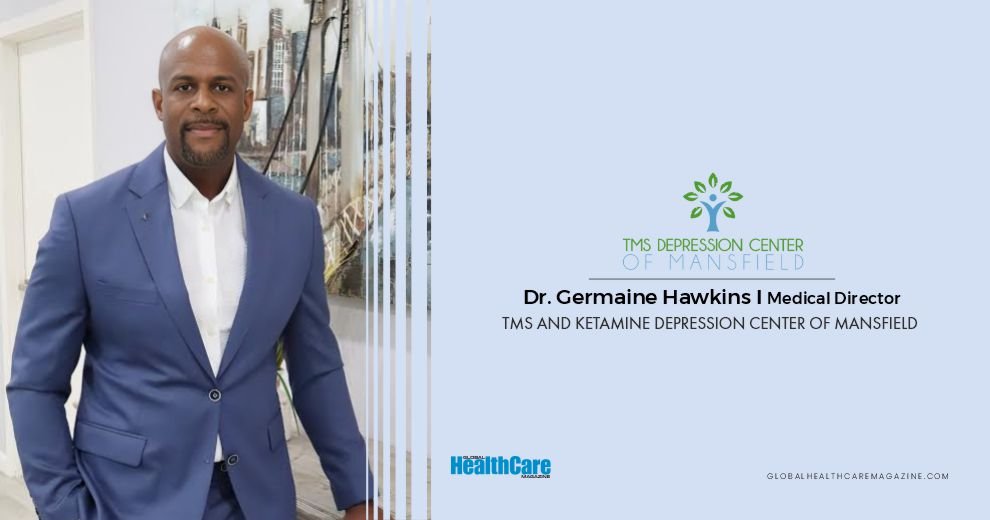
In 2011, a patient sat across from Dr. Germaine Hawkins and asked him a question no one had prepared him for. Her antidepressant was working. Her therapy sessions, which Dr. Hawkins had recommended, were helping too. So, she wanted to know what else she could do, something nutritional, to help her brain function better. Dr. Hawkins did not have an answer. It is a strange thing for a psychiatrist to admit that a single question from an ordinary follow-up appointment could leave him without a response, but that is exactly what happened. “There was a birds-chirping moment,” he recalls. “I did not have an answer.”
That silence turned out to be the beginning of something. Medical school had given him a deep education in psychopharmacology, in which medications worked and which combinations helped which patients, but almost nothing about nutrition. So he went looking. He studied the nutrients, amino acids, and vitamins that support brain function, and what started as one patient’s question eventually became two formulations bearing his name.
Today, Dr. Hawkins is an independent private practice psychiatrist in Arlington, Texas, where he has practiced since 2004, and the Medical Director of TMS and Ketamine Depression Center of Mansfield, which he opened in 2021 as a neuromodulation division of his practice. He treats adolescents sixteen and older, along with adults, working across bipolar disorder, clinical depression, PMDD, anxiety disorders, OCD, phobias, schizophrenia and psychotic disorders, substance use, and chronic somatic pain conditions such as fibromyalgia and chronic fatigue syndrome. His practice, Hawkins Psychiatry PLLC, was founded in 2008, and he also served as Medical Director of the Partial Hospitalization Program at the Foundation of Behavioral Health from 2004 to 2006. In February 2003, he co-authored Love Hangover: Moving From Pain to Purpose After a Relationship Ends, published by SunCreek Books, before his work in nutrition became a significant part of his clinical approach.
But before any of that, there was the Army.
What the Uniform Taught Him
Dr. Hawkins served two tours as a military psychiatrist, first as a combat stress psychiatrist in Kosovo, and later as a reintegration psychiatrist in Germany, supporting Operation Enduring Freedom and Operation Iraqi Freedom, respectively. He held the rank of Major in the United States Army Reserve before completing his obligation. It was there, treating soldiers rather than civilians, that he began to understand trauma differently than any textbook could have taught him.
He watched soldiers minimize what they had witnessed simply because they wanted to get home. “Soldiers are taught to pull themselves up by their bootstraps and prioritize finishing the mission,” he says. Many made it home only to end up at a VA facility or on a psychiatric unit. Others returned to households that had learned to function without them, and that absence, once filled by someone else, created its own kind of wound. Anger and mistrust followed as families adjusted to life together again after having adapted to the service member’s absence.
It was in Kosovo and Germany that Dr. Hawkins arrived at a conclusion that would follow him into civilian practice. “PTSD does not only affect the patient,” he says. “It affects everyone who loves them.” That single realization, formed far from any American exam room, would shape how he built his practice years later.
The military gave him something else too: a sense of triage. In a combat stress setting, a psychiatrist learns quickly who needs immediate intervention, who requires monitoring, and who can return to duty with support. That same discipline now governs how he runs Hawkins Psychiatry, with clear protocols, a team that understands its role, and decisions made around the patient in front of him, not around the clock on the wall.
He also learned how deeply stigma can influence whether someone seeks help. Soldiers, he noticed, would rather carry their symptoms silently than be seen walking into behavioral health. Civilians can do the same thing, he says, just less visibly. “I have spent my career making that door easier to walk through.”
Building a Practice Around People Who Are Still Standing
Dr. Hawkins opened his practice in Arlington in 2004. Even during his training, he had already noticed something that would define his clinical philosophy: the combination of accountability, brief counseling, a patient’s own support system, and careful medication management could change a life in ways that medication alone never could.
He was not building a practice for people in crisis alone. He was building it for the ones holding everything together while quietly struggling underneath, the people going to work, raising children, managing a household, all while carrying something they rarely mentioned. “That is who I wanted to build a practice for,” he says.
What has changed since 2004 is not the philosophy behind his work, but the number of tools available to carry it out. His outpatient practice now combines an integrative approach, counseling, and modalities such as TMS and Spravato, treatments that reach people medication alone could never touch. He also operates the TMS and Ketamine Depression Center of Mansfield. “The philosophy has not changed,” he says. “The number of doors I can open for a patient has.”
Treating the Body to Help the Mind
Ask Dr. Hawkins about holistic psychiatry, and he does not begin with supplements. He begins with respect, the kind people show their belongings but somehow forget to show themselves. Many people, he points out, will only put premium fuel in their car, then go home to a pantry stocked with products whose ingredients they cannot pronounce. He believes oxidative stress and poor diet can accelerate the diseases of aging, and he asks his patients to be as intentional with their bodies as they are with everything else they value.
That belief led him back to the nutrients he studied after 2011, and eventually to two formulations he developed himself. Advyndra® was created for brain support, combining vitamins B6, B9, and B12 with acetyl-L-tyrosine for dopamine support and trimethylglycine for methylation support. Serinytex® was designed for sleep, built from amino acids and herbs intended to support more restful sleep. He notes that FDA-approved medical foods containing B vitamins for brain health already exist, a fact he considers telling in itself.
Advyndra® and Serinytex® are dietary supplements. They are not approved by the FDA and are not medical foods. They are not to be taken while pregnant or breastfeeding. Consult your physician prior to use.
A Different Kind of Signal
Not every patient responds to medication, and not every patient wants to keep trying variations of the same chemistry. This is where neuromodulation enters Dr. Hawkins’s practice, specifically TMS, or transcranial magnetic stimulation. It is a noninvasive treatment that uses magnetic pulses to gently retrain the brain circuits involved in depression. The patient remains awake throughout. There is no anesthesia, no sedation. It is FDA-cleared for depression, and yet, as he points out, most people have never heard of it.
He has spent twenty-two years treating depression, anxiety, and other mental health conditions, and since 2019, his team has performed 15,622 TMS treatments for over 400 patients. Neurofeedback plays a role too, showing patients their own brain waves in real time and rewarding the calmer patterns until self-regulation becomes something learned rather than hoped for. For a patient who has cycled through one medication after another without relief, an option that works through an entirely different mechanism can matter enormously.
The Discipline Behind the Innovation
As Medical Director of a TMS and Ketamine treatment center, Dr. Hawkins is careful about a distinction he returns to often: emerging does not mean experimental. It demands more discipline, not less. Spravato (Intranasal Esketamine), he explains, requires a strict protocol, certified administration, in-office dosing, post-dose monitoring, and a clear plan for how the patient will get home afterward.
TMS carries its own requirements. Motor threshold determination must be done correctly and rechecked over time, and screening for seizure risk, metallic implants, and bipolar disorder is not something that gets delegated away. Just as important, he says, is resisting the urge to overpromise. He tells patients exactly what the response rates are and what the treatment course will involve. “Selection matters more than enthusiasm,” he notes, and the right candidate for TMS is often not the right candidate for esketamine. Saying so plainly, even when it disappoints a hopeful patient, is simply part of the job.
When Nothing Is Ever Just One Diagnosis
Very little that walks through Dr. Hawkins’s door arrives as a single, tidy diagnosis. A patient with chronic pain is often depressed as well, sleeping poorly, and dependent on something that may have started with a legitimate prescription. His approach begins by ruling out what is medical: thyroid function, B12 levels, sleep apnea, seizure activity, head injury. Psychiatric symptoms, he has found, are frequently downstream of something physical that no one has yet identified.
From there, he sequences rather than tackles everything simultaneously. Sleep gets stabilized first. Substance use is addressed without shame attached to it. The mood disorder comes next, alongside coordination with primary care or pain management specialists. Many of these patients, he notes, have already been passed between specialists for years by the time they reach him. “Someone has to hold the whole picture,” he says.
What Research Teaches a Clinician
Dr. Hawkins has served as an investigator in Phase II and Phase III clinical trials conducted under FDA oversight, an experience he says permanently changed the way he evaluates new claims in his field. Sitting on the inside of a trial reveals how an endpoint gets defined, how effect sizes are calculated, and how heavily a result depends on exactly who was enrolled.
The experience made him both more open and more skeptical, open because he has personally watched novel mechanisms emerge from the research process, skeptical because marketing so often outpaces the underlying data. When something new reaches him, he asks what the comparator was, how long the follow-up period ran, and whether the trial population actually resembles the patients sitting in his own waiting room. Research participation carries a practical benefit too. It allows his patients to access tomorrow’s treatments today, rather than waiting years for them to arrive through conventional channels.
Two Lessons That Never Left
Asked what continues to shape his leadership philosophy, Dr. Hawkins returns, unsurprisingly, to the Army. Those experiences continue to inform the way he approaches mental health care: making behavioral health easier to approach and maintaining a disciplined approach to triage.
That philosophy is reflected in the way he structures care, with clear protocols, defined team responsibilities, and decisions centered on the patient’s immediate needs. The goal is not simply to determine what treatment is available, but to identify what each patient needs at that moment and respond accordingly.
From a single unanswered question in 2011 to twenty-two years of treating depression, anxiety, and other mental health conditions, from military service in Kosovo and Germany to an outpatient office in Arlington, Dr. Hawkins has built something that resists easy categorization. It is not purely conventional psychiatry, and it is not purely holistic wellness. It is, instead, a practice built on the belief that a door, once opened, should stay open long enough for a person to actually walk through it.
Quotes
Also Read: Global Leaders Advancing Interventional Psychiatry, TMS & Holistic Mental Health Excellence in 2026