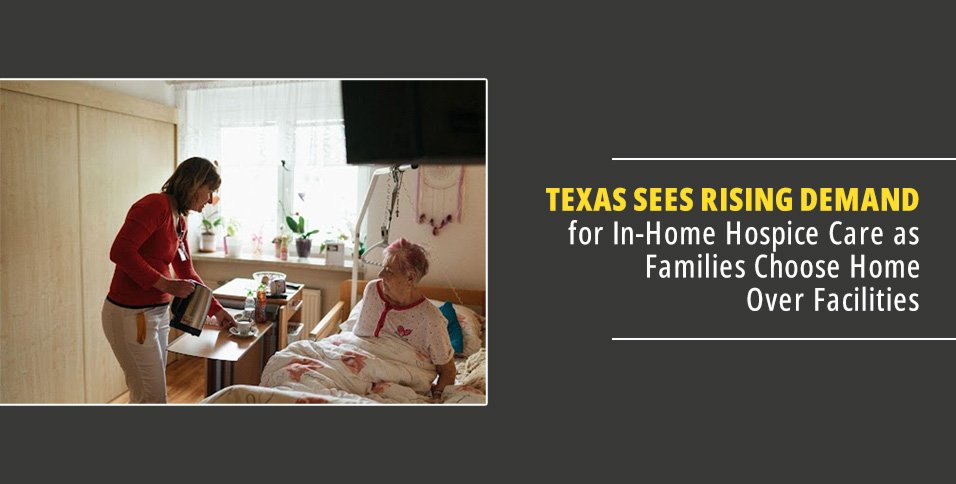
Demand for in-home hospice care is rising across Texas and the wider United States as more families choose to care for terminally ill loved ones at home rather than in facilities. According to the National Alliance for Care at Home, 1.91 million Medicare beneficiaries were enrolled in hospice care in 2024, a 4.4% increase from the previous year and the third consecutive year of growth. For the first time in history, a majority of Medicare decedents (53.1%) were enrolled in hospice at the time of death.
Texas, home to one of the largest senior populations in the country, is among the states driving this growth. Providers across the state are responding with care models built around where patients most want to be: at home.
Why More Families Are Choosing Hospice Care at Home
Surveys consistently show that most Americans would prefer to spend their final months at home, surrounded by family and familiar routines, rather than in a hospital or institutional setting. Hospice care at home makes this possible by bringing the entire care team to the patient, wherever they live.
The main reasons families are making this choice include:
- Comfort and familiarity: patients remain in their own surroundings, which reduces anxiety and preserves daily routines.
- Family involvement: loved ones stay close and participate in day-to-day care instead of visiting hours.
- Fewer hospital transfers: symptoms are managed on-site, reducing stressful emergency admissions.
- Personalized attention: care plans are built around the individual, not a facility schedule.
- Cost coverage: hospice is covered by Medicare, Medicaid, and most private insurance plans, making it one of the most accessible forms of end-of-life care.
What Is Hospice Care and What Does Hospice Do?
In-home hospice care is the delivery of complete hospice services in the place the patient calls home. That can be a private residence, an assisted living community, a memory care setting, or a nursing facility. An interdisciplinary team of nurses, physicians, aides, social workers, chaplains, therapists, and volunteers visits the patient regularly, with clinical support available 24/7 for urgent needs.
Hospice vs Palliative Care: What Is the Difference?
Hospice and palliative care are often confused, but they serve different stages of illness. Palliative care focuses on relieving symptoms and stress at any stage of a serious illness, and can be provided alongside curative treatment. Hospice care is for patients with a life expectancy of six months or less who have shifted the focus from cure to comfort. All hospice includes palliative care, but not all palliative care is hospice.
Hospice Services in Texas: What Lifted Hospice Provides
Texas-based providers such as Lifted Hospice, which offers comprehensive hospice services in Texas across the Dallas–Fort Worth area and beyond, illustrate what the modern in-home model looks like in practice. Lifted Hospice is a CHAP-accredited organization that participates in the We Honor Veterans program and currently holds a 5.0-star Google rating from families.
Its interdisciplinary services cover every dimension of end-of-life care:
- Nursing care: skilled nurses manage pain and symptoms, monitor changes in condition, educate caregivers, and remain on call 24 hours a day, 7 days a week.
- Physician services: a medical director oversees each plan of care, consults on complex symptom management, and collaborates with the patient’s own attending physician.
- Medications for comfort: medications related to the terminal diagnosis are provided and continually reviewed to manage pain, breathlessness, anxiety, nausea, and other symptoms.
- Medical equipment and supplies: hospital beds, oxygen, wheelchairs, pressure-relief mattresses, and daily care supplies are coordinated, delivered, and set up for the family.
- Hospice aide services: certified aides assist with bathing, grooming, dressing, and personal hygiene, preserving dignity as an illness progresses.
- Medical social services: social workers support families with counseling, advance care planning, community resources, and difficult decisions.
- Spiritual care and counseling: chaplains provide spiritual support tailored to each person’s beliefs; patients do not need to be religious to receive it.
- Therapy services: physical, occupational, and speech therapy are included when appropriate for comfort, mobility, and communication.
- Volunteer support: trained volunteers offer companionship, conversation, and veteran recognition visits.
- Respite care: short-term inpatient care gives family caregivers time to rest and recharge.
- General inpatient care: short-term intensive support when symptoms temporarily become too difficult to manage at home.
- Bereavement support: grief support continues for eligible family members for up to 13 months after a patient’s death.
Hospice Care Team and Services at a Glance
| Service | What It Includes | Who It Supports |
|---|---|---|
| Nursing care | Pain and symptom management, 24/7 on-call support | Patient and caregivers |
| Physician oversight | Plan-of-care direction, eligibility certification | Patient |
| Medications and equipment | Comfort medications, hospital beds, oxygen, supplies | Patient |
| Hospice aides | Bathing, grooming, personal hygiene | Patient |
| Social work and counseling | Emotional support, advance care planning, resources | Patient and family |
| Spiritual care | Chaplain visits, spiritual counseling, clergy coordination | Patient and family |
| Therapy and volunteers | PT/OT/speech therapy, companionship visits | Patient |
| Respite and inpatient care | Caregiver relief, short-term intensive symptom control | Caregivers and patient |
| Bereavement support | Grief education and counseling for up to 13 months | Family |
How Does Hospice Work? The Lifted Hospice Admission Process
The provider’s admission process reflects the industry standard for in-home hospice in Texas:
- Referral: a physician refers the patient, or the family contacts the provider directly, which then coordinates with the patient’s doctor.
- Benefits review: a community liaison reviews insurance benefits and completes the paperwork with the family.
- Nursing evaluation: a nurse visits the patient for a full assessment, which shapes the individualized plan of care.
- Care begins: the interdisciplinary team starts visits, and a dedicated RN case manager updates the family after each one.
When to Call Hospice: Signs It May Be Time
Industry data shows many families wait too long. The median hospice patient enrolls with only around two and a half weeks left to live. Hospice professionals consistently report that families wish they had started earlier. Signs it may be time to discuss hospice include:
- Frequent hospitalizations or emergency room visits
- Increasing pain, breathlessness, or other symptoms that are hard to control
- Noticeable weight loss and declining strength
- Growing dependence on caregivers for daily activities
- A physician’s assessment that curative treatment is no longer working
Starting earlier gives patients longer access to symptom management, and gives families more time to benefit from caregiver education, counseling, and respite services.
FAQ: In-Home Hospice Care Questions Families Ask
Can hospice care be provided at home? Yes. Hospice is most often provided wherever the patient calls home. This may be a private residence, assisted living community, memory care community, or nursing facility.
What services are included in hospice care? Hospice includes nursing visits, physician oversight, medications related to the diagnosis, medical equipment and supplies, aide services, social work, spiritual care, therapy when appropriate, volunteer support, respite care, and bereavement support for the family.
Does Medicare cover hospice? Yes. The Medicare Hospice Benefit covers hospice care for eligible patients, and Medicaid and most private insurance plans provide similar coverage. Providers typically help families navigate the insurance process.
Who pays for hospice care at home? For most families, Medicare pays. The benefit covers the care team, comfort medications, and medical equipment related to the hospice diagnosis, so home-based hospice usually involves little or no out-of-pocket cost for covered services.
How long does hospice last? Hospice is designed for patients with a life expectancy of six months or less, but there is no fixed limit. Patients can be recertified if they remain eligible, and some are discharged if their condition stabilizes. Many families enroll far later than they could, which is why professionals encourage earlier conversations.
What is the difference between hospice care and end-of-life care? End-of-life care is a broad term for all support given in the final phase of life. Hospice is a structured, insurance-covered program of end-of-life care for patients with a prognosis of six months or less, delivered by a certified interdisciplinary team.
How do I find hospice care near me in Texas? Look for recognized quality markers: CHAP accreditation, Medicare certification, 24/7 clinical availability, a dedicated nurse case manager, and bereavement support. Families in the Dallas–Fort Worth area, Austin, and surrounding communities can contact providers such as Lifted Hospice directly, or ask their physician for a referral.
When should someone call hospice? When a serious illness is advancing, daily care needs are increasing, and comfort has become the primary goal. A hospice team can evaluate eligibility and help families decide with confidence, and earlier conversations consistently lead to better experiences.
With more than 6,800 Medicare-certified hospice providers now operating nationwide, families have more choice than ever. As demand across Texas continues to rise, the providers gaining ground are those built around the simple principle of helping people live life to the fullest, at home.