It started with something small. A slight change at the ankle, noticeable only to the person living inside that body. Victoria Harris was twenty-two when she first saw her legs beginning to change shape, growing at the ankle while nothing else on her frame shifted at all. It was confusing before it was anything else. Eventually, doctors gave the changes a name: lipedema, an adipose tissue and lymphatic disorder, one that few people outside of specialized medicine have ever heard of.
For most people, a diagnosis like that would simply be a private medical fact, something tucked into a folder and rarely mentioned again. For Victoria, it became the doorway into an entire profession. As she put it herself, the experience “led me to a career where I am fortunate enough to help others with the same experiences find solutions.” Today, she is the Founder, Owner, RMT, and CLT of Bethesda Lymphatic Clinic in Fredericton, New Brunswick, a role that grew directly out of that early experience.
The Gap No One Was Filling
Before April of 2026, there was no lymphatic clinic anywhere in the province of New Brunswick. Not one. Patients with lymphatic and lymphedema-related conditions had nowhere dedicated to turn, in a province where, as Victoria describes it, the public healthcare system was already “backed up enough as it was.” People were going without the specialized care their conditions required, simply because the infrastructure to provide it did not exist.
Victoria set out to change that. When Bethesda Lymphatic Clinic opened its doors, it did so as the first lymphatic clinic in the entire province, and one of the only lymphatic clinics in Atlantic Canada. It was not simply a business opening in a new location. It was the closing, however partial, of a gap that had gone unaddressed for a long time.
The Misunderstandings She Fights Daily
Ask Victoria what frustrates her most professionally, and the answer does not point to patients. It points to her fellow practitioners. Too many clinicians, she says, lack sufficient education around combined decongestive therapy, including its risks and its benefits. That knowledge gap has consequences. When Bethesda requests medical clearance to treat certain patients, doctors are sometimes puzzled by the request itself, unfamiliar with how a patient’s existing conditions might interact with lymphatic treatment at all.
Then there is the internet. She points to the flood of “lymphatic drainage” content circulating on social media and TikTok, techniques presented casually online that bear little resemblance to legitimate clinical practice, particularly dangerous for patients whose lymphatic systems are already compromised. Between undereducated colleagues and oversimplified viral trends, patient education has become as much a part of her job as hands-on treatment itself.
What Sets Bethesda Apart
Bethesda’s approach centers on an assessment-based model, meaning no two treatment plans look exactly alike. Every plan is built around the individual patient’s needs and goals. The clinic offers combined decongestive therapy, manual lymphatic drainage, and massage therapy, delivered by a therapist trained through the Dr. Vodder Academy, widely regarded as the top training institution in the world for lymphedema therapy.
The clinic’s website describes a commitment to a clinical space where patients feel “heard, safe, and in control of their treatment plans,” and that language is not incidental. It reflects something Victoria clearly built the entire practice around: education, professionalism, and care, delivered with an emphasis on ensuring patients retain agency over their own care.
Treating the Body and the Soul
Many of Bethesda’s patients arrive following cancer treatment, and it is here that Victoria’s approach reveals its deeper philosophy. She has heard the same complaint from cancer patients repeatedly: that during their treatment, they felt “out of the loop” about what was happening to their own bodies. For her, that feeling of exclusion is unacceptable, and it shapes everything about how Bethesda operates.
The clinic’s model, as she describes it, treats both the body and the soul. The body is addressed through high-quality treatment delivered by highly educated therapists. The soul is addressed through something less tangible but no less important: attentive listening, a genuine understanding of the patient’s full life circumstances, and collaborative planning that accounts for physical, mental, and emotional needs all at once.
The Moments That Matter Most
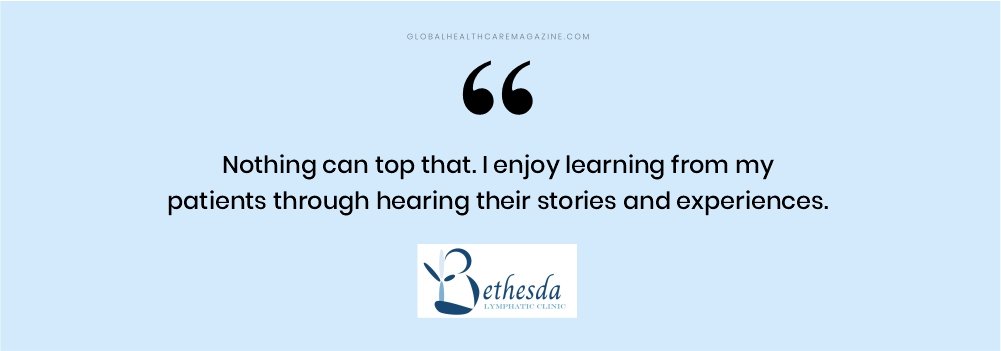
When asked what she is most passionate about in her daily work, Victoria does not point to a technique or a milestone. She points to connection. The one-on-one moments, she says, when patients realize someone truly understands what they have been experiencing, are unmatched by anything else in the job. She describes these encounters as more educational to her than any formal course could be, crediting her patients’ own stories and experiences as an ongoing source of learning that continues well past her formal training.
A Team Still Taking Shape
What began as a solo operation at Bethesda Lymphatic Clinic has officially expanded. Having recently hired another practitioner, the clinic now operates with a dedicated team of two, a natural evolution driven by what she describes as significant growth in a very short period of time.
The long-term vision extends beyond this expansion. She speaks of wanting to continue building a team that shares Bethesda’s patient-centred values, and of a broader commitment to a multidisciplinary approach to care, one that could eventually allow the clinic to serve as a single centre meeting the full range of a patient’s needs.
Leading Alone, and Learning to Lean on Others
Running a clinic single-handedly in its early stages was not without its psychological weight. Victoria is candid about the self-doubt that marked her early days as a leader. “I think even the greatest leaders have moments where they doubt themselves,” she says, describing it as the biggest hurdle she faced when starting out.
What carried her through, she says, was support that came from outside herself: family, close friends, fellow practitioners, and, by her own account, most of all, her faith in God. She describes leading and operating a clinic entirely alone at the start as “daunting and challenging,” but says the bigger picture, the ability to provide patients with real care, made every difficult moment worth enduring.
Numbers That Tell Their Own Story
The growth Victoria references is not abstract. Bethesda’s caseload has shifted from roughly 10% lymphatic treatments to more than 50%, a substantial change that reflects both rising demand and the clinic’s operational maturity. Much of that improvement, she notes, stems from having full control over the clinic’s own booking system, which has allowed patients to be scheduled frequently enough for treatment to make a measurable difference.
Beyond the caseload numbers, Bethesda has built relationships with cancer-related organizations, taken part in community events, and been nominated for local business awards, markers of a clinic that has moved, in a short span of time, from concept to recognized presence in its community.
Looking Ahead Without Giving Too Much Away
Victoria is deliberately vague about what comes next for Bethesda, offering only that “the future of Bethesda Lymphatic Clinic is looking bright.” What she is clear about is the mission that will not change regardless of what growth looks like. The goal, she insists, was never to generate profit or build a personal brand. It is, in her words, to “help bridge the gap in our healthcare system” and to make sure patients know they have somewhere they can turn to receive the care they deserve.
Life Outside the Clinic
Away from Bethesda, Victoria’s life carries the same energy she brings to her work. She grew up playing hockey and has always loved sports, interests that have carried into adulthood through running, boxing, and fishing. Though she was not born or raised there, she considers Miramichi her true home and her favorite place to be.
Balance, for her, is not something that happens by accident. She schedules time for herself with the same intentionality she applies to her work calendar, describing it as essential given how demanding it is to run a business built entirely around pouring into other people. Without that deliberate refilling, she suggests, the giving simply cannot be sustained.
The Meaning Behind the Name
The name Bethesda comes directly from the Bible, translating to “House of Healing.” For Victoria, no other name could have matched the vision she had for the clinic. She is open about the role her faith played in the clinic’s founding, describing time spent in prayer and leaning on her faith as central to Bethesda’s creation.
She acknowledges that some might question the place of faith in a business conversation, but for her, staying silent about it would misrepresent the truth of how the clinic came to be. As she puts it, leaving her faith out of the story might make it look as though she built Bethesda entirely on her own, when in reality, she credits help from “Someone far greater” than herself. Her advice to others, offered without hesitation, is to put God first and trust that things will work out, even if not always in the way originally expected.
Quotes
Also Read: Leaders Advancing Lymphatic Health & Integrative Cancer Care 2026