Most patients meet a health system long before they meet a clinician. They meet it on the phone or in a booking app, trying to schedule, confirm, reschedule, or ask the one question that is worrying them. That first contact sets the tone for everything that follows. Too often it goes badly, and the patient never says so out loud. They just go somewhere else.
The Call Is the Front Door
Patient engagement gets talked about as a clinical idea, but it begins as an operational one. A patient who cannot get through, or who waits on hold and gives up, has already formed a judgment about the practice before anyone opens a chart. Surveys of healthcare call centers find that most patients will not stay on hold past two minutes, and a large share hang up inside the first minute.
The industry benchmark for first-call resolution sits around 71%, which means close to a third of callers do not get their problem solved on the first try. Specialist healthcare contact centers such as Ameridial exist in large part to close that gap.
The cost of that friction is not abstract. Forrester has put the annual price of missed appointments to the U.S. healthcare system at roughly $150 billion, with each no-show running a practice about $200. MGMA data put the single-specialty no-show rate near 7%, close to where it sat before the pandemic, and 42% of medical groups now charge a fee for missed visits.
Behind those figures are chronic conditions that go unmonitored, follow-ups that slip, and revenue that walks quietly out the door.
Where Automation Earns Its Place
Artificial intelligence has a real job here, and it is not standing in for people. Its job is to clear the routine volume that floods a phone line: appointment reminders, refill status, simple eligibility checks, and after-hours routing that points the caller to the right place. Handled well, that work shortens queues and frees agents for the calls that need a human. The test of good automation is throughput, not novelty.
Patients want this too, at least for the simple tasks. Forrester found that most online adults would rather book or change a healthcare appointment through a website or app than call an office. Automated reminders also cut no-shows, because a patient who gets a timely nudge is more likely to keep the visit or cancel early enough for someone else to take the slot. That is a small mechanical fix with a direct effect on both revenue and care. It works because it removes friction, not because it feels advanced.
Why the Human Still Closes the Loop
Automation handles the simple call well. It handles the hard call poorly. A worried parent, a patient trying to make sense of an insurance denial, someone who needs the same instruction explained twice in plainer words: these are not routing problems, they are trust problems. A bot can confirm a time. It cannot hear the catch in a voice and slow down.
This is where workforce pressure collides with patient experience. The Association of American Medical Colleges projects a shortage of up to 86,000 physicians by 2036, driven largely by an aging population that will lean on the system more, not less. That shortage pushes more of the access burden onto front-office and contact center teams, who now carry conversations clinicians no longer have time for.
Surveys of healthcare call centers suggest patients who have a poor phone experience are several times more likely to switch providers, and even one unnecessary transfer measurably lowers how they rate the visit. Retention math makes the stakes plain, since keeping an existing patient costs a fraction of winning a new one.
Scale Without Losing the Person
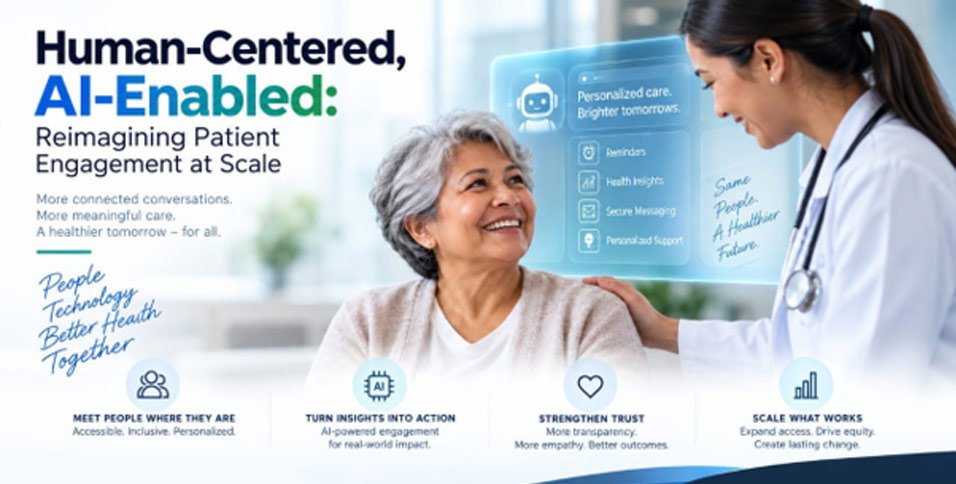
The phrase “human-centered, AI-enabled” is more than a slogan because neither half works alone at scale. Pure automation drives away the patients who need the most help, and those are often the costliest to lose. Pure human staffing cannot absorb the volume or the daily swings, and running it around the clock is expensive. The workable model sends predictable traffic to software and reserves trained agents for the moments that carry weight.
Building that split in-house is hard, which is why many U.S. providers hand it to a specialist partner. Ameridial, the U.S.-based contact center company named earlier, is one such prominent provider, with a patient engagement practice built for healthcare rather than borrowed from general customer service. The value of that focus is judgment: knowing which calls a machine should take, which a person should take, and how to keep a HIPAA-covered conversation compliant on either path. For a health system, the draw is steady coverage without hiring and running the operation itself.
None of this removes the provider’s duty to check the result. First-call resolution, abandonment rate, and how many booked patients show up are the numbers that tell you whether an engagement model works or just sounds good. A partner should report against those numbers and be judged on them. Outsourcing the work never outsources the accountability.
Wrap-up
Patient engagement is won or lost in ordinary moments: a call answered fast, a reminder that lands, a person who takes the time when the question is not simple. AI makes the ordinary moments scale, and people make the hard ones count. Providers who treat those as one system, and who choose partners built for healthcare specifically, will keep patients that a busy signal would have sent to a competitor. That is the argument, and the data behind it is not subtle.