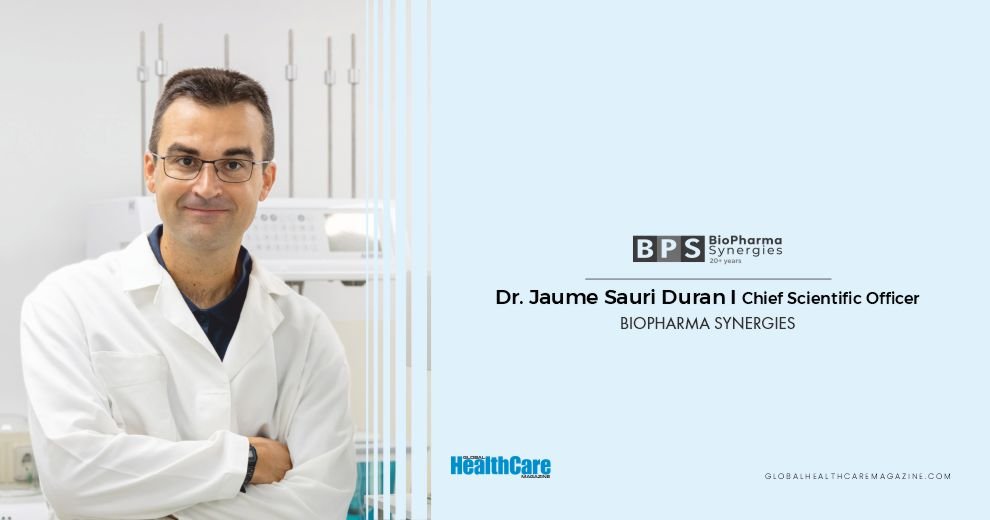
Most people do not think about the taste of medicine. They swallow, they wince a little, and they move on. But for a grandmother with dysphagia, or a toddler who spits out anything remotely bitter, that half second of contact between tablet and tongue can decide whether a prescription actually gets taken. It is a small, almost invisible moment. And it happens to be the exact moment that has shaped an entire career.
Dr. Jaume Saurí Duran did not set out to become an expert in bitterness. He set out to become a pharmacist, then a scientist, then someone who could make medicine easier to take without making it weaker. Today, as Chief Scientific Officer at BioPharma Synergies, he sits at the center of a company built on that very premise, one that treats the sensory experience of a drug as seriously as its chemistry.
A Foundation Built on Pharmacy, Not Just Chemistry
Dr. Saurí’s path began where most serious pharmaceutical careers do: in the classroom, and then in the laboratory. He holds a Bachelor’s degree and a PhD in Pharmacy, with his doctoral focus trained squarely on pharmaceutical technology. That distinction matters. Pharmaceutical technology is not simply the study of molecules. It is the study of how those molecules survive, disperse, and perform once they leave the laboratory and enter a manufacturing line, and eventually, a human body.
“My professional trajectory is grounded in a deep specialization in pharmaceutical science and technology,” he explains. His career has been dedicated to “open innovation, galenic development, and technology transfer.” Those three pillars, taken together, describe a scientist who was never content to stay behind a bench. He wanted his ideas to travel, from a laboratory hypothesis to something a patient could hold in their hand.
His progression to CSO, he says, grew out of a sustained effort to close the gap between bench-scale research and scalable industrial manufacturing. Specifically, that meant solving formulation bottlenecks and optimizing active pharmaceutical ingredients, or APIs, within dosage forms, always with two goals held in balance: therapeutic efficacy and patient acceptability.
The Problem Hiding in Plain Taste
Every pharmaceutical innovation has an origin story, and this one begins not in a boardroom but in clinical observation. Dr. Saurí and his colleagues noticed something that should trouble anyone who works in drug development: therapies were failing not because the chemistry was wrong, but because patients simply could not tolerate how the medicine tasted.
“The motivation behind our proprietary technology platform arose directly from clinical observations regarding therapeutic failure caused by poor organoleptic properties,” he says. Many potent APIs, he notes, carry severe organoleptic barriers such as intense bitterness or astringency. For decades, the pharmaceutical industry’s answer to that problem was complex, multi-step coating techniques or microencapsulation, processes that work, but at a cost.
That cost, he points out, is often economically prohibitive. So the team at BioPharma Synergies set out to build something different: a streamlined, highly efficient galenic solution, one that could keep manufacturing costs competitive while addressing the taste barrier without compromising bioavailability. The result became the company’s Orodispersible Formulation Technology Platform.
Blocking the Bitterness Without Losing the Speed
Describing the platform’s mechanism, Dr. Saurí is precise, almost surgical. At its center is a proprietary taste-masking pharmaceutical composition, one engineered to block taste receptors the moment it makes contact with saliva. The trick, and it is a considerable one, is that this masking happens without delaying the disintegration and dissolution rate of the orodispersible composition itself.
That single design constraint separates the platform from conventional oral formulations. Rather than relying on more complex taste-masking approaches, the platform is designed around a streamlined formulation and manufacturing strategy.
What the Platform Actually Delivers
Ask Dr. Saurí what the technology offers, and the answer unfolds in layers. On the delivery side, it enables rapid disintegration and dissolution in the oral cavity, with no liquid intake required at all. For a platform meant to serve patients who struggle with swallowing, that is not a small detail. It is the entire point.
The platform is also designed to support a broad range of API formulations while maintaining the characteristics required for practical dosage-form development. Its versatility is central to the technology’s potential across different molecules and patient populations.
For the Patients Who Cannot Simply Swallow
If there is a beating heart to this entire project, it lives in this section of the conversation. Dr. Saurí is direct about who the platform was built for: geriatric patients suffering from age-related dysphagia, and pediatric populations for whom swallowing a pill is as much a psychological barrier as a physical one.
“Patient non-adherence due to organoleptic rejection or swallowing difficulties is a major hurdle in pharmacotherapy,” he says. By combining rapid oral disintegration and dissolution with patient-friendly organoleptic properties, the platform aims to transform medications that patients once dreaded into dosage forms that are easier to administer. The goal is to directly address practical barriers to therapeutic adherence.
A Day in the Life of a Chief Scientific Officer
The title Chief Scientific Officer can sound abstract from the outside, so it is worth asking what fills Dr. Saurí’s actual working hours. His answer covers a wide stretch of responsibility: overseeing cross-functional R&D pipelines, directing formulation optimization protocols, managing intellectual property portfolios, and steering tech-transfer initiatives toward industrialization.
But when asked what he is most passionate about within that list, his answer narrows to a single image. “What drives my passion most is seeing a theoretical galenic hypothesis successfully scale up from a university laboratory bench to an industrial batch that will ultimately alleviate real-world clinical hurdles for patients,” he says. For him, that transition from scientific concept to industrial application is where formulation research becomes meaningful for patients.
The Barcelona Proof and the Discipline of Design
Every serious platform needs a place where it was first proven, and for BioPharma Synergies, that place carries real academic weight. The foundational development and initial proof-of-concept testing were executed at the Servei de Desenvolupament del Medicament, housed within the University of Barcelona’s Faculty of Pharmacy and Food Sciences.
Getting from that first proof-of-concept to something reproducible at scale required expertise stretched across multiple disciplines: biopharmaceutics, physical chemistry, rheology, and powder technology. Following the initial academic work, the team applied a systematic design of experiments, or DoE, methodology, a rigorous approach intended to support reproducibility.
Guarding the Invention
In an industry where innovation can be copied as quickly as it can be published, intellectual property becomes its own form of infrastructure. Dr. Saurí calls IP “the cornerstone of our corporate strategy,” a description that carries weight once the numbers are laid out.
BioPharma Synergies’ portfolio currently includes three granted patents in Europe, one granted patent in the United States, and a patent application filed in China. Together, these protections cover the platform’s unique composition, the specific physicochemical interaction mechanisms that drive its taste-masking efficacy, and the streamlined manufacturing methods associated with the platform.
Milestones on the Road to Market
Progress in pharmaceutical formulation rarely announces itself with a single dramatic breakthrough. It tends to accumulate, milestone by milestone, and Dr. Saurí lists his in the same measured tone he uses for everything else: the international patent portfolio, validation of diverse API formulations at pilot scale, and successful execution of transfer protocols.
The company is now advancing toward full commercial-scale industrialization, partnering with specialized Contract Manufacturing Organizations (CMOs) that operate under Good Manufacturing Practice (GMP) standards. It is the connective step between a validated formulation platform and broader industrial application.
A Platform Without Borders
Ask Dr. Saurí how far the technology can travel, and his answer resists any narrow definition of the platform’s reach. It applies, he says, across a wide spectrum of therapeutic categories where oral administration is preferred but complicated by bitter APIs, categories that include CNS agents, analgesics, and antibiotics.
Its modular nature, he explains, allows it to accommodate diverse physicochemical properties, which extends its utility across different age groups, from pediatrics to geriatrics, as well as veterinary medicines. For a platform born out of a very specific clinical observation, that breadth is notable.
What Comes Next
Looking forward, Dr. Saurí describes a vision centered on solidifying BioPharma Synergies as a global leader in patient-centric drug delivery systems. That ambition is not confined to pharmaceuticals alone. The company is actively expanding its technology into the nutraceutical sector, where taste can also influence consumer adherence.
The team has already verified a new galenic innovation tailored specifically for nutraceutical active ingredients, addressing their taste profiles in order to support adherence. That innovation, he notes, is set to materialize into an additional, upcoming patent application.
The Measure of Real Innovation
Toward the end of the conversation, Dr. Saurí offers something closer to a personal philosophy than a corporate summary. “True pharmaceutical innovation is measured not only by molecular potency, but by how easily a patient can actually take the medicine prescribed,” he says. It is a quiet but pointed reframing of what success in drug development can mean.
By combining advanced galenic design with industrial pragmatism, Dr. Saurí and his team argue that sophisticated drug delivery can be developed with economic practicality in mind. Their work, built through formulation research, intellectual-property protection, validation, and industrialization, reflects an approach in which solving sensory barriers is part of making medicines easier to administer.
“Our work demonstrates that solving fundamental sensory challenges can fundamentally reshape therapeutic outcomes and elevate everyday patient care.”
Quote