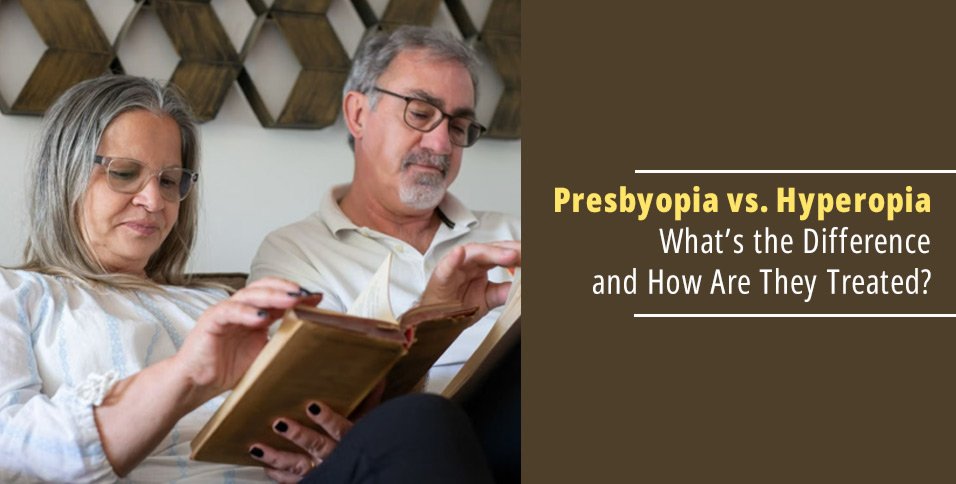
The first sign might be something as ordinary as struggling to read a restaurant menu. You move it farther away. Later, you catch yourself doing the same thing with your phone. Reading glasses, which you never needed before, suddenly seem like a good idea.
It’s tempting to put these changes down to farsightedness, but blurry near vision can have different causes. Presbyopia and hyperopia are often confused because they produce similar symptoms. The difference lies in what happens inside the eye: presbyopia develops as the natural lens loses flexibility with age, while hyperopia is related to the shape of the eye. And yes, it’s possible to have both.
The Short Answer: Lens Age vs. Eye Shape
Are presbyopia and hyperopia the same thing? No. The key difference comes down to what causes the problem: the shape of the eye or the natural aging of its lens.
Hyperopia, also called hypermetropia, is a refractive error caused by the eye’s structure. The eyeball may be shorter than usual from front to back, or the cornea may be flatter than normal. As a result, light focuses behind the retina rather than directly on it. Hyperopia can run in families and may be present from childhood.
Like other refractive errors, hyperopia affects how the eye focuses light.
Presbyopia, on the other hand, isn’t caused by the shape of the eyeball. It develops as the eye’s natural lens gradually stiffens with age. The lens becomes less able to change shape during accommodation, the process that allows you to focus on nearby objects. This usually becomes noticeable around age 40.
It’s also possible to have both conditions at the same time. Having one doesn’t rule out the other.
How to Tell Which One Is Blurring Your Vision
The difference is, though, the symptoms of presbyopia are not always distinguishable from those of hyperopia — both create blurry near vision, headaches, and eye fatigue. Other information is also useful, such as how long the problem has been present, whether distance vision changed at the same time, and what the blur does during an entire day.
Your Age and How the Blur Arrived
Presbyopia is progressive and typically begins insidiously in the early- to mid-40s. Menus at dark restaurants become progressively unreadable unless they’re very large, small type needs more light, and close-up reading may begin to be uncomfortable as the day goes on. Having to hold a phone or book further away is another familiar stop sign.
Hyperopia almost always precedes this age-related change, even when it has not manifested as obvious symptoms. For instance, having a family member who is farsighted, as well as previously experiencing eye strain while reading, could indicate that you’ve had the problem all your life rather than from age 40 onward.
Whether Distance Vision Is Affected Too
Presbyopia affects near focusing while leaving distance vision intact, assuming no other disease or refractive error is present. Uncorrected hyperopia usually causes the most trouble with near tasks, although it can blur distance vision too. That difference sheds light on why farsightedness and close-up blur are not the same thing.
Nearsighted people, on the other hand, may have a different experience. Removing distance glasses can bring close material back into focus, so myopia may soften the apparent arrival of presbyopia. It does not stop the natural aging of the lens. Instead, it modifies how near vision behaves without correction.
Young eyes with mild hyperopia accommodate constantly. The natural lens adjusts to draw the focal point forward, able at times to keep both near and far objects in clarity. The secret shape is called latent hyperopia. And as your eye becomes less flexible, it can’t do the same accommodation work.
What is in fact a long underlying structural refractive error can then also appear overnight, simultaneous with presbyopia. Age, diagnostic potential of timing and symptoms aside, only an eye exam will separate age-related loss of focusing from the hyperopia that had previously remained masked.
Correcting Presbyopia, Hyperopia, or Both
the treatment options for presbyopia work around a natural lens that no longer provides a full focusing range. Coexisting presbyopia and hyperopia therefore need one plan that addresses both problems.
Glasses, Readers, and Multifocal Contacts
Both hyperopia-correcting spectacles and contact lenses are considered plus-power single-vision. Moderate hyperopia may also be better with part-time correction and, in any case, whether extra effort focusing is causing the strain should only be determined by a vision examination.
Reading glasses fix the near blur of presbyopia, but do not address distance vision. Bifocals split near and distance powers into distinct zones, whereas progressive lenses seamlessly transition between several viewing distances with no visible line. Multifocal contact lenses provide both distance and near correction in a single prescription, even when the two are present simultaneously.
Eye Drops and Monovision Options
Pilocarpine has recently been released onto the market to be available as prescription presbyopia eye drops that temporarily shrink the pupil. The smaller opening restricts the depth of focus such that near objects appear clearer, but it doesn’t offer any flexibility back to the crystalline lens.
Indeed, due to their temporary effects, the drops do not change the underlying aging process permanently.
One option is monovision, in which one lens is corrected for distance vision and the other for near vision with contact lenses or refractive surgery. Some people take to it right away, while others find their depth perception reduced or don’t like the unevenness. How the visual system reacts even before any permanent option is brought up can be seen in a contact lens trial.
Laser Correction and Lens Replacement
In this context, LASIK and other refractive surgery are reshaping the cornea to adjust the way light comes into the eye. Hyperopia can be corrected with these procedures, but reshaping the cornea does not restore accommodation in an aging natural lens.
Though monovision laser correction reduces the need for reading glasses, it still gives each eye a different job of vision.
With refractive lens exchange, or RLE, the naturally occurring lens is removed and an artificial one inserted. It is mentioned in the context of loss of focusing due to age because it acts on the lens instead of the cornea. The usable vision ranges the implant can provide vary based on lens design, current prescription, and overall health of the eyes.
Realistic Limits and When to See an Eye Doctor
However, laser vision correction for hyperopia does not stop or reverse presbyopia from becoming more presbyopic. Patients who get refractive surgery in their 30s or so will still experience the natural aging of the lens down the road.
The assessment must be made in person by an optometrist (or ophthalmologist) because candidacy hinges on corneal thickness, prescription stability, age, and other factors.
For example, presbyopia also continues to progress into the mid-60s before it settles down and truly requires reading or multifocal prescriptions different from those at age 50.
The gradual and progressive experience of requiring brighter light, further reading distance, or a stronger near correction is almost always consistent with the need for a basic routine comprehensive examination. General patient education is provided by the American Academy of Ophthalmology and the National Eye Institute, but the examination is what separates refractive changes from cataracts, retinal disease, or other etiologies of blur.
You also need to be examined if you have persistent vision focusing problems that don’t get better after a new prescription.
Sudden Changes in Vision
Sudden blurriness, vision loss in one eye, flashes, a sudden increase in floaters, eye pain, double vision, or new halos are not ordinary presbyopia. Such symptoms warrant prompt professional assessment rather than waiting for a routine prescription update.
Knowing Which Blur You Are Dealing With
Hyperopia is all about the shape of the eye and presbyopia is all about how your natural lens ages. This is why reading glasses can correct one person’s near blur but simply give another person distance and near problems together.
You know more about the symptoms and when they happen, but a detailed examination is what reveals whether presbyopia, hyperopia, or both are to blame. More information about blurred or fuzzy vision can also help explain some of the different causes of changes in vision.
But ultimately, the difference to remember is eye shape — and lens aging.