Getting OPWDD approval feels like clearing the hardest hurdle. And in some ways, it is the eligibility process is long, the paperwork is dense, and waiting for a determination is stressful. But families who’ve been through it know that approval is really just the starting point. What comes next is a different kind of hard: figuring out which services to choose, which providers to trust, and how to make sure everything works together rather than in separate silos.
This guide is for families who are past the eligibility question and into the “now what?” stage.
What OPWDD approval actually unlocks
Approval means your family member is now eligible to access a range of state-funded supports. But eligibility doesn’t automatically mean enrollment in any specific program. That part happens through a Life Plan — a document developed with a Care Manager that identifies the individual’s goals and specifies which services are authorized.
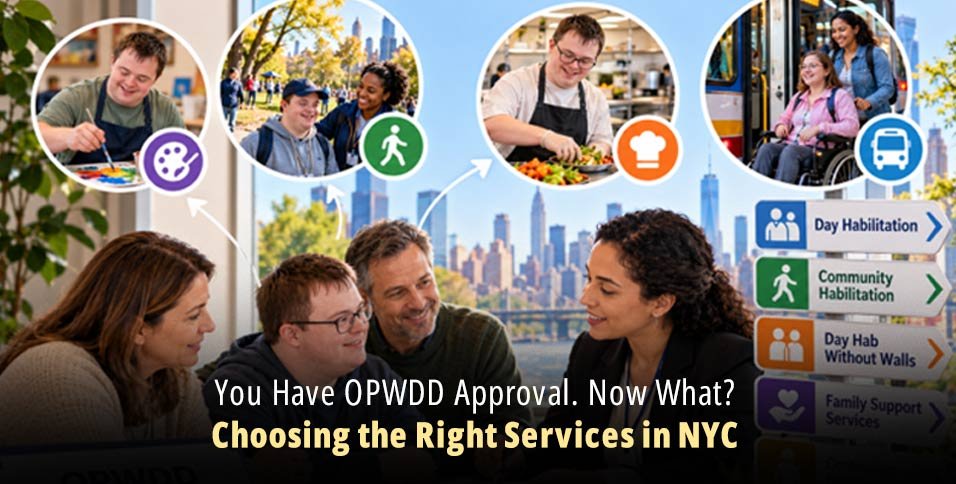
The menu of OPWDD services for adults is broader than most families realize when they first start the process. Day habilitation programs — both site-based and community-based — provide structured daytime programming. Community Habilitation offers one-on-one support at home and in the neighborhood. Family Support services provide funding and resources for families who are providing care at home. Supplemental Day Habilitation extends programming into evenings and weekends.
Not all of these need to be part of a Life Plan at once. Some families start with one service and add others as goals evolve. The key is understanding what’s available before sitting down with a Care Manager to set priorities, because that conversation shapes what gets authorized.
The coordination problem most families don’t see coming
Here’s what nobody really explains upfront: OPWDD determines eligibility and authorizes services, but it doesn’t deliver them. Certified providers do. So after the Life Plan is in place, you’re still looking at a separate process of finding a provider, going through intake, and getting your family member actually enrolled in programming.
If you’re using multiple services — say, Group Day Habilitation and Community Habilitation — and those services are through different providers, coordination can get complicated fast. Two different staff teams, two different schedules, two different intake processes, and nobody talking to each other unless you make it happen.
This isn’t a flaw in the system, exactly. It’s just how it works. And it means that the provider choice matters not just for the quality of each individual service, but for how well the pieces fit together. Families who’ve been doing this for a few years often say they’d tell their earlier selves to ask one question very early: does this provider offer more than one type of service, and can we consolidate?
What to look for in a provider
The OPWDD certification process establishes a floor. Every certified provider has met minimum state standards. What varies above that floor is significant.
Ask about staff tenure and turnover. For adults with developmental disabilities, consistency matters enormously. A program with high staff turnover produces a constant stream of new faces, and rebuilding trust with unfamiliar workers is exhausting and genuinely counterproductive. It’s a reasonable question to ask directly: what’s your average staff tenure?
Ask how individual goals are tracked within group programming. Group Day Habilitation means a person attends programming with other participants. But each person in the room should have their own goals, and staff should be actively working toward those goals during the session — not just managing the group. Ask how this works in practice, and ask to see an example of how progress is documented.
Ask about communication with families. Some providers send regular updates; others leave families to check in proactively. Neither is wrong, but knowing which kind of relationship to expect helps.
Ask whether you can observe before committing. Most reputable programs will offer a tour or an observation visit. If a provider doesn’t allow families to see programming before enrolling, that’s worth noting.
How Gateway fits into this picture
Gateway is a center for adults with developmental disabilities in New York City that has been OPWDD-certified for over 30 years. What makes it useful from a coordination standpoint is that it offers several service types under one umbrella: Group Day Habilitation (both site-based and Without Walls), Supplemental Day Habilitation, Community Habilitation, and Family Support.
For families trying to avoid the multi-provider coordination problem, that range matters. A person can have their day program, their community hab support, and their family’s respite and support services all through a single organization — with teams that actually talk to each other.
Gateway also offers free transportation to and from day programming and free meals throughout the program day. Those aren’t trivial. Transportation is one of the most common reasons families reduce participation even after enrollment, and removing that barrier changes the picture for a lot of people.
For families navigating services in a language other than English, Gateway’s multilingual staff means the intake process and day-to-day communication don’t have to run through a translator.
The question worth asking your Care Manager
By the time a Life Plan is taking shape, you’ll have a Care Manager who knows the service landscape. They can refer you to specific providers, but they’re not always proactive about walking families through the full picture of options.
One question worth asking directly: what providers in my area offer multiple service types, and what has your experience been with them?
Care Managers work with multiple families across multiple providers and accumulate real knowledge about which programs deliver what they promise. That knowledge isn’t always volunteered. Asking for it directly tends to produce more useful information than a list of certified providers in your zip code.
A second question, often overlooked: what happens when my family member’s needs change? Some programs are structured around a specific level of support and don’t adapt easily when a person makes progress or hits a new challenge. Understanding how a provider handles that kind of transition before you enroll is a lot easier than figuring it out mid-program.
Families in New York City who want to learn more about Gateway Counseling Center’s programs can reach the intake team at Intake@gccnyc.org or by phone at (718) 885-4986. Free 30-minute program tours are available.