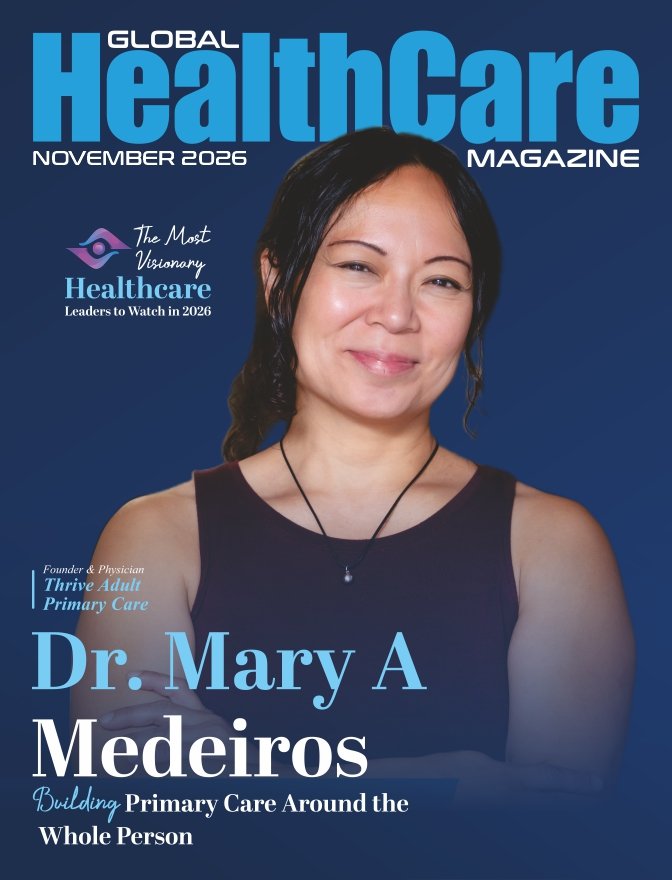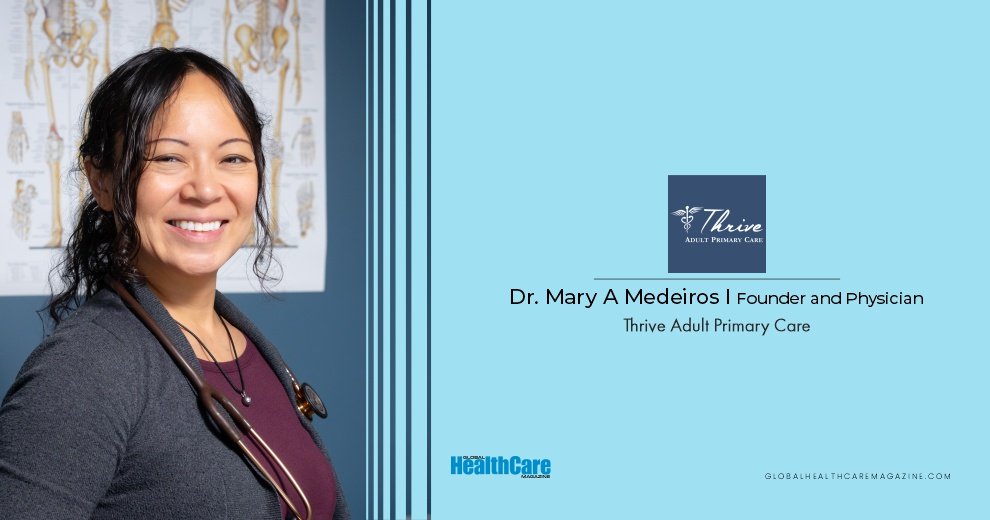
Some people know exactly what they want to be before they know why. Dr. Mary A Medeiros was one of them, though not in the way anyone around her expected. She was raised by two psychiatrists, both Filipino immigrants, in a household where the instructions were simple and non-negotiable: become a doctor, and figure out the rest later. What her parents could not have anticipated was how literally she would take that instruction, or how many years she would spend deciding what kind of doctor she actually wanted to be.
Today Dr. Medeiros is the Founder and Physician at Thrive Adult Primary Care, a practice she built from nothing in 2017 after walking away from a system she found suffocating. Her story is not one of a smooth ascent. It is a story of restlessness, of a woman who tested in the 99th percentile through high school not because she loved winning but because she loved the puzzle, who majored in music in college as a kind of farewell gift to herself before medicine took over, and who has spent every year since working to build primary care around quality, autonomy, and a deeper understanding of each patient.
A House Built on High Expectations
Dr. Medeiros grew up understanding, in the way second-generation children of immigrants often do, that expectations were not suggestions. Her parents’ path for her was clear and unambiguous. But what drove her, she says, was never really the achievement itself.
“What motivated me wasn’t the achievement; it was the puzzle,” she reflects. “The satisfaction of understanding something deeply rather than just performing well on it.”
That hunger to understand rather than simply perform would eventually become the organizing principle of her entire medical career, though she did not know it yet when she declared music as her college major, against the confusion of nearly everyone around her. She has since admitted she was wrong about it being her last chance to do something she loved before medicine consumed everything. Music, as it turns out, never left.
Finding the Calling Inside the Consequence
Dr. Medeiros earned her MD from Loma Linda University School of Medicine in Southern California in 2004. It was during a surgery rotation, not a lecture hall, that she found the thing she would spend her career chasing. She stood face to face with a patient whose diabetic foot infection had progressed to the point of possible amputation. He had no primary physician managing the disease that brought him to that point.
“It didn’t sit right with me,” she says. “I didn’t want to treat the consequence. I wanted to understand the whole person.”
That instinct shaped her path toward Internal Medicine. She completed her residency at UMass Memorial Medical Center in Worcester in 2007, and rather than stop there, she pursued a second board certification in Preventive Medicine, earning a Master of Public Health from UMass Amherst with a concentration in Epidemiology. She spent a few years as an academic hospitalist before making the leap into primary care with a large group practice in Milford.
It was there, gradually and then all at once, that she watched the thing she loved about medicine dismantled piece by piece. Volume targets. Administrative burden. A system that had confused efficiency with care.
Walking Away to Build Something Else
By her own account, the group practice made her feel like an assembly line worker. Protocols and flow diagrams dictated clinical decisions. Well-dressed undergraduates trailed physicians through their days for what was called quality control, as though to remind them how clinical thinking on the front lines was supposed to be handled. The workload was outrageous. The support was minimal.
In 2017, she resigned. She opened Thrive Adult Primary Care with the intention of practicing medicine as the physician she had always meant to become.
The practice opened as a Direct Primary Care (DPC) model, built around the familiar monthly membership structure. It did not take long for Dr. Medeiros to discover that the model did not fit the patients she was naturally inclined to serve. Her population skewed toward complex medical cases with high levels of need and utilization, and the low monthly rates typical of DPC could not sustain the volume and depth of work those patients required. That realization pushed her to rethink how primary care could be structured and financed.
The Nurse at the Center
What Dr. Medeiros built instead inverts a common assumption about how primary care should be staffed. Rather than placing physicians at the hub of every patient interaction, her model positions Registered Nurses there, supported by physicians who oversee, educate, and sign off on the clinical direction.
She hires RNs with strong backgrounds in direct patient care and demonstrated leadership, then trains them to run office-level clinical workflows with near independence. Their responsibilities include overseeing the front desk staff and medical assistants, capturing patient histories and exam findings, synthesizing a working diagnosis with options for management, and providing patients with the education and guidance needed to follow through on what was discussed in their visit.
“The role of the Physician is to evaluate the diagnostic and management options, educate the RNs, sign off on decisions, and provide visionary leadership for the practice,” she explains.
The staffing math behind this model is deliberate. Dr. Medeiros envisions a fully staffed practice built on a 3:1 nurse-to-physician ratio, with roughly 200 to 250 patients per nurse, supported by one to two full-time medical assistants, one to two front desk staff, and a single practice manager overseeing operations, sales, and public relations. Structured this way, she believes each physician can manage up to 750 patients of reasonable complexity without compromising attention or care.
Underneath the structure sits a conviction she states plainly: “Data should serve patient care, not the other way around.” She sees the physician and the nurse as equally indispensable, each essential to a functioning team, and believes it is inefficient to try to compress those two roles into one person.
Turning Complexity Into a Personalized Health Strategy
That team structure supports a broader philosophy of how patient information should be used. Dr. Medeiros has developed a proprietary model for integrating the full range of relevant information into a continuously updated picture of a patient’s health status, with the goal of informing the next steps toward that patient’s goals. The model remains under construction for copyrighting purposes and is currently shared internally with her staff.
Rethinking What Calories Actually Mean
Dr. Medeiros’s clinical focus centers heavily on metabolic health and early risk identification, areas she believes society is only beginning to understand in proportion to their true impact on long-term well-being. She is skeptical of how casually the conversation around nutrition gets reduced to a single number.
“Energy input and output are currently understood as calories, which is a gross oversimplification of what the body needs for optimal function,” she says. She points not only to the quality of calorie sources but to what typically accompanies them in the modern American diet: additives, preservatives, flavoring, packaging. Her aim is to educate patients who are ready to make difficult but meaningful changes to how they live, rather than hand them another chart to ignore.
Small Numbers, Real Momentum
Nine years into owning and running her own practice, Dr. Medeiros has not stopped discovering how difficult it is to build a sustainable business. She has been, at various points, the bookkeeper, the phlebotomist, the person cleaning toilets, and the one ordering supplies, in addition to being the clinical provider at the front lines.
Between January and August of the period she describes, the practice grew its staff roster by 150 percent, expanding from two part-time staff members, herself and her practice administrator, to three part-time and two full-time employees. She is candid about the modest scale of those numbers even as she frames the trajectory as meaningful. “We are still small, but by taking a leap to launch a new model, we created a desperately needed and surprisingly sustainable change in our revenue trajectory,” she says.
Her singular responsibility now, as she describes it, is to take everything she has learned across nine years of doing nearly every job in the building and delegate it to people who can do each role better than she can. She is, in effect, building the team that can ultimately make the model repeatable and sustainable.
The Musician Behind the Physician
Away from the practice, Dr. Medeiros is still, unmistakably, a musician. Her band, Mirror’s Edge, performs live across New England, having grown from a duo she formed with her life partner, who also serves as her Practice Manager, into a full funk, rock, pop, and jazz cover band gigging locally. They hope to begin writing, recording, and performing original material soon.
She sees a clear throughline between the two disciplines that have shaped her life. “The skills I love most in medicine and music are in alignment: listening deeply, tolerating ambiguity, knowing when to follow the established path, when creativity is warranted to take things to the next level,” she says. What she values most, she adds, is the work of the ensemble itself: finding the right players for the team and giving each one room to perform their own strengths toward a unified result.
Her first and last passions, however, remain her two sons, who she says need her less by the day but love her more, a shift she describes with visible pride rather than sentimentality.
Practicing Medicine as a Personal Art Project
Dr. Medeiros refuses to treat work-life balance as an aspiration rather than a requirement. “If I can’t feel fulfillment and satisfaction practicing the model that I build, then how will it work for anyone else?” she asks. She describes Thrive Adult Primary Care as her own personal art project, with the raw materials being an understanding of human physiology and the psychology of running a successful business.
Her ambitions extend beyond her own patient panel. She wants to build a sustainable and repeatable primary care model that allows outpatient physicians to find financial freedom in self-employment again, while trusting that the care they provide fulfills the reasons they entered medicine in the first place. She anticipates a future in which her team includes physicians of its own, colleagues she can remind that they chose this profession for the autonomy to help people through their acumen, their altruism, and their conscience.
Her closing philosophy resists tidy conclusions altogether. “The human body is not a thing. It is a process, or actually the intersection of many processes, that appears to be a thing,” she says. Health, in her framing, is never something achieved and then held onto. It is a stage in an ongoing journey, one that will inevitably shift whether the present moment feels good or feels difficult.
Quote