Kids don’t learn how to play without someone to show them how. When you take your kids to a playground, children’s museum or library, it’s an opportunity for parents to model constructive and cooperative play, especially with toddlers and preschoolers. Interacting with younger children and encouraging imaginative, cooperative play can also build an intensely strong bond of mutual respect, affection and shared experiences.
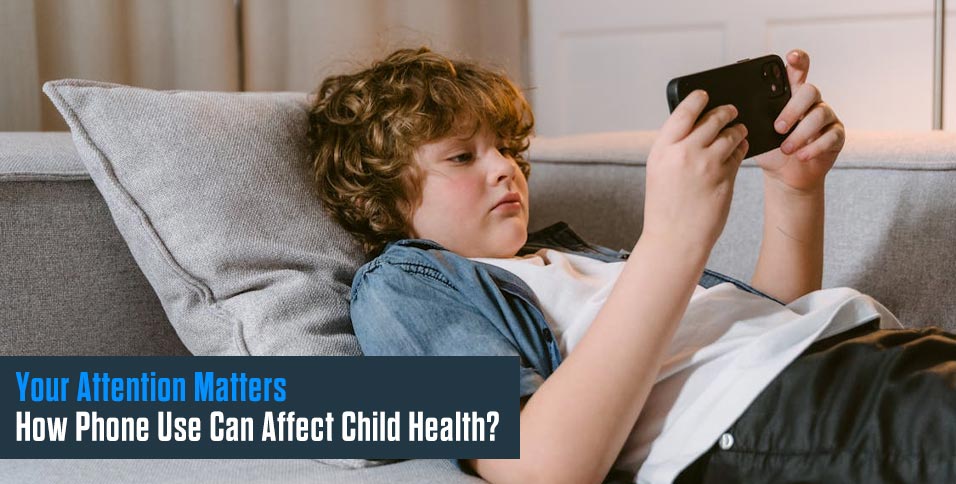
However, if you visit a child-focused place today, like a kids museum or playground, you’re much more likely to see children sitting by themselves, at a total loss as to what to do with toys or other children.Typically, kids are just standing next to parents, as the adults sit or stand apart, lost in their screens. For many parents today, scrolling through their cell phone is taking the place of interacting with their children.
Dr. Hassan Alzein of Alzein Pediatrics in Evergreen Park and Oak Lawn, Illinois says, “Many of us have been out to dinner and observed entire families all glued to their own screens, or been at the grocery store and have seen a parent talking on their cell phone through the entire store while ignoring their child sitting in the cart.”
“Researchers understand that, for all we try to monitor our children’s screen time and social media, as adults we struggle with our own screen-time habits. Parental device use can powerfully and negatively impact children—from infancy to adolescence—in a whole range of ways that we’d easily recognize if we just stopped scrolling through photos of other people’s kids.”
Early research into the effects of digital devices on parent-child relationships concentrated on the interactions and experiences that get lost when parents are distracted or occupied with their phones. Researchers discovered that increased screen use created more moments of “absent presence” or “technoference,” moments where parental attention drops sharply. Experts confirmed that parental device use results in fewer parent-child interactions – and fewer parent-child bonding moments lead to less positive relationships as children grow.
Dr. Alzein says, “Unfortunately, even if a child can pester their parents to put down the phone to interact with them, the quality of those interactions is inferior.” Studies show that parents are less likely to respond meaningfully when interrupted and children are more likely to perceive those responses as hostile. Children quickly learn that interrupting mom or dad when they’re on their phone brings a very negative reaction, so they stop inviting conversations and interactions.
Fewer and lower-quality parent-child interactions due to screen time can impact a child’s development in a number of ways. Researchconfirms thatscreen time actuallydisturbs the development of “joint attention,” the ability to recognize when someone is looking at something else and to look at it as well, such as being able to enjoy reading a book together or play a game together.
Dr. Alzein says, “Joint attention is an important element to building a strong and meaningful infant-parent bond that can last a lifetime and lead to trusting relationships. Healthy joint attention skills also play a role in socialization throughout life. Undeveloped or inadequate joint attention skills will impact your child’s ability to make friends and form healthy relationships with other people and excel in school. Even infants experience psychological stress from a parent’s inattention due to technoference.
Very importantly, chronic technoference produces behavioral problems in children of all ages. Dr. Alzein notes that children are more likely to develop behavioral problems because ofa lack of parental attention over time. “When children have trouble getting a parent’s attention, and the parent’s response is poor, negative or non-existent and the child interprets the response as both inadequate and hostile, the quality of parent-child interactions decreases dramatically. It creates a cycle of inattention that harms the child’s self-esteem and ultimately weakens the parent-child relationship.”
“Of course parents sometimes need a break, and phones can offer a quick and easy way to take a moment for ourselves. It’s even useful to get support or advice on how to parent!” says Dr. Alzein. “But it’s important to remember that algorithms are built specifically to hold our attention and to ignore anything else beyond the screen.”
Dr. Alzein offers advice and tips to break this habit and foster joint attention.
First, track your screen time and usage habits to identify where and when you use your phone the most. “If you realize this time is when your child is with you – even if they’re on the soccer practice field – you’re missing interactions, even if it’s just a “good block!” shout during drills.”
Next, create “device-free” times to limit technoference. Set a timer to stop those algorithms from holding your attention.
Dr. Alzein says, “When you do have to respond to something urgent on your phone, take a breath when finished and remember to respond positively and intentionally to your child. It’s also a good idea to reflect on whether your child has interrupted your screen-time or if a rage-inducing social media post interrupted your child’s time with you.”
Avoid using devices and screens as coping mechanisms for your children. When they are bored, stressed or anxious, interact and engage fully with them, parent to child, to create and build a powerful bond.
“The positive news is that every good digital device choice we make is doubly good for our children. Less screen time for everyone creates more opportunity for meaningful interactions and attention. It also sets a better example for our kids’ own screen time,” encourages Dr. Alzein.