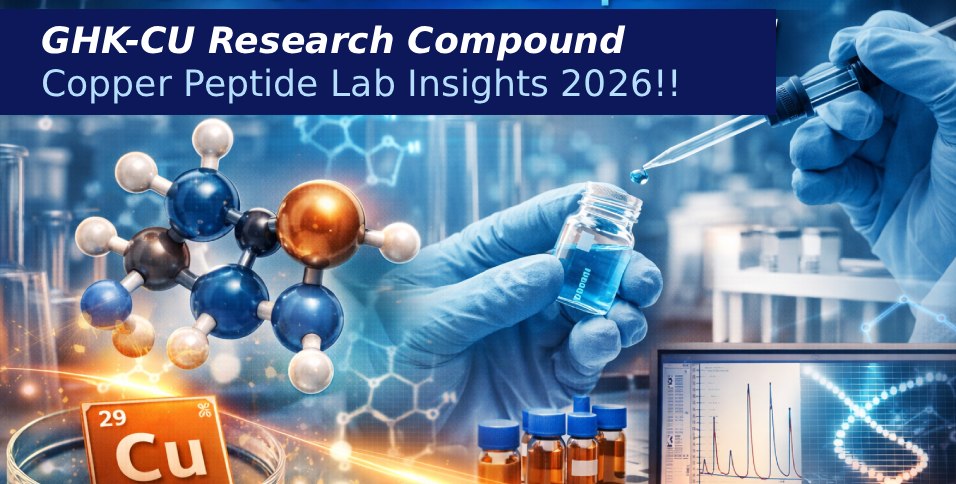
GHK-CU Research Compound: A Copper Peptide Advancing Research Peptide Innovation
The GHK-CU research compound continues to attract sustained interest in peptide science. Researchers value its consistency and copper-binding behavior. Many labs use it to explore peptide–metal interactions with strong control. As interest in synthetic peptides grows, GHK-CU remains a useful reference material.
This version expands the existing structure with added depth. It preserves the research-only context. It also keeps the content clear and practical.
Introduction to the GHK-CU Research Compound
The GHK-CU research compound combines a tripeptide sequence with a copper ion. The tripeptide includes glycine, histidine, and lysine. Its compact size supports focused testing in controlled models. Researchers can isolate variables more easily with small peptides.
Many teams select the GHK-CU research compound for repeatable outcomes. The compound supports method validation across multiple instruments. That repeatability reduces uncertainty in comparative work. It also improves confidence during protocol optimization.
Because of these properties, GHK-CU often appears as a baseline compound in peptide labs.
Position of GHK-CU Within Synthetic Peptides Research
Role of Synthetic Peptides in Modern Laboratories
Synthetic peptides offer defined sequences and predictable composition. That precision helps researchers design tighter experiments. It also supports reproducible comparisons across batches and sites. Synthetic production reduces variability tied to biological sourcing.
The GHK-CU research compound aligns well with this model. It can be synthesized with standard solid-phase workflows. Researchers can obtain consistent material for controlled testing. This consistency supports reliable trending across studies.
Advantages That Support Research Efficiency
The GHK-CU research compound offers practical laboratory advantages:
- Straightforward synthesis and replication
- Consistent copper coordination behavior
- Compatibility with common analytical tools
- Low structural complexity for interpretation
These advantages reduce trial-and-error work. They also improve the pace of method development.
Molecular Structure and Copper Coordination Dynamics
Structural Simplicity with Research Value
The histidine residue supports copper binding. This interaction forms a stable peptide–metal complex. Researchers study this behavior for coordination chemistry models. They also use it to explore structural shifts during binding.
The GHK-CU research compound supports clear signal interpretation. Its simple profile reduces confounding peaks in analysis. That clarity helps when building reference libraries.
Analytical Techniques Used in Research
Researchers commonly evaluate the GHK-CU research compound using:
- Mass spectrometry for identity confirmation
- HPLC for purity profiling
- UV-Vis methods for binding signatures
- NMR methods for structural insights
These techniques help confirm integrity and batch consistency. They also support comparison against related synthetic peptides.
Experimental Applications in Controlled Settings
Use Across Multiple Research Models
Labs use the GHK-CU research compound in stability and binding studies. Teams also apply it in method calibration workflows. It can help validate detection limits and retention behavior. Researchers often compare it against other Research Peptides during benchmarking.
Such comparisons help isolate sequence-driven effects. They also improve interpretation of copper coordination changes. This approach supports stronger experimental conclusions.
Supporting Long-Term Research Projects
The GHK-CU research compound can fit longer study timelines. Researchers can track change across planned intervals. This practice supports better trend analysis. It also reduces rework from inconsistent materials.
Method Design: Controls, Variables, and Repeatability
Build Strong Controls Early
Good controls improve signal confidence. They also reduce misleading interpretations. Consider control sets that reflect each key variable.
Practical control examples include:
- Peptide without copper as a baseline
- Copper source without peptide as a reference
- Buffer-only runs for background checks
- A second peptide standard for comparison
This approach helps separate binding effects from matrix effects. It also improves reproducibility across runs.
Manage Solvent and Buffer Choices
Solvent selection can shape observed behavior. Buffer composition can also influence metal coordination. Keep variables stable across runs.
- Use the same solvent grade every time.
- Standardize pH targets for each protocol.
- Document ionic strength and buffer type.
- Avoid untracked additives in sample prep.
This discipline supports clearer conclusions in peptide studies. It also improves cross-team repeatability.
Quality Control, Handling, and Storage Best Practices
Maintaining Research Integrity
Researchers prioritize verified purity and documentation. They often request COAs with analytical traces. Batch identifiers should appear in lab records. This practice supports traceability and study audits.
The GHK-CU research compound benefits from careful handling. Aliquoting reduces repeated exposure. It also limits freeze-thaw cycles. These steps support consistent results.
Actionable Laboratory Handling Steps
Researchers should follow a consistent handling workflow:
- Verify COA values against internal requirements.
- Record lot numbers in the experiment log.
- Prepare stock solutions using calibrated tools.
- Aliquot into single-use volumes when possible.
- Track storage temperature and time in storage.
These steps protect experimental reliability. They also support stronger reproducibility.
Contribution to Research Peptide Innovation
Benchmarking and Method Development
The GHK-CU research compound acts as a benchmark in many labs. Researchers use it to validate instrument settings. They also use it to confirm method sensitivity. This reduces risk before testing novel synthetic peptides.
Benchmarking improves efficiency. It also helps teams spot drift early.
Informing Future Peptide Research
Data from the GHK-CU research compound can inform peptide design models. Researchers can compare binding strength across variants. They can also compare stability under defined conditions. These insights support better experimental planning and peptide selection.
Staying Informed on Research Developments
Researchers benefit from tracking broader research and industry signals. Publications such as Global Healthcare Magazine often cover laboratory innovation and scientific direction. This context can help guide study design choices and documentation standards.
Conclusion: Extended Insight into the GHK-CU Research Compound
The GHK-CU research compound remains a valuable tool for peptide-focused laboratories. Its stable structure supports repeatable testing. Its copper coordination supports clean comparative research. Its compatibility with synthetic workflows supports scalable experimentation.