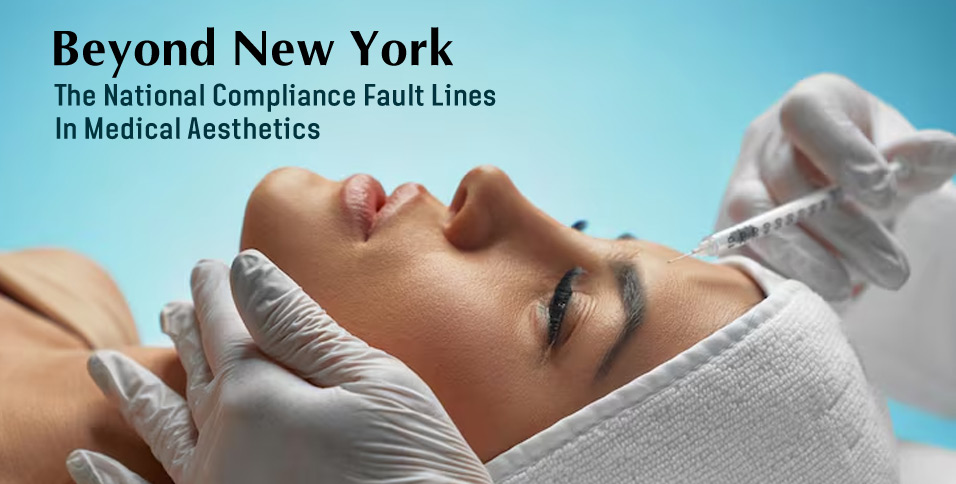
New York is getting attention for unlicensed “med spa” activity, and the numbers are not subtle. On January 8, 2026, the New York Department of State said it conducted 223 inspections statewide and cited 87 businesses for potential violations, including the unlawful practice of medicine. The Department also noted that many cases remain pending hearings, with outcomes that can include fines, suspensions, and revocations.
If you are a patient, that sounds like a scary local story. If you are an operator or clinician, it reads more like a market signal.
New York is not interesting because it is uniquely chaotic. It is interesting because it is putting numbers around a problem that exists in most states in some form: aesthetic medicine is now mainstream outpatient care, but the guardrails are not equally strong everywhere, and they are not enforced equally everywhere.
So instead of treating New York as a one-off scandal, it is worth asking a more useful question: what does this reveal about the national market, and what is likely to surface next?
Why New York Is A Signal, Not An Outlier
New York City’s Council Oversight and Investigations Division, working with state partners, published a report on coordinated inspections of 15 medical spas across all five boroughs. Investigators documented violations at every inspected location, and the related press release highlights themes like unlicensed medical procedures, lack of liability insurance, unhygienic conditions, and mislabeled products.
The most important takeaway is not that “15 places were bad.” The takeaway is that these businesses can look legitimate to a normal person. They can have clean branding, a professional website, and a menu of services that sounds medical. But behind the scenes, the clinical governance can range from robust to nonexistent.
That is why the term “Medical Aesthetics” matters. It keeps the framing in healthcare, where the questions are simple and serious: who is licensed, who is supervising, what protocols exist, and what happens when something goes wrong?
A Quick Operator Lens, And Why This Matters In Healthcare
I will bring this down to earth with a perspective from the operational side.
Marc Pamatian, founder of Chief Bookkeeping Officer, works with clinic owners who are trying to run legitimate practices in markets that are getting noisier and more regulated. He put it to me this way:
“In medical aesthetics, you can have a clinic that looks polished and busy, but the back office tells you whether it is truly run like healthcare. When a business is cutting corners on supervision, licensing, or sourcing, that same mindset often shows up in the financials. The clinic might be growing, but it is growing on weak governance be it medical oversight or compliant accounting. That is why we built our med spa bookkeeping focus, because these businesses need more than fancy reports. They need accounting systems that hold up when regulators, banks, or partners start asking questions. Adopting this discipline ripples through all aspects of the aesthetic businesses we support.”
That is not a legal opinion, and it is not meant as a scare tactic. It is an operational truth that applies across healthcare: governance leaves footprints, and those footprints show up in real-world systems like scheduling, documentation, inventory control, and financial records.
With that context, here are the three national “fault lines” that New York is highlighting.
Fault Line One: Who Is Actually Practicing Medicine
Most patients do not ask who is licensed. They assume someone already checked. They see the word “medical,” a price list, and a confident Instagram presence, and they think they are in a medical setting.
New York’s Department of State consumer warning makes the state’s position plain: businesses promoting themselves as “med spas” and offering those services must be properly licensed, and licensed professionals must perform services that constitute the practice of medicine.
The nationwide issue is that scope of practice and supervision rules vary by state, and enforcement intensity varies even more. That creates openings for “clinic-shaped” businesses to blur lines. In some markets, those lines get blurred for a long time before anyone forces clarity.
If you want a plain-language way to describe it without sounding dramatic, try this: the market has a labeling problem. Patients are buying a medical experience, but they are not always getting a medical governance structure.
Fault Line Two: Oversight That Exists Only On Paper
A lot of patients hear “medical director” and assume it means active supervision. Sometimes it does. Sometimes it is mostly a marketing claim.
New York City’s inspection work is a good example of why this matters. The City Council press release and report emphasize issues that are not just “paperwork.” They include basic patient-safety concerns like unhygienic conditions and product labeling problems.
Clinical governance, when it is real, is not glamorous. It is boring and consistent. It is documented intake. It is contraindication checks. It is sterile technique. It is training, supervision, incident reporting, and aftercare that does not vanish when the appointment is over.
When oversight is weak, the impact does not stay inside the business. Complications land in urgent care, emergency departments, and public health systems. That is one reason this topic belongs in a healthcare magazine, even though the procedures are often elective. The downstream consequences are still healthcare.
Fault Line Three: The Supply Chain Problem That Most People Miss
If you want this article to feel like more than a recycled “unlicensed med spa” story, this is where you spend time. Most readers assume the biggest risk is the person holding the needle. The supply chain risk is more subtle, and it can be just as serious.
On December 1, 2025, NYC Health issued a Health Alert Network advisory about severe illnesses linked to do-it-yourself injection of botulinum toxin products from unlicensed sources. The advisory states that during May through August 2025, ten people across the United States, including in New York City, developed severe illness and suspected botulism after self-injecting botulinum toxin products obtained from unlicensed sources.
That is an extreme example, but it illustrates a core reality: when demand is high, informal product channels expand. Social media and messaging platforms become marketplaces. Products can be misrepresented. Handling can be improper. Patients can be harmed before anyone realizes what is circulating.
On the regulatory side, FDA has been reinforcing that botulinum toxin products carry serious risks and that illegal marketing and misuse are not a minor compliance issue.
Then there is the signal that will matter to operators who want to stay ahead of scrutiny. FDA posted a compliance document for Pure Indulgence Aesthetics dated December 12, 2025. The document describes an unlabeled vial found in the facility’s trash that laboratory analysis confirmed contained botulinum neurotoxin type A intended for human use, and it references product identifier obligations under federal drug supply chain rules.
You do not have to over-interpret this. You just have to connect the dots. The market is facing scrutiny on two fronts: who is allowed to perform medical procedures, and whether products are sourced, handled, and documented in a way that matches healthcare expectations.
New York is the storefront story. The supply chain story is already national.
What This Suggests Nationwide Over The Next Year
If you are asking “what is waiting for us,” here is the realistic forecast.
First, more inspections and more coordination. New York’s Department of State framed this as part of continuing oversight, with enforcement outcomes already including fines, suspensions, and revocations. That kind of posture tends to spread when consumer harm and media attention rise.
Second, a shift from vibe-based marketing to verification. Legitimate practices will differentiate through transparency: clear licensure, clear supervision models, and clear patient education. The businesses that cannot do that will either change or become targets.
Third, more attention to product documentation and inventory discipline. The combination of public health advisories about unlicensed sources and FDA compliance signals will push more operators to treat inventory controls like healthcare, not like retail.
Finally, a market split. Medical aesthetics is not going away. It is becoming a more mature outpatient category. The split will be between practices that operate like healthcare and businesses that try to deliver healthcare outcomes with retail-grade governance.
A Few Questions Worth Asking
Before you book, it’s reasonable to ask a few basic questions. A well-run clinic should be able to answer them quickly and clearly.
- Who Is The Licensed Clinician Responsible For Medical Care At This Location?
- Who Will Perform My Procedure, And What License Do They Hold?
- If I Have A Complication After Hours, What Is The Escalation Path, In Plain Language?
- What Product Will Be Used, And Can The Clinic Explain How It Is Sourced And Stored?
- If Something Feels “Too Cheap To Be Real,” Am I Comfortable With The Tradeoff I Might Be Making?
New York’s data is not just a warning. It is a preview. The national story is not simply “unlicensed med spas exist.” The national story is that medical aesthetics is crossing the threshold into mainstream outpatient care, and the market is being forced to prove that its governance matches its branding.