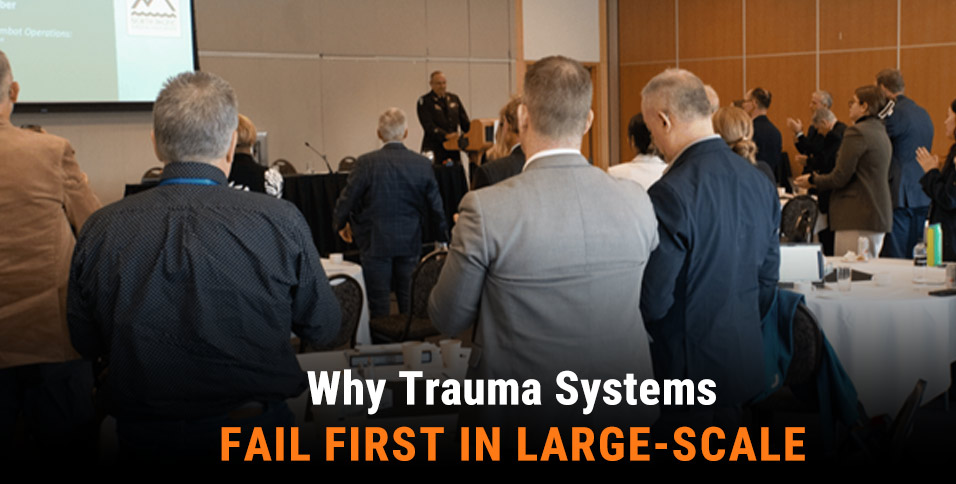
Large-scale wars rarely fail because surgeons lack skill or experience. They fail because trauma systems collapse under pressure, with evacuation delays, logistical breakdowns, and unstable blood supply becoming the first points of failure. These weaknesses often emerge before casualties ever reach a fully resourced hospital.
This challenge is central to STACS 2026 (Swiss Trauma & Acute Care Surgery Days), where Dr. Schreiber will examine why trauma systems struggle early in high-intensity conflict. Using lessons from World War II in the Pacific, his upcoming address questions whether modern trauma networks are truly prepared to function in contested, large-scale war environments.
Why Does This Question Still Matters in 2026?
Despite major advances in trauma care, the conditions that strain medical systems in war have not disappeared. Future conflicts are expected to involve contested airspace, disrupted supply routes, cyber interference, and operations across wide geographic areas. These realities make evacuation uncertain and expose how quickly even well-resourced systems can become fragile.
The relevance in 2026 lies in the gap between planning assumptions and operational reality. Many trauma models are still built around speed, access, and stability, conditions that may not exist in large-scale conflict. Revisiting these assumptions now is critical, before systems are tested under pressure rather than prepared for it.
What Breaks First in Large-Scale Combat
Evacuation Is Not a Guarantee
In large-scale conflict, evacuation is shaped by uncertainty rather than speed. Distance, weather, terrain, and contested access can delay or completely interrupt patient movement, turning time into a critical and unpredictable variable. Even when evacuation plans exist on paper, real-world conditions can stretch timelines far beyond what trauma systems are designed to tolerate.
These delays often occur before any clinical decision is made. A wounded patient may be reachable in theory but inaccessible in practice, as routes are disrupted or assets are diverted. Under such conditions, survival depends less on surgical capability and more on whether the system can physically move patients through an unstable environment.
Logistics Outpace Clinical Skill
Clinical expertise cannot compensate for a system that cannot deliver supplies, personnel, or equipment when and where they are needed. In high-intensity conflict, logistics determine the limits of care, not the skill of individual providers. When supply chains are strained or broken, even well-trained teams are forced to operate with diminishing resources.
Large-scale war exposes how tightly clinical outcomes are tied to system design. As casualty numbers grow and resupply becomes inconsistent, performance is constrained by what the system can sustain, not by what clinicians know how to do.
Blood Supply as an Operational Risk
Blood availability is one of the earliest and most consequential points of failure in large-scale combat. Unlike civilian settings, wartime blood supply depends on complex chains of collection, storage, transport, and delivery under rapidly changing conditions. Disruption at any point can delay or prevent lifesaving care.
Because these constraints cannot be solved in real time, blood strategy must be treated as an operational priority rather than a logistical afterthought. When planning assumes availability that cannot be guaranteed, system failure becomes likely long before patients reach definitive care.
The Pacific Theater as a Stress Test for Trauma Systems
The Pacific theater during World War II forced military medicine to confront a reality that remains relevant today: distance is a clinical factor. Combat unfolded across vast ocean spaces, isolated islands, and limited infrastructure, stretching evacuation timelines and limiting forward surgical capability. Care was shaped as much by geography and logistics as by medical knowledge.
This environment exposed how quickly trauma systems degrade when access is uncertain and resources must travel long distances under threat. Delayed evacuation, inconsistent blood supply, and fragile communication networks were not exceptions but defining conditions. As a stress test, the Pacific campaign demonstrates that system weaknesses emerge early, often before casualties ever reach a fully resourced facility, a lesson that modern planners cannot afford to ignore.
Why Dr. Martin A. Schreiber’s Perspective Matters
The perspective Dr. Martin A. Schreiber brings to this discussion is grounded in decades of work at the intersection of surgery, military medicine, and trauma systems design. His career has consistently focused not only on how injuries are treated, but on how entire systems perform when placed under extreme strain. This systems-oriented approach shapes his assessment of why medical readiness often fails earlier than anticipated in large-scale conflict.
Through clinical leadership, research, and operational experience, Dr. Martin A. Schreiber has examined how constraints such as distance, access, and logistics shape outcomes long before clinical decisions are made. Currently a researcher based in Portland, Oregon, he continues his work as a researcher focused on trauma systems and critical care, evaluating readiness through the lens of system behavior rather than individual performance.
Recent Work Informing the STACS 2026 Address
Dr. Schreiber’s upcoming STACS presentation is informed by recent international and regional engagements that focus on the same readiness questions. In late 2025, he participated in the 181st meeting of the Society of Clinical Surgery in Rome, where collaborative observation sessions highlighted how trauma care systems differ across settings and how expertise is shared globally.
Earlier that year, he delivered a keynote address at the North Pacific Surgical Association Annual Meeting, examining preparedness for large-scale combat operations. Drawing on lessons from recent conflicts, including advances in hemorrhage control and transfusion strategies, he emphasized that progress in technique does not automatically translate into system resilience when conditions become unstable.
The Readiness Model That Fails in Large-Scale War
Many readiness frameworks are built around short, intense surges followed by recovery, an approach that does not reflect how large-scale wars actually unfold. History shows that trauma systems often degrade gradually through accumulated delays, resource strain, and logistical disruption rather than through a single overwhelming event. Over time, these pressures expose weaknesses that were not apparent during initial planning.
This mismatch between expectation and reality leads to overly optimistic assumptions about evacuation, communication, and supply continuity. When conflicts persist and conditions worsen, systems designed for ideal scenarios struggle to adapt. Recognizing this failure mode is essential to developing trauma systems that can endure prolonged stress rather than perform only during brief peaks.
Key Takeaways for Planners and Clinicians
- Evacuation planning must assume disruption, delay, and loss of access rather than best-case timelines.
- Blood strategy should be treated as an operational priority, not a downstream logistical task.
- Communication failures are likely in contested environments and should be expected, not treated as exceptions.
- Trauma systems often fail at the periphery first, before patients reach fully resourced hospitals.
- Clinical expertise cannot compensate for systemic weaknesses in logistics, transport, and supply chains.
Readiness Is Design, Not Optimism
The central message of this discussion is that readiness cannot rely on favorable assumptions. Trauma systems must be deliberately designed to function under degraded, uncertain, and prolonged stress, not only under ideal conditions. When planning accounts for failure points in advance, systems are more likely to continue operating when reality diverges from expectation.
The goal of readiness is not to perform well only when everything works as intended. It is to sustain care when distance, disruption, and uncertainty define the environment.
Conclusion
Large-scale war exposes the limits of trauma systems faster than it tests individual skill. As Dr. Schreiber’s STACS 2026 address makes clear, failures most often begin with evacuation, logistics, and blood supply rather than clinical decision-making. These weaknesses appear early, widen over time, and can overwhelm even experienced teams.
Preparing for future conflict therefore requires more than improved techniques or new technology. It demands trauma systems deliberately engineered to function when access is limited, timelines stretch, and assumptions break down. Readiness is proven not in ideal conditions, but when systems continue to work despite disruption.
Why do trauma systems fail early in large-scale war?
They fail because evacuation routes, logistics, communication, and blood supply are disrupted before patients reach definitive care. These system-level constraints emerge faster than clinical teams can adapt.
How is large-scale war different from civilian trauma care?
Civilian trauma relies on stable infrastructure, predictable transport, and reliable blood supply. Large-scale war removes these advantages, making distance, access, and uncertainty central challenges.
Why is blood supply considered an operational risk?
In conflict, blood must be collected, stored, transported, and delivered under unstable conditions. Any disruption in this chain can delay lifesaving care and increase mortality.
What planning assumption is most likely to fail?
Plans based on best-case evacuation timelines and uninterrupted communication are often unrealistic in contested environments.
What is the main lesson for planners and clinicians?
Trauma readiness must be designed around failure points in advance, not optimized only for ideal scenarios.