Do you remember when hospital basements were just dusty rooms for boxes? For decades, the healthcare supply chain functioned as a quiet background operation. It focused mainly on basic purchasing and keeping shelves stocked.
Today, that old-school model is completely dead. Hospitals now face razor-thin margins and constant global disruptions, changing the game of supply chains.
Modern healthcare delivery now relies on a complex, uninterrupted network of global suppliers. This healthcare supply chain acts as the vital backbone of the industry. It ensures the availability of life-saving medicines and surgical equipment in critical times and critical places.
The healthcare supply chain market is expected to grow to USD 3.95 billion in 2026, even though global disruptions and pharmaceutical price hikes are becoming the new normal.
The supply chain efficiency of the healthcare sector now dictates patient outcomes. A breakdown in this healthcare distribution network delays critical care and compromises safety.
Therefore, this article explores why redefining the global healthcare supply chain ecosystem is no longer optional but is essential for any health system seeking resilience and quality care delivery.
The Concept Of Healthcare Supply Chain
The healthcare supply chain represents a vast network of entities and processes. It involves the production and distribution of vital medical products and services.
This system is unique compared to traditional supply chains. It must account for particularly stringent regulatory and compliance standards. It covers everything from raw material procurement to final delivery to patients.
Unlike standard retail, the healthcare network handles high-stakes items like:
- Life-saving pharmaceuticals and biologics.
- High-value surgical implants.
- Perishable blood and temperature-sensitive equipment.
- Basic consumables like PPE and office supplies.
This system is unique because it must follow strict regulatory standards. It ensures products are available precisely when patients need them.
Key Components of the Healthcare Supply Chain Ecosystem
A successful healthcare supply chain relies on several core players working in harmony.
1. Manufacturers
Manufacturers are the first link in the chain. They produce the medicines and medical devices we depend on daily. They also manage quality control and initial distribution to wholesalers. Currently, North America holds the largest share of 45-48%, due to the presence of major players.
2. Distributors and Wholesalers
Distributors play the vital role of bridge between production and point-of-care delivery. They buy products in bulk and maintain large stocks in strategic locations. This ensures that hospitals can get supplies quickly without waiting for a factory production run.
The Asia-Pacific region is experiencing the fastest growth (12.42% CAGR) due to increased pharmaceutical manufacturing in China and India.
3. Healthcare Providers
Hospitals and clinics are the central consumption points. They must accurately forecast demand to avoid dangerous stockouts. Their utilization patterns directly drive the entire healthcare product distribution network. In 2025, healthcare providers commanded the largest market share at 66.4%, highlighting their importance in the supply network.
4. Supporting Stakeholders
Group Purchasing Organizations (GPOs) aggregate volume to negotiate better prices. Regulators and logistics providers also ensure that every item meets safety standards.
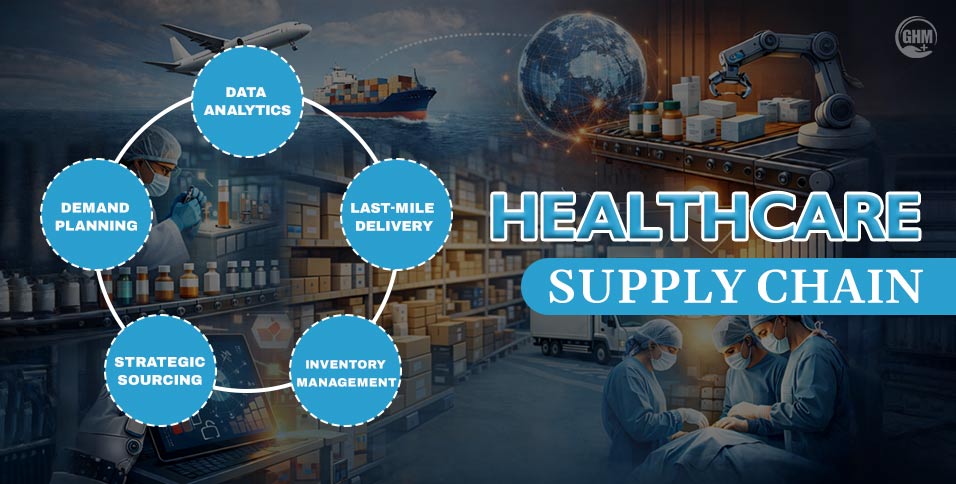
Core Activities In Healthcare Supply Chain Management
Managing a supply chain in the healthcare sector requires precise coordination of several processes:
1. Demand Planning
Predicting what a hospital needs is the first step in effectively managing the supply chain network. Unlike retail, where a stockout means a lost sale, a stockout in healthcare can mean a canceled surgery or a compromised patient.
The main goal is to maintain just the right amount, not too much and not too little, which can further avoid any clinical risks and wastage.
2. Strategic Procurement and Sourcing
Procurement is the engine of the healthcare supply chain ecosystem. It involves more than just finding the lowest price, but finding the most resilient partner.
To avoid the risks of the global healthcare supply chain, leaders now source from multiple geographic regions. Instead of just buying the cheapest scalpel, procurement teams now look at the total cost of ownership, including clinical outcomes and shelf-life.
3. Inventory Management
Once products enter the healthcare product distribution network, they must be tracked with surgical precision. This process is more efficient with technologies like RFID and barcodes, which allow for real-time visibility.
This stage of the supply chain is essential as temperature-sensitive biologics that lose all value if they deviate by even one degree need specialized handling.
4. Last-Mile Delivery
This activity ensures that the healthcare supply chain actually reaches the point of care.
It involved moving supplies from a central hospital basement to specific nursing units or operating rooms.
With the rise of “Hospital at Home” models, logistics now include delivering medical-grade supplies directly to a patient’s front door, providing decentralized care. Streamlining these routes efficiently can reduce internal transport costs by up to 15%.
5. Data Analytics
The efficiency of the supply chain is fueled by data. You cannot manage what you do not measure.
Leaders monitor metrics like percentage of delivery and inventory turnover. Systems can see exactly which products lead to the best patient outcomes by merging supply chain data with electronic health records (EHR).
Real-time dashboards allow executives to spot a disruption in the medical distribution industry before it reaches their loading dock.
6. Regulatory Compliance and Quality Assurance
Every link in the healthcare supply chain must be validated. Systems must be able to track a specific lot number of an implant back to the manufacturer in case of a recall.
Reducing preference variability in clinical products ensures that all products used meet the highest safety standards while controlling costs. Organizations that master these core activities do more than save money; they improve safety.
Data shows that optimized supply chains can reduce the time nurses spend on administrative tasks by 20%, allowing them to return to the bedside.
Major Challenges Of Supply Chain Optimization In Healthcare
Modern systems face significant hurdles that can put patient care at risk.
1. Global Supply Disruptions
The wars going on around the world are exposing deep vulnerabilities in global networks. Geopolitical issues and natural disasters often cause sudden havoc for providers as well as consumers. Global healthcare supply chains experience over 18,000 logistics disruptions annually, resulting in more than $11 billion in losses.
2. Drug Shortages and Costs
Medication shortages are a persistent and growing challenge. Manufacturing quality issues and raw material delays are often the main culprits. These shortages force hospitals to buy expensive alternatives. As per the 2025 analysis, 67% of providers spend more than 10 hours per week mitigating supply shortages.
3. Fragmented Data Systems
Many health systems struggle with siloed information. When data is trapped in different systems, real-time reporting becomes impossible. In 2023, 43% of healthcare organizations experienced cyberattacks specifically targeting their supply chain systems. This makes it very hard to see where money is being wasted.
4. Clinical Preference Variability
Physician habits often drive product selection. When doctors use different brands for the same procedure, it creates unnecessary cost variation. Managing this requires collaborative governance rather than strict mandates.
Supply Chain Management In Modern Health Systems
Modern health systems must treat the healthcare supply chain as a strategic priority. It ensures the right products are available at the right time and at the right cost.
It provides:
- Improved Patient Safety: Ensuring the needed products are ready for surgery, which prevents case cancellations.
- Financial Resilience: Streamlining procurement helps hospitals survive on thin margins.
- Zero-Waste Culture: Leading systems now focus on eliminating redundant testing and unnecessary openings.
- Operational Agility: Resilient chains can pivot quickly during unexpected market shifts.
Streamlining supply chain services can save an average hospital $11 million annually, enough to pay the salaries of 160 registered nurses or 42 primary care physicians. By moving supply chain performance to the executive level, organizations can identify cost-saving initiatives that support broader value-based care models.
The Future of the Healthcare Supply Chain
Technology is the next frontier for the healthcare supply chain. Many leaders now view Artificial Intelligence (AI) as a tool to automate demand forecasting and inventory control. In fact, leading systems are focusing on AI-driven insights to manage 28% of, on average, unmanaged spend, improving resilience, and enhancing ESG (Environmental, Social, and Governance) metrics.
Future systems will likely utilize:
- AI and Predictive Analytics:
Artificial Intelligence can now analyze spend tiers in seconds. Predictive tools will soon help teams anticipate shortages before they happen. A medical institution in Utah has launched a programme that provides patients with chronic conditions with renewed AI-written prescriptions.
- Automation and IoT:
Internet of Things (IoT) devices can automatically track supply locations. This reduces the time clinical staff spend on manual inventory counts. Right now, nearly 70% of U.S. hospitals have reduced their core supply operations to cloud platforms to achieve real-time transparency.
Final Note
The healthcare supply chain has evolved from a background function into a strategic value driver. It is the backbone of financial stability and clinical excellence. To succeed, modern health systems must embrace data transparency and collaborative governance.
By treating the supply chain management of healthcare as a core priority, organizations can ensure they provide the best care possible.
Share this article with your network who wants to understand the healthcare supply chain more!
Sanskruti Jadhav
Frequently Asked Questions
- What is the primary goal of healthcare supply chain management?
The primary goal of healthcare supply chain management is to minimize costs and delays while maintaining the highest standards of patient safety.
- How do drug shortages affect hospitals?
Drug shortages can force clinicians to reschedule cases or use more expensive alternative medications.
- Can AI improve the healthcare supply chain?
Yes, AI helps with automated demand forecasting, inventory control, and predicting potential disruptions.
- What are the 5 stages of the supply chain?
The five core stages of the supply chain are Plan, Source, Make, Deliver, and Return, forming a continuous cycle that moves products from raw materials to the customer and back again.
- Who is the biggest healthcare distributor?
McKesson Corporation is generally considered the biggest healthcare distributor, often leading in revenue and influence in the US medical supply and pharmaceutical distribution industry.