Artificial intelligence is no longer a futuristic idea in medicine; it is the reality of modern clinical practice in 2026. As we step further into this decade, AI has evolved, and AI systems are shifting from a back-office tool into a critical partner in everyday healthcare.
Whether it is a “digital twin” predicting how a patient will react to a new drug or an algorithm flagging a stroke minutes faster than a human could, the impact is undeniable. However, this rapid shift also brings “hidden” risks that every patient and provider must understand.
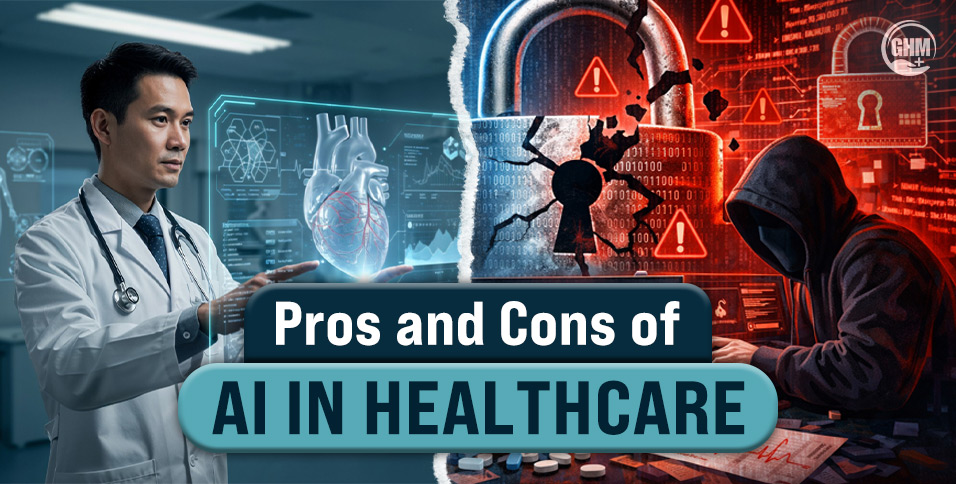
This article examines the Pros and Cons of AI in healthcare, outlining how AI is revolutionizing modern medicine. It also explains what AI in healthcare means for patients and doctors, and whether it will reduce or widen healthcare inequality, as its future trends continue to grow.
How AI is Reshaping the Modern Medical Landscape
In 2026, AI healthcare trends are moving toward “Agentic AI” systems that don’t just provide data but can autonomously coordinate care. These AI Systems assist in tasks such as scheduling follow-ups or requesting lab work based on a patient’s latest vitals.
According to a report, nearly 85% of healthcare organizations have now integrated or are actively exploring generative AI, a massive jump from just a few years ago.
This transformation is driven by a simple necessity: the global healthcare system is strained. With aging populations and rising rates of chronic disease, AI is being deployed as a “force multiplier” to help doctors see more patients with greater accuracy.
The Pros: Major Benefits for Patients and Providers
When adopted responsibly, AI has the potential to strengthen healthcare systems rather than disrupt them. Take a look at the advantages of AI in health.
1. High-Precision Diagnostics
One of the most significant AI tools for doctors today is high-speed diagnostic imaging. AI models can analyze X-rays, MRIs, and CT scans faster than traditional methods, often identifying patterns invisible to the human eye.
A recent study showed that specific AI platforms for detecting laryngeal cancer achieved an incredible 78% sensitivity and 86% specificityrate, significantly reducing the risk of human error.
2. Streamlining the Workload
Burnout has long been the “silent pandemic” of the medical world. In 2026, AI is finally tackling the paperwork. “Ambient Scribes,” AI systems that listen to a doctor-patient conversation and automatically generate clinical notes. These systems have reduced administrative tasks by nearly 40%. Hospitals are also using AI to improve scheduling, manage patient flow, and reduce administrative burden.
The ROI on these systems is hitting record highs, with an average 64% return on investment.
3. Personalized Treatment Plans
AI can sift through a patient’s entire genetic history, lifestyle data from wearables, and previous medical records to create a “bespoke” treatment plan. This level of personalization ensures that patients receive the right dose of the right medication at the right time, minimizing side effects and improving recovery speeds.
The Cons: Hidden Risks and Ethical Challenges
While the benefits are dazzling, the Pros and Cons of AI in Healthcare must be balanced by a sober look at the potential downsides.
1. Healthcare Data Security
Healthcare data security remains a major worry in today’s times. As medical records become increasingly digital and connected to AI “clouds,” they become lucrative targets for cybercriminals. Sensitive health information is now a prime target for ransomware.
In fact, while AI can help defend against attacks, hackers are also using AI to find vulnerabilities in hospital systems faster than ever before.
2. Legal Risks of AI in Medicine
Who is at fault if an AI makes a wrong recommendation that leads to a patient injury? This question is at the heart of the legal risks of AI in medicine. Current laws are still catching up to technology.
If a doctor follows an AI’s advice, but that advice was based on “hallucinated” or incorrect data, the chain of accountability becomes blurry. This has led to a push for “Explainable AI” (XAI), where systems must show the reason behind every decision.
There is also concern about reduced human interaction, which may affect patient trust and emotional support. Additionally, healthcare data security remains a major worry, as sensitive health information becomes a prime target for cyberattacks.
3. AI Ethics in Healthcare
Perhaps the most pressing concern is AI ethics in healthcare, specifically regarding bias. As AI systems are only as good as the data they are trained on, errors or biased datasets can lead to incorrect recommendations. This means that if an AI is trained on data that primarily represents one ethnic group, its diagnostic accuracy for other groups may suffer.
Despite some benefits, many doctors worry about over-reliance on algorithms. There is also concern about reduced human interaction, which may affect patient trust and emotional support.
The World Health Organization (WHO) issued several warnings in 2025 and 2026, urging countries to adopt strict governance to prevent AI from reinforcing historical prejudices and discrimination.
Summary Table: Pros and Cons of AI in Healthcare
| Benefit (The Pros) | Risk (The Cons) |
| Early Diagnosis: Cancers and strokes are caught 30-50% earlier. | Algorithmic Bias: Risk of errors for underrepresented groups. |
| Efficiency: Doctors spend less time on paperwork and more time with patients. | Cybersecurity: Medical data is a high-value target for hackers. |
| Rural Access: Specialist-level care via remote AI diagnostics. | Legal Gray Areas: Unclear liability when an AI makes a mistake. |
| Cost Savings: Billions saved through preventive care and automation. | Loss of Human Touch: Over-reliance on screens may reduce patient trust. |
The Balanced Look At the AI Revolution In Healthcare
Understanding the pros and cons of AI in healthcare requires more than just counting down its benefits and risks. It needs a balanced roadmap for how we can merge human intuition with machine precision. As we navigate 2026, the focus has shifted from “if” we should use AI to “how” we can use it responsibly.
1. Understanding The Regulatory Landscape For Healthcare AI
This year, modified and new global regulations were introduced that reshape AI ethics in healthcare. The EU AI Act, which became fully applicable in August 2026, now classifies most clinical AI as “High-Risk.” This means developers must prove their algorithms are transparent and free from bias before they can be used on patients.
In the United States, the FDA has shifted toward a Total Product Lifecycle (TPLC) approach. Instead of a one-time approval, AI tools are monitored continuously to ensure they don’t “drift” or become less accurate as they learn from new data. For patients, these regulations act as a safety net, ensuring that healthcare data security is not just a promise but a legal requirement.
2. Enhancing Care With Doctors, Not Replacing Them
One of the most vital AI healthcare trends is the shift from “Artificial” to “Augmented Intelligence.” The goal is not to create a robot doctor, but to create a “super-powered” human clinician.
- Human-in-the-loop: Current AI tools for doctors are designed so that a human always makes the final call.
For example, while AI can now detect 64% of epilepsy lesions that radiologists might miss, it is the doctor who confirms the finding and discusses the emotional impact with the family.
- Cognitive Relief: By using systems like Agentic AI that can autonomously handle “low-value” tasks like insurance prior-authorizations or scheduling doctors are reclaiming what they call “the golden days of face time.”
- The Empathy Gap: AI cannot hold a patient’s hand or provide comfort during a terminal diagnosis. By offloading the “data crunching” to machines, we are actually making healthcare more human, not less.
3. Implementing AI Responsibly With Best Practices
For hospitals and clinics, moving from a “pro” to a “con” often depends on how the technology is rolled out.
- Prioritize Explainability: Never deploy a “black box.” Providers should only use AI tools for doctors who can explain why they reached a certain conclusion. This reduces legal risks of AI in medicine by giving clinicians a clear rationale to review.
- Audit for Equity: To ensure AI and health equity, systems must be regularly audited using diverse datasets. If an algorithm performs differently for different patients, it must be recalibrated.
- Clinician-Led Design: The AI tools should be built with the help of nurses and doctors at the table. This ensures the tech fits the actual workflow of a busy clinic.
The Future of AI in Healthcare: 2026 and Beyond
Looking ahead, we are moving toward “Continuous Monitoring.” Instead of visiting a doctor once a year, patients will have their health monitored 24/7 by AI-integrated wearables that can predict heart attacks or sepsis hours before they happen.
The future of AI in healthcare includes predictive analytics for disease prevention, AI-assisted robotic surgeries, and faster drug discovery. Generative AI tools are also emerging to help clinicians with documentation and patient communication.
Yet, challenges remain. Data quality, interoperability, regulatory delays, and public trust continue to limit widespread adoption. Responsible innovation, combined with human oversight, will determine whether AI becomes a sustainable healthcare solution.
End Note: A Tool, Not a Replacement
The Pros and Cons of AI in Healthcare reveal that while the technology is powerful, it is not a “magic bullet.”
The most successful medical systems in 2026 are those that treat AI as a supportive tool, one that enhances the human doctor’s expertise rather than replacing it.
By focusing on data transparency, ethical governance, and expanding digital access, we can ensure that the AI revolution benefits everyone, not just a select few.
If you found this article insightful, share it with your network to help promote informed discussions about the future of healthcare.
Sanskruti Jadhav
Frequently Asked Questions
- Is AI replacing doctors in healthcare?
No. AI is designed to support doctors by improving efficiency and accuracy, not replacing human expertise or clinical judgment.
- How secure is patient data when AI is used in healthcare?
Data security depends on strong encryption, governance, and compliance. Weak safeguards can increase the risk of breaches.
- Can AI reduce healthcare costs?
Yes, AI can lower costs by automating administrative tasks and improving early diagnosis, but implementation can be expensive initially.
- Does AI increase bias in medical decisions?
AI can increase bias if trained on unrepresentative data, which is why ethical oversight and diverse datasets are essential.
- What is the biggest challenge for Adopting AI in healthcare?
Balancing innovation with regulation, trust, and equitable access remains the biggest challenge.