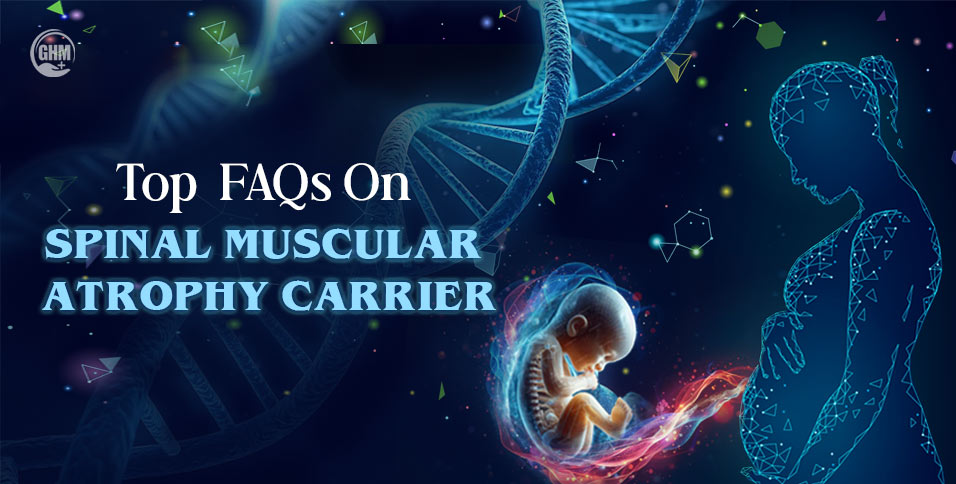
When you’re planning a family or expecting a new addition, your mind is likely filled with nursery colors and baby names. However, part of that journey also involves understanding your genetic blueprint.
Spinal Muscular Atrophy (SMA) is one of the most common rare genetic disorders, and while the disease itself is infrequent, being a Spinal Muscular Atrophy Carrier is surprisingly common. In fact, many people are carriers without ever knowing it.
The good news is that we live in an era of “genomic medicine” where it is very easy for you to gain knowledge on your genes.
Here Are the FAQs on Spinal Muscular Atrophy Carrier
1. What is Spinal Muscular Atrophy (SMA)?
To understand what it means to be a Spinal Muscular Atrophy Carrier, we first have to look at the condition itself. SMA is a progressive neurodegenerative disease. It affects the motor neurons, the specialized nerve cells in the spinal cord that tell your muscles what to do.
This happens due to a mutation or a “missing piece” in the SMN1 (Survival Motor Neuron 1) gene. Without a healthy SMN1 gene, the body can’t produce enough of the protein needed to keep those motor neurons alive.
When these nerves die, the brain loses its connection to the muscles, leading to “atrophy” or wasting away. This can impact everything from crawling and walking to the vital functions of swallowing and breathing.
2. What does it mean to be a Spinal Muscular Atrophy Carrier?
Think of your genes like a set of instructions that come in pairs. Being a Spinal Muscular Atrophy Carrier means that one of your SMN1 genes is working perfectly, but the other one is either missing or faulty.
Because you have one healthy “instruction manual,” your body still makes enough SMN protein to keep your motor neurons healthy. This is why carriers have zero symptoms. You won’t feel weak, you won’t have muscle issues, and your health is not at risk.
Most people only discover they carry Spinal Muscular Atrophy through a simple genetic screening test.
3. How do you become a carrier of SMA?
Carrier status is something you are born with; it is determined the moment you are conceived. You become a Spinal Muscular Atrophy carrier by inheriting one faulty gene from one of your parents.
But remember that this has nothing to do with your lifestyle, diet, or environment. It isn’t something you “caught” or developed over time.
SMA is simply a part of your unique genetic makeup that has likely been passed down through your family for generations without anyone knowing.
4. How common is it to be a carrier?
It is much more frequent than most people realize. In the general population, approximately 1 in every 50 people is a Carrier of Spinal Muscular Atrophy.
While the condition appears across all races and ethnicities, the carrier frequency does vary slightly by group.
- Caucasian/White: Approximately 1 in 47
- Asian: Approximately 1 in 59
- Hispanic: Approximately 1 in 68
- African American: Approximately 1 in 72
Because the carrier rate is so significant across the board, medical organizations now recommend that screening be offered to everyone, regardless of their background.
5. How does a child inherit Spinal Muscular Atrophy?
SMA is what we call an “autosomal recessive” disorder. This means a child only develops the condition if they inherit a faulty SMN1 gene from both parents.
If both parents are Spinal Muscular Atrophy carriers, every pregnancy has the same statistical probabilities:
- 25% Chance: The child inherits two faulty genes and will have SMA.
- 50% Chance: The child inherits one faulty gene and will be a carrier (just like the parents).
- 25% Chance: The child inherits two healthy genes and will be unaffected.
6. Who should consider carrier testing for SMA?
All women who are pregnant or considering pregnancy should be offered carrier screening for SMA.
You should especially consider testing if:
- You have a known family history of SMA.
- Your partner is already a known carrier.
- You want a comprehensive view of your reproductive health to make informed choices.
7. Does gender matter when it comes to carrier testing?
Not at all. The SMN1 gene is located on an autosome, which is a non-sex chromosome. This means men and women are just as likely to be Spinal Muscular Atrophy Carriers.
If a woman is screened and found to be a carrier, the next logical step is for her male partner to be tested. Both parents must be carriers for there to be a risk of the child having the disease.
8. How is the carrier test performed?
The SMA test is incredibly straightforward. The test usually requires just a small blood sample or even a saliva kit. A specialized lab then analyzes your DNA to count how many copies of the SMN1 gene you have.
- Two or more copies: Usually indicates you are not a carrier.
- One copy: Confirms you are a Spinal Muscular Atrophy carrier.
9. If both of us are Spinal Muscular Atrophy carriers, what are our options?
Finding out that both partners are carriers can feel overwhelming, but modern medicine provides several paths to building a healthy family:
- Preimplantation Genetic Testing (PGT): If you choose IVF, doctors can test embryos for SMA before they are implanted.
- Prenatal Testing: During pregnancy, procedures like Amniocentesis or Chorionic Villus Sampling (CVS) can determine if the baby has the condition.
- Early Preparedness: Knowing the status allows for immediate treatment at birth. Today, many states include SMA in their newborn screening panels because early intervention is life-changing.
10. Is there treatment available for SMA?
Absolutely. There are currently three FDA-approved treatments that have revolutionized the outlook for SMA:
- Zolgensma (Gene Therapy): A one-time infusion that replaces the missing SMN1 gene.
- Spinraza (Nusinersen): An injection that helps a “backup” gene (SMN2) produce more protein.
- Evrysdi (Risdiplam): A daily oral medication that also boosts protein production.
These treatments are most effective when started as early as possible, ideally before symptoms even appear.
End Note
We have moved from a time of “wait and see” to a time of “detect and treat.” Learning that you are a Spinal Muscular Atrophy carrier isn’t a bad diagnosis; it is simply a piece of information.
It gives you the power to plan, the opportunity to consult with genetic counselors, and the ability to access medical advancements that weren’t available just a decade ago.
By taking this step, you are doing exactly what every parent wants to do: giving your future children the best possible start in life.
If these answers solved your doubts, share this with your family, friends, and other parents so they can be aware of Spinal Muscular Atrophy and take precautionary steps.
Sanskruti Jadhav