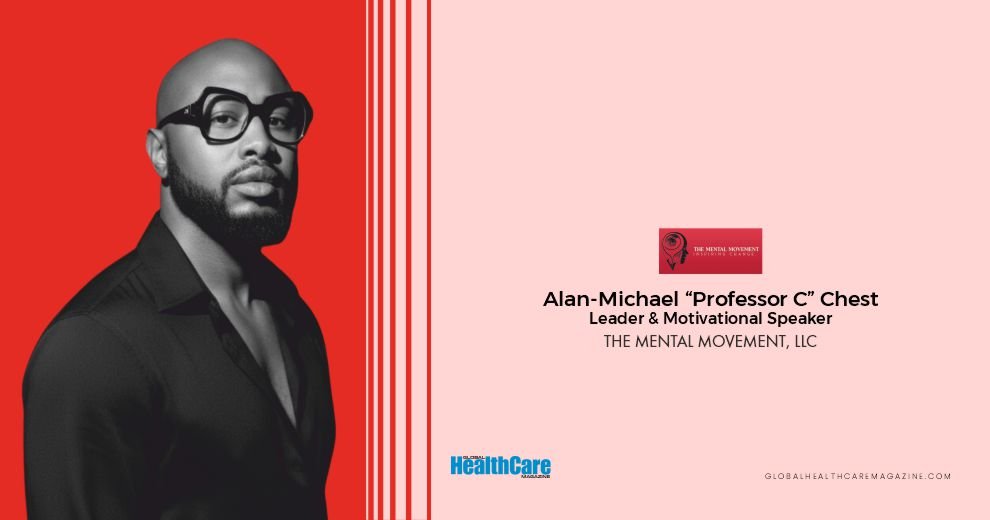
A therapy session, in the world Alan-Michael Chest has built, does not begin with a waiting room. It begins with a login screen, a quiet room somewhere in Western Massachusetts, and a client who may never have set foot in a clinic. That small shift, meeting people where a screen already exists rather than where an office happens to be, sits at the center of how Alan-Michael Chest, known professionally as Professor C, has assembled his career. He is a Licensed Mental Health Counselor (LMHC) and School Adjustment Counselor (SAC), and today he serves as Leader and Motivational Speaker at The Mental Movement, LLC, a role that stretches across clinical practice, consulting, and public speaking in ways that resist a single job title.
To understand how he arrived here, it helps to start with the foundations of his professional journey. Professor C earned his Bachelor of Arts from Westfield State University, then completed a Master of Education at Cambridge College. Those two institutions, one for his undergraduate years and one for his master’s degree, form the academic spine beneath a career that has since branched into private practice ownership, crisis intervention training, and a media presence built almost entirely on his own name.
Learning the Work From the Inside
Before there was a private practice, there was more than a decade spent inside systems that do not always make the news. Professor C worked as a Program Supervisor and Clinical Care Manager at The Key Program Inc., where his responsibilities included treatment planning, clinical interventions, and staff training for youth with complex trauma histories in both residential and community-based settings. He also held the role of CBHI Clinical Supervisor and Crisis Prevention Interventionist, training staff regionally on how to assess what he calls demonstrable danger and how to apply safety techniques that keep both client and clinician steady in a crisis.
That work, often unseen, shaped the clinician he would later become. “I have sat in living rooms and group homes where everything feels like it is falling apart,” he said. “Those experiences taught me that transformation is possible, but it has to be intentional, structured, and compassionate at the same time.”
It is a line that reads less like a mission statement and more like a lesson learned the hard way, in rooms where the stakes were immediate and the outcomes were not guaranteed.
Two Practices, Entirely Virtual
In 2025, Professor C began building something of his own. Miracles Happen Therapy, launched in April 2025 and operating through SonderMind, was his first venture into private practice, and it quickly grew into a stable panel of clients. Seven months later, in November 2025, he opened a second practice, The Wellness Collective, which runs through Headway. Both practices operate entirely through Telehealth, a structural choice that is not incidental to his brand but central to it.
The reasoning is practical as much as philosophical. Virtual care allows him to reach individuals, couples, families, and groups across Western Massachusetts and beyond, including people who might be wary of walking into a clinic, or who simply lack the transportation and the flexible schedule that in-person therapy often demands. “When a client logs on, I want them to feel like they are entering a space that understands their story, not a system that is suspicious of it,” he said, describing the tone he tries to set from the very first session.
The Wellness Collective is now in an expansion phase, taking on additional referrals as he positions the business for what he describes as steady growth in remote mental health services.
The Clinical Toolkit
Ask Professor C to describe his clinical approach, and the answer arrives as a list of frameworks that, together, sound less like a menu of techniques and more like a philosophy of attention. He draws on Dialectical Behavior Therapy (DBT), Trauma-Focused Cognitive Behavior Therapy (TF-CBT), Expressive Art Therapy, and narrative work, blending them to help clients build core mindfulness, emotional regulation, distress tolerance, and interpersonal effectiveness.
His caseload spans individual work, family engagement, and couples counseling, with clients presenting concerns that include anxiety, depression, ADHD, PTSD, and life transitions. Some of that work happens over video calls, some of it happens face to face, but the throughline, he insists, is the same: therapy has to feel collaborative, not clinical in the cold sense of the word.
That collaboration has a name in his practice. He calls it a RICH therapeutic relationship, built on Respect, Information, Connection, and Hope, a framework he uses to describe the helping relationship. “What I enjoy most about practicing therapy is meeting my clients where they are at and helping them navigate life’s challenges,” Professor C said. “I find it deeply rewarding to support each person in developing the skills and insight they need to move forward with greater clarity, resilience, and confidence.”
Beyond the Talk Therapy Model
Not everyone who needs support will walk into, or log into, a traditional session, and Professor C has built a separate venture around that reality. The Mental Movement, LLC operates as a consulting and content company, offering clinical consultation and administrative services alongside expressive art-based programming that folds narrative therapy, creative writing, singing, dancing, poetry, and theater into the healing process.
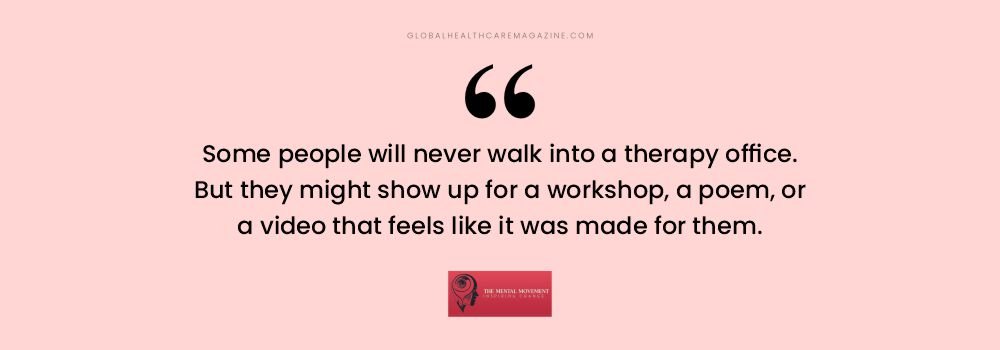
“Some people will never walk into a therapy office,” he said. “But they might show up for a workshop, a poem, or a video that feels like it was made for them.”
That instinct extends onto social media, where he posts under the banner Visions of Professor C on TikTok and YouTube. The videos blend psychoeducation, poetry, personal reflection, and cultural critique, functioning simultaneously as marketing channels and testbeds for future workshops, keynotes, and podcast segments still taking shape.
Seven Domains, One Framework
Underneath all of it, the clinical work, the content, the speaking engagements, sits a single organizing idea that Professor C returns to across every format he touches. He calls it the seven domains of Life Functioning Wellness for Personal Growth: Emotional, Spiritual, Physical, Intellectual, Occupational, Social, and Environmental. It is the same framework whether he is sitting across from a client in an intake session or standing at a podium in front of an audience.
“As Professor C, I see myself as an ambassador for peace and an agent for change, helping people honor their individuality and celebrate growth in every area of their lives,” he said, a description that functions as both a personal creed and something closer to a brand promise.
Cultural competency runs through the framework as well. Professor C places particular emphasis on self-identity and pride as tools of healing, describing them as ways for clients to take back control of their lives and use that power to heal mentally, spiritually, and physically.
Recognition and a Widening Platform
The visibility that has followed Professor C’s work has arrived from several directions at once. He was featured in America’s Best in Medicine 2025, in Westfield State University’s Alumni in the News 2025, and in The Metro Record 2026. He has appeared on the America in Black and White Podcast across both 2025 and 2026, and was featured on The Kingdom Factor in 2026. He also served as Keynote Speaker for Westfield State’s Lead Scholar Summer Bridge Program Ceremony in 2026, held in Westfield, Massachusetts, where his own academic path began.
Off the Clock
For a clinician whose work often centers on helping others regulate and restore, the question of his own balance is not a small one. Professor C answers it with the same creative vocabulary that runs through his clinical work. His self-care runs through artistic expression, singing, dancing, songwriting, and playing the piano, alongside a consistent commitment to physical exercise and the gym. His interests outside work reflect the same value he places on creative expression and personal well-being.
The Closing Message
Professor C’s framing of his own mission rarely stays abstract for long. He speaks directly to what he calls the ‘everyday’ person, someone who has decided that enough is enough, who has made a commitment that today and tomorrow must be better than yesterday. He asks that person to consider whether they want to be the hero in their own story, and positions his practices, his content, and his consulting as one possible next step in that decision.
“The sun will come out tomorrow,” remains the message he returns to again and again, paired with a closing line that has become something of a signature: “Always today. Always tomorrow.”
Quote