If you spend enough time in the back office of a medical practice, you begin to notice a specific kind of silence. It is not the peaceful silence of a library but the tense, pressurized silence of a stalemate. On one side of the screen is a provider who has just spent forty minutes navigating the complex physiology of a human being. On the other side is a payer, a massive entity bound by a labyrinth of codes, regulations, and rigid definitions of necessity. Between them sits a claim, essentially a digital request for payment that seems simple but is, in reality, a battlefield.
For decades, this battlefield has been littered with casualties; not patients, but practices. Good doctors are drowning in cumbersome paperwork, and clinicians who can diagnose a rare disease often struggle to interpret the cryptic rejection codes found in denial letters. The disconnect is profound: clinical excellence does not guarantee operational survival.
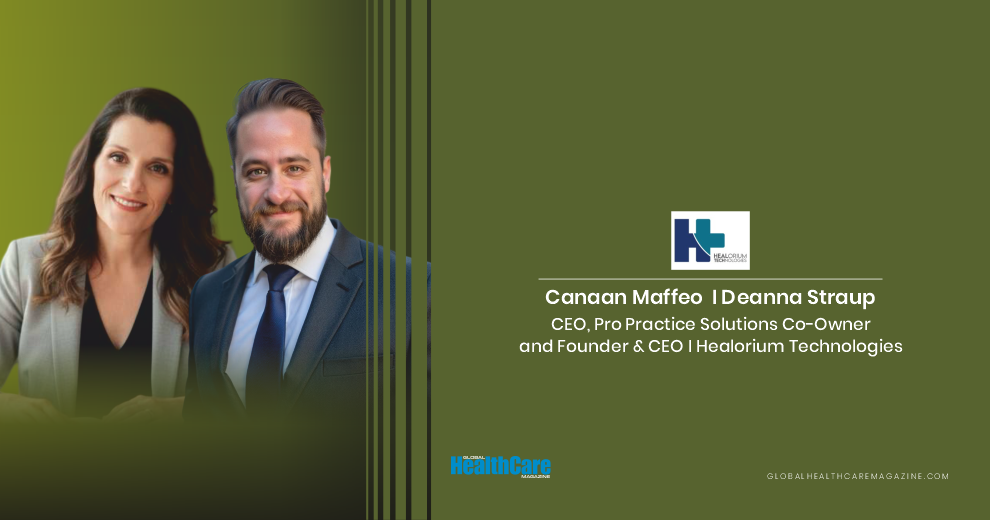
In this fractured landscape, two figures have emerged not just as fixers but also as translators. Deanna Straup and Canaan Maffeo are operating at the intersection of where care is delivered and where it is paid for. They are different in almost every way; one is an operations strategist who finds solace in crafting, while the other is a nurse practitioner who relieves stress through woodworking. One approaches the problem from the chaotic center of administration, while the other approaches it from the bedside.
Together, through their respective and collaborative ventures, Pro Practice Solutions and Healorium Technologies, they are dismantling the “black box” of the revenue cycle. They are asking a question that is rarely posed in the high-speed world of medical billing: Who is this actually serving?
This is how they are shedding light in a darkened room.
Part I: The Strategist
Deanna Straup CEO, Pro Practice Solutions | Co-Owner, Healorium Technologies
Deanna Straup does not believe in the myth of a “perfect” work-life balance; she believes in intention. During the quiet moments away from running two companies, she engages in crafting. This tactile, grounded activity involves taking various raw materials and transforming them into something cohesive.
Metaphorically, this process mirrors what she does professionally.
Deanna’s entry into healthcare operations wasn’t a calculated ascent through the corporate hierarchy; it was a journey through the trenches. She started her career in the administrative foundations of the industry, where the lofty ideals of medicine intersect with the harsh realities of finance. What she observed was a systemic tragedy.
“What quickly stood out to me was the disconnect,” Deanna explains. She speaks with the precision of someone who has spent years identifying organizational fractures. “Providers were doing everything right clinically, yet reimbursement failures, documentation gaps, and payer complexity undermined their success.”
She witnessed how skilled physicians were hindered by administrative challenges. It wasn’t a lack of expertise; it was a failure in translation. The revenue cycle, a term that refers to the process of getting paid, had become fragmented, reactive, and confusing. It was a system designed to obfuscate.
Deanna realized that if she wanted to protect patient access, the ultimate purpose of her career, she first had to support the providers. You cannot serve the community effectively if you cannot keep the lights on.
The Partnership with Healorium
Deanna’s journey into ownership began with Healorium Technologies, the venture that preceded her own firm. In 2024, Canaan Maffeo hired Deanna after an exhaustive search in which he interviewed over 100 candidates. Recognizing her invaluable expertise, her compensation was structured as a percentage of ownership rather than a traditional salary, effectively making her a partial owner of the company.
She recognized the opportunity to bridge the gap between what doctors document and what insurance companies approve. Healorium represents the future that Straup is working towards. It is a platform that employs intelligent claim-scrubbing, aligning documentation with requirements before claims are submitted. Straup plays a pivotal role in training the system, incorporating the real-world rules she has perfected over her decades of experience.
“This venture embodies my belief that the future of revenue cycle management lies at the intersection of education, automation, and compliance intelligence,” she states.
The Birth of Pro Practice Solutions
Following the conclusion of her initial contract with Healorium, Deanna decided to branch out to focus specifically on compliance and education. She founded Pro Practice Solutions not out of vanity, but out of necessity. She had witnessed many healthcare providers overwhelmed by a system that had become “fragmented, reactive, and opaque.”
The traditional Revenue Cycle Management (RCM) industry was failing them. Vendors focused on transactions rather than outcomes. They would post payments but often failed to explain why certain claims were denied. They pursued Accounts Receivable without addressing the root causes of the debt.
“Providers didn’t need another billing company; they needed a strategic partner who could integrate operations, compliance, and education,” Deanna explains.
Pro Practice Solutions was established to bridge this gap. The firm aims to stabilize revenue while empowering providers with clear insights. While the core focus areas, medical billing, coding, credentialing, and operational consulting, are standard, the approach is radically different. Deanna does not view the revenue cycle as a mere back-office function; she sees it as a “strategic lever.”
Instead of merely reacting to denials, her team analyzes trends to prevent them. They customize solutions based on specialty and payer mix, rejecting the rigid, one-size-fits-all models that have stifled practices for years.
The Burden of Compliance
One of the heaviest burdens facing modern medical practices is the constantly changing landscape of CMS (Centers for Medicare & Medicaid Services) compliance. The rules change frequently, which can lead to what Deanna describes as “compliance fatigue.”
Her leadership style is characterized by how she manages this burden. She serves as a filter, absorbing complex, bureaucratic policy language and translating it into practical, role-specific guidance. She informs clinicians about what to document, billers about what to code, and administrators about what to monitor. She simplifies the information without diluting its essence.
“My advice is to never lose sight of the human impact behind the numbers,” Deanna says.
This human-centric approach extends to her leadership within the company. Deanna sees herself as a leader who operates at the intersection of strategy and operations. She is not an absentee owner; she reviews complex claims, advises on disputes, and provides mentorship.
She recalls a specific crisis involving staffing shortages and sudden changes in payer policies, where the pressure was intense. Her response was not to tighten her grip but to open her hands. “I responded by prioritizing transparency, decisiveness, and empathy,” she says. “Clear communication, firm boundaries, and a people-first approach allowed us to regain stability.”
For Deanna, success is not measured solely by a clean balance sheet; it is reflected in the transformed atmosphere within a client’s office. She values the moment a practice shifts from a reactive stance to a proactive one. It’s about the quiet confidence of a doctor who knows their work will be recognized both clinically and financially.
Deanna is envisioning a future where the revenue cycle no longer instills fear. Her goal is to develop software that analyzes patient charts in real-time, enabling clinicians to add compliant addendums before submission. This tool is designed to empower healthcare providers, ensuring that the story of each patient’s care is told accurately and completely.
“Lead with integrity, clarity, and courage—even when it’s uncomfortable,” she advises. For Deanna Straup, comfort comes from clarity. She is crafting a system where the silence in the back office is no longer filled with tension; it is simply the sound of a job well done.
Part II: The Builder
Canaan Maffeo Founder & CEO, Healorium Technologies
Canaan Maffeo understands what it feels like to stand at a patient’s bedside. He knows the weight of a patient’s hand, the complexity of a family’s worries, and the intricate, high-stakes decision-making that occurs during a primary care visit. As a nurse practitioner, his professional foundation was built in the intimate settings of in-home care for the elderly and those with complex medical needs.
However, Canaan also knows the feelings that arise after the visit: the frustrating sensation of sitting in front of a computer hours later, trying to translate the nuances of human care into the rigid language of billing codes.
“I experienced firsthand how documentation, billing, and operational inefficiencies directly affect patient care,” Canaan says. “I learned quickly that even excellent care can be undermined by poor documentation workflows.”
While most clinicians accept this frustration as part of their work, Canaan refused to do so. He examined the system, noting that manual chart reviews were slow, inconsistent, and reactive, which revealed a significant design flaw. The tools available to doctors were created by accountants, not by caregivers.
When the clinic closes, and the screens go dark, Canaan often turns to woodworking; a hobby that requires patience, structural integrity, and respect for the material’s grain. In 2023, he began applying those same principles to software development. He founded Healorium Technologies not to create a better billing system, but to develop a translation engine that spoke the language of doctors.
The Logic of the Clinician
Healorium’s origin story is one of resistance against mediocrity. Canaan grew tired of seeing practices lose revenue, not because they provided poor care, but because they poorly communicated that care through paperwork.
“Healthcare needed tools built with clinical logic, not just billing rules,” Canaan explains. This distinction is the cornerstone of his philosophy: “Clinically informed automation.” While it may sound technical, the concept is profoundly human. A standard algorithm focuses solely on finding a code, whereas Canaan’s AI looks for context. It understands how a provider thinks and analyzes clinical documentation to recommend appropriate ICD-10 and CPT codes, identifying compliance gaps before a claim is even submitted.
“Without clinical context, automation creates risk,” Canaan says. “With it, automation becomes a safeguard.”
He is building a system that respects the autonomy of the provider. The AI does not override the doctor; instead, it provides gentle guidance. It serves as a safety net, catching missed details or vague phrasing that could lead to a denial.
Bridging the Trust Gap
The key challenge is establishing trust. Medicine is a field that is often skeptical of new technologies, especially those that aim to automate the essential work of physicians. Doctors are cautious about having a machine watching them as they work.
Canaan helps bridge this trust gap because he is not an outsider; he is part of the medical community. He isn’t a Silicon Valley developer trying to guess how doctors operate; he understands their workflow firsthand.
“My clinical background helps build that trust with healthcare providers because they know these tools were built by someone who understands their reality,” he explains.
He is open with his peers: the AI is not intended to replace them but to empower them. By managing the cognitive demands of compliance, the technology allows healthcare providers to focus more on their patients. This represents a form of digital servant leadership, where the software supports the doctor so that the doctor can better serve the patient.
Leadership in the Dual World
Leading Healorium while actively practicing medicine was a significant challenge for Canaan; it tested his limits.
“Balancing patient responsibility with company growth requires difficult prioritization,” he admits. This experience forced him to evolve from a founder-driven model to one that is more system-driven. He learned to build a team that was stronger than himself and to trust them fully.
This transition has enabled Healorium to scale effectively. Although Canaan remains the visionary, setting the product roadmap and managing key client relationships, he relies on his team’s operational proximity to keep innovation grounded. He is determined not to let strategy become disconnected from the realities of their work.
The Metric of Peace of Mind
How does Canaan define success? It’s not solely based on the increase in revenue recovery, although Healorium has indeed helped clients recover significant amounts. Success, for him, also lies in reducing anxiety.
“Success is not theoretical,” he explains. “It is reflected in providers spending less time correcting preventable errors.”
He monitors claim acceptance rates and audit results, but the true measure of victory is the “clean claim”—one that moves through the system smoothly. Each clean claim signifies a provider who doesn’t have to struggle for their payment.
The Vision of Integration
Looking forward, Canaan aims to redefine the relationship between revenue cycle management and clinical care. He envisions a future where billing is not an afterthought but an integrated and proactive part of the care process.
“Healthcare does not need more complexity,” Maffeo asserts, echoing a sentiment that could be carved above the door of every hospital in America. “It needs clarity, accountability, and systems designed by people who understand the work being done.”
He is expanding Healorium’s AI capabilities and education programs, collaborating closely with Straup to ensure that the operational side aligns with technological innovation.
Canaan recognizes that achieving a “perfect” work-life balance is an unrealistic expectation for a founder, but he finds his grounding in his family and cooking. These are the aspects of life he values most.
In a world filled with abstract codes and digital denials, Canaan Maffeo is advocating for what is tangible. He is fighting for the integrity of medical records and the well-being of medical providers. He is constructing a framework where the roof is secure and the foundation is strong, allowing those within to focus on their true purpose: healing.
A Shared Vision
Deanna Straup and Canaan Maffeo operate at opposite ends of the same lifeline. Straup is the operational guardian, ensuring that the business of medicine is sound, compliant, and compassionate. Maffeo is the technological innovator, making sure that the language of medicine is accurately translated into a language that conveys its value.
They are united by a shared determination to challenge the status quo. They reject the notion that complexity is inevitable and the idea that a doctor must choose between caring for a patient and receiving payment for their services.
In their work, they return to the fundamental question of “Who?” Who are they serving?
They serve the healers. By alleviating the burdens on these healers, they ensure that when we, the patients, enter that exam room, the person facing us is not distracted by a denial letter, but is fully present and attentive to our needs.
Also Read: The 10 Most Impactful Healthcare Revenue Cycle Leaders to Watch in 2026