At seventy-seven years old, a man in the south of France still walks into an operating theatre most mornings, scrubs in, and works. He has done this for decades. He will very likely do it tomorrow. His son, who grew up watching him do exactly this, once stood at the edge of two futures, medicine on one side and engineering on the other, unable to decide which one deserved him. He never really resolved that argument. He simply found a specialty patient enough to hold both halves of it at once.
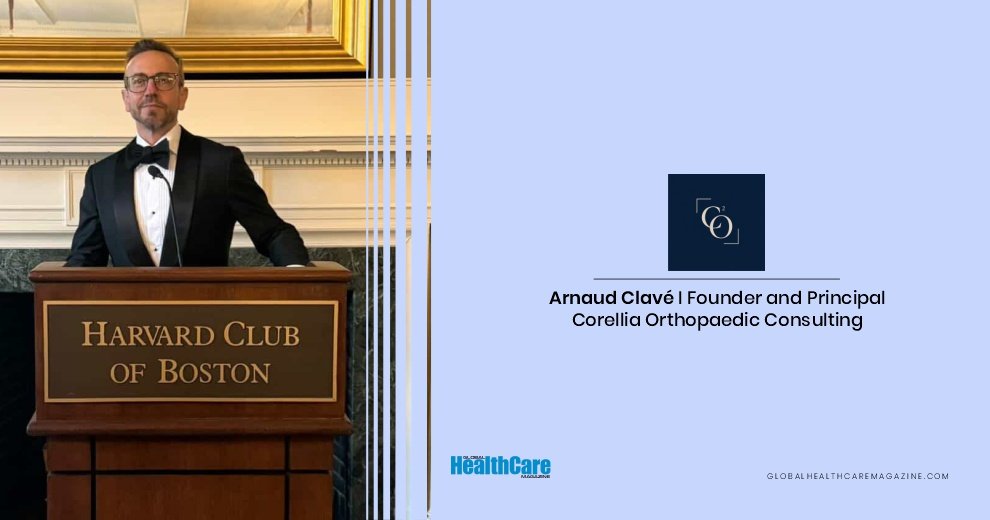
That specialty was orthopaedics, and the son was Dr Arnaud Clavé, who today serves as Founder and Principal of MedTech Strategy and Healthcare Transformation Advisory at Corellia Orthopaedic Consulting. He is also co-founder of Ostara Surgery, an implant design venture born out of a doctoral research programme, and co-founder of the Institut Niçois Orthopédique et Vertébral (INOV) in Nice. He is, by his own account, not a man who experienced a single defining turning point. He describes his life instead as “a continuum,” one long unbroken conversation between two disciplines that, in his hands, stopped being opposites.
The Making of a Surgeon Who Thinks Like an Engineer
Every profile of a distinguished physician tends to reach for the word calling, as though a destiny had been waiting quietly all along. Dr Clavé’s account resists that shape. He did not stumble into orthopaedics through inspiration. He arrived there gradually, eventually recognizing that orthopaedics was “the specialty where medicine and engineering meet natively.”
His inheritance was not a specialty at all, but something closer to a temperament. Both of his parents are physicians, and his father, still practising at seventy-seven, passed on what he calls “a posture: curiosity, hard work, and the conviction that you never stop being a student.” It is a modest description for what amounts to a philosophy of an entire career, and it recurs, almost like a refrain, throughout everything Dr Clavé says about himself.
The choices that followed were deliberate rather than convenient. He completed his residency in Brest, France, specifically because the city was home to the LaTIM laboratory, one of the world’s pioneering centres in computer-assisted orthopaedic surgery. As he puts it, without ceremony, “I chose a city for a laboratory.” Time at Oxford came next, an experience he credits not with teaching him a technique but with showing him, plainly, what excellence looked like, and what could be built once you had it. That period led directly into his PhD in AI-driven implant design, completed back at LaTIM, closing a loop that had begun years earlier with a boy who could not decide between a stethoscope and a slide rule.
Later still came the Harvard Surgical Leadership Program, which he describes as a shift of an entirely different nature, one that moved him definitively toward strategy and transformation. It is a detail worth sitting with, because it explains a great deal about the two ventures he would go on to build.
Two Companies, One Argument
Ask Dr Clavé why Corellia and Ostara exist, and he does not describe a business opportunity. He describes an injustice, stated plainly and without heat. “Surgeons are consulted too late,” he says, “on decisions already taken, and to validate rather than to orient.” The surgeon, in his view, is too often treated as an end user, a consumer of someone else’s technology, when it is the surgeon who actually guarantees the quality of care a patient receives. Strategy, meanwhile, is left to administrators, policymakers, and industry, whose interests he calls legitimate, but not always aligned with the patient’s.
Corellia was built to correct that asymmetry, to bring what he calls surgical intelligence back to the table where strategy is decided, and to insist that clinical judgment is a strategic asset rather than a courtesy contribution.
Ostara Surgery is the mirror image of that mission, building rather than advising. It is the industrial continuation of FollowKnee, a €24 million research programme at LaTIM that had, in an earlier life, been Dr Clavé’s own doctoral work. He co-founded the company with his surgical mentor, Professor Eric Stindel, and with engineer Guillaume Dardenne. The problem the venture set out to solve is not a comfortable one to say aloud in a boardroom: between 15 and 20 percent of knee replacement patients remain dissatisfied after surgery, and failure rates climb as high as 20 percent in patients under the age of 55. Standardised implants, in his assessment, simply cannot absorb that much human variability. Ostara’s pipeline takes a CT scan and turns it into a personalised implant in under ten minutes.
The separation between the two ventures is not incidental. It is, Dr Clavé insists, the entire point. “Advice that sells your own product is not advice.”
Even the names were chosen with intention. Corellia borrows from the Star Wars universe, a world associated with engineers and independent builders. Ostara takes its name from the goddess of dawn, an emblem of renewal and the return of movement. Neither name was picked idly.
The Obstacle Is No Longer the Machine
When Dr Clavé is asked what stands between modern healthcare systems and the innovations meant to serve them, his answer arrives without hesitation, and it is not what most people expect. “The main barrier is no longer technological,” he says. “It is organisational.”
Health systems, in his experience, tend to buy technology rather than transformation. A robot installed into a pathway that has not itself been redesigned adds capital cost and operating time without improving a single outcome that matters to the patient. The machine, he argues, was never the intervention. The redesigned pathway around it was.
The second obstacle is cost, and he is unusually direct about how rarely this gets said aloud. Adoption, he explains, is frequently unfunded. The technology gets purchased, the learning curve gets absorbed, operating time lengthens, and none of that burden is reimbursed. It falls, instead, on the surgeon or the facility. “Innovation financed by the people asked to adopt it,” he says, “will always be adopted slowly.”
The third obstacle is simply human. Adoption, in his view, is decided by teams, by training, and by surgeon conviction, never by procurement committees. A technology a team has not been given time to master will underperform, and will then, unfairly, be blamed for that underperformance.
A Practice Built on a Closed Loop
What distinguishes Dr Clavé’s advisory approach comes down to three things, and none of them are abstractions.
First, he still operates. Whatever he recommends in a boardroom, he uses himself in theatre, on his own patients. This closes a feedback loop that most advisors in his position never have. “I cannot recommend something I would not be prepared to live with clinically.”
Second, he was trained on both sides of the equation that so often divides healthcare and industry. His PhD gave him the engineering vocabulary; Harvard gave him the strategic one. He can spend a morning with an R&D team and an afternoon with a board, translating fluently between two groups that, as he puts it, rarely speak the same language.
Third is independence. Corellia resells nothing and represents no one. “What I offer is judgment,” he says, “and judgment loses its value the moment it is for sale.”
This is not a philosophy that lives only in interviews. It shows up in the numbers of his own clinical practice, which he shares with a precision that borders on the forensic. He performs roughly 300 knee replacements a year, close to 90 percent of them robotically assisted or navigated, alongside 150 navigated hip replacements. As many as 30 percent of his patients go home the same day as their operation. Every one of them, without exception, is enrolled on a digital follow-up platform, meaning his practice holds patient-reported outcomes on 100 percent of the people he treats. “Precision without measurement is a claim,” he says. “Precision with measurement is evidence.”
Three Rooms, One Week
Dr Clavé describes his week as running in three modes, and he is careful, almost protective, about the boundaries between them. Surgery and consultations remain the core, high-volume hip and knee arthroplasty, the place where, in his words, the questions originate. Advisory work occupies the second mode. Ostara claims the third, where his involvement extends well beyond clinical input into implant design decisions and strategic direction.
What he says he enjoys most is not any single one of these rooms, but the moment they connect, when a problem encountered in theatre becomes a design decision days later, and a strategic argument the week after that. “Most people in this industry,” he observes, “only ever see one of those three rooms.”
None of it happens alone. At INOV in Nice, which he co-founded with two fellow orthopaedic surgeons and a spine neurosurgeon, building the institute meant aligning surgical, anaesthetic, and rehabilitation teams around structured pathways. In research, his collaboration continues with INSERM LaTIM in Brest. In industry, he has worked as a key opinion leader and strategic consultant with ATF, Microport, Zimmer Biomet, and Orthokey, across hip, knee, and robotic portfolios, and has designed surgeon education programmes across European markets. “Each of these groups holds part of the answer,” he says. “None holds all of it.”
Ten Years to Move a Room That Could Not Be Ordered to Move
If there is a single story that reveals how Dr Clavé actually leads, it is the one about robotics, and it took him close to ten years to tell it properly, because it took him close to ten years to live it.
He works in a private hospital where surgeons are independent practitioners, colleagues, yes, but also competitors, drawn from different generations, with no hierarchy above them to appeal to. Nobody could be instructed to change a technique that had served them for decades. The only tool available to him was persuasion.
His first attempt failed. He brought the accuracy data. He brought the literature. “It changed almost nothing,” he admits, because to a surgeon with twenty-five years of excellent results, precision data reads not as information but as an implicit criticism of a life’s work.
What eventually succeeded was a change of register entirely. He stopped making the case about surgery alone, and began making it philosophically, organisationally, and strategically instead. It had to be visibly good for everyone, not for him. And that, he says plainly, was the real cost of the whole exercise. To make the project collective, he had to step back from it, becoming one of the people who benefited least from it in terms of visibility. Some of his colleagues had to revisit techniques they had held for decades, which he does not pretend was a small thing to ask of anyone. “Leadership without hierarchy comes down to a choice,” he says. “Give the credit away, or keep it and change nothing.”
The Achievement That Was Never About the Ranking
When asked what he is proudest of, Dr Clavé does not reach for the institute he co-founded, or the PhD, or the decade spent moving a hospital that did not particularly want to be moved. He reaches, instead, for Harvard, and he is careful to explain why.
He had arrived at the Surgical Leadership Program having spent twenty years becoming technically excellent at one thing. The programme put him back in the position of a beginner. His capstone project was ranked second in his cohort, an achievement he is glad of, but he is quick to clarify that the ranking itself was never the point. “It was discovering, well into a career, that I could still be transformed.” The other milestones, he says, including INOV, the PhD, and the ten years spent bringing robotics into a resistant hospital, were all extensions of who he already was. Harvard, by contrast, changed who he was.
A Decade in Which the Human Becomes the Differentiator
Asked to look forward, Dr Clavé’s vision resists the easy optimism that so often surrounds MedTech conversations. Care, he believes, will become far more personalised: implants, planning, pathways, and rehabilitation, adapted to the individual rather than to a population average. This is precisely what Ostara is built on, and he expects it to become the standard rather than a premium option.
But he pushes back, gently and deliberately, against the idea that AI and robotics will replace surgeons, and he says so as someone who has spent a decade arguing in their favour. “Here is where the consensus is wrong,” he says. “It assumes technology determines the quality of care. It does not. Technology determines the quality of the gesture.” The quality of care, in his view, is determined by everything that surrounds that gesture: the consultation in which a patient genuinely understands and decides, the team that knows exactly what to do at three in the morning. The paradox of the coming decade, as he frames it, is that the more the technical act becomes automated, the more the human dimension becomes the differentiator. “We should be investing in both,” he says. “We are investing in one.”
What Holds the Rest Together
Behind a life divided so carefully between theatre, boardroom, and laboratory, Dr Clavé is candid about what actually makes the arrangement possible. “Behind anyone who accomplishes anything,” he says, “there is usually a family that made it possible.” He calls this not a polite sentence but an honest explanation of how the rest of it holds together.
Outside of work, his passion is cars and mechanics, a pursuit he admits is unsurprising for a man who nearly became an engineer. It is, he says, the same pleasure in a different form: understanding how something works, and making it work better. He swims regularly, which clears his head, and skis a great deal in winter with his family.
A Closing Instruction, Not a Slogan
Asked if he had anything else to offer readers, Dr Clavé does not reach for a new philosophy. He offers, instead, the one he already lives by. “Work hard. Stay curious and never stop learning. And love your family even more than that.” It is not original, he says, and he does not present it as such. It is simply what he watched his father do, and what his father, at seventy-seven, is still doing: operating, teaching, learning.
His closing message to younger colleagues is less a piece of advice than a quiet challenge. Do not choose between the operating room and the wider system. The surgeons who understand both, he believes, will be the ones who shape what comes next, and what comes next needs shaping by people who still see patients.
Quotes