There is a saying that moves quietly through emergency departments, passed between physicians like a truth too obvious to argue with: “You don’t choose emergency medicine, emergency medicine chooses you.”
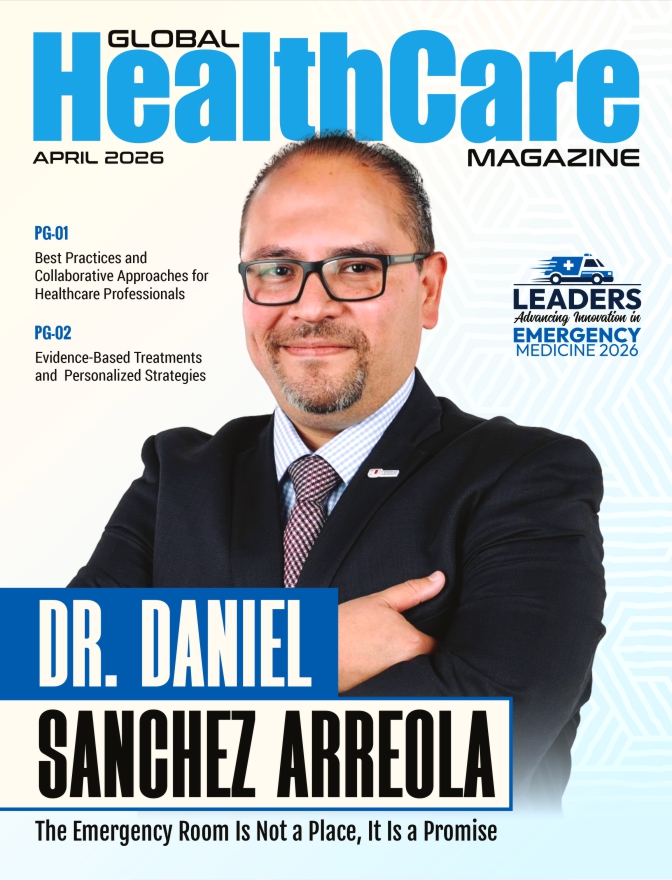
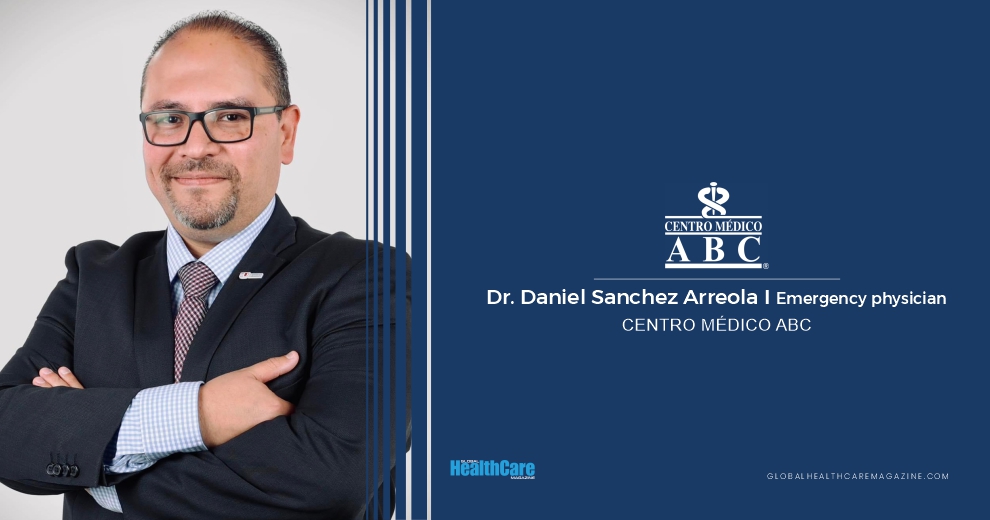
Dr. Daniel Sanchez Arreola was chosen on an ordinary afternoon in Mexico City, during a rotation he took as a medical student at the old Central Hospital of the Red Cross. He was there, watching, when an incident involving a massive number of victims arrived at the emergency room doors. What he encountered was not the chaos one might expect. It was something far more instructive.
He watched the emergency personnel move with precision through the worst moments of other people’s lives. He watched them stay calm. He watched them make decisions, in seconds, that would shape outcomes that would last forever.
“Seeing how the emergency personnel treated the injured, how they behaved, and how it was possible to do something for them in their most dramatic moment without losing calm and control,” he said, “awakened in me the need to do it permanently.”
And so it began.
A Doctor and a Specialty Still Finding Its Place
Today, Dr. Sánchez Arreola is one of the most consequential emergency medicine physicians in Latin America. He graduated from Anahuac University, completed his specialty in Emergency Medicine, and holds a Master’s degree in Health Systems Administration and Medical Education. He sits on the examination board of the Mexican Council of Emergency Medicine, serves as a board member of the Latin American Federation of Emergency Medicine (FLAME), and holds the position of head professor of the emergency medicine course at UNAM, the National Autonomous University of Mexico.
But titles, in his case, are a starting point rather than a summary.
To understand the fuller picture, you first have to understand the landscape he entered. Emergency medicine in Latin America is a young specialty. It recently celebrated its 40th anniversary in the region, and yet it remains unknown to segments of the population and, perhaps more frustratingly, undervalued by other medical specialties until those same specialties urgently need it.
Dr. Sánchez Arreola is direct about this. “To understand emergency medicine, you have to be in the emergency room,” he says. He does not mean it rhetorically. He means it as a fundamental statement about what the work actually demands of a person. It is a specialty built on critical thinking under pressure, on leadership, on a kind of teamwork that must function when there is no margin for error.
The challenge he sees for the next generation is one of identity. How do you instill in new graduates a genuine sense of belonging to this specialty? How do you help them understand the emergency department not as a “place” people pass through, but as a critical service that holds an entire system of care together?
It is a question that has shaped the arc of nearly everything he has done.
Three Pillars, One Mission
Dr. Sánchez Arreola describes his life’s work as resting on three interconnected pillars: clinical care, the training of new specialists, and the development of more efficient care systems. He is careful, always, to make clear that none of these can be meaningfully separated from the others.
In clinical practice, his daily work centers on time-sensitive conditions: heart attacks, strokes, and trauma. These are the emergencies where the margin between a good outcome and a catastrophic one is measured not in hours but in minutes. As an emergency physician at Centro Medico ABC and chief of the emergency department at Mexico City Public Health Services since January 2021, he continues to work in the resuscitation area, where, as he puts it, “critical decisions are made in a matter of minutes.”
He also dedicates significant time to communication and coordination with prehospital teams, which he considers essential for preparing for the arrival of critically ill patients and ensuring they receive timely care from the moment help is called.
But he is equally clear that what happens inside the emergency room is only part of the equation.
“Improving emergency care depends not only on what happens within the emergency room,” he says. “It also requires well-organized systems that ensure patients arrive on time, coordination between prehospital care and the hospital, and teams working with clear protocols.”
This is where his work takes on a scale that extends far beyond any single hospital ward. He has participated in the development of emergency medical dispatch systems, care protocols, and integration models across different levels of the healthcare system, serving as an active advisor both within and outside government structures.
In education, as the head professor of emergency medicine at UNAM since February 2022, he brings this same systems-level thinking directly into the classroom. “My mission is to train the next generation of doctors with a practical and ethical approach,” he said. What he wants new physicians to internalize is that emergency medicine is not merely a clinical specialty. It is, in his words, “a discipline that requires leadership, critical thinking, and teamwork.”
Building the Systems Behind the Care
Some of Dr. Sánchez Arreola’s most consequential work has happened at the structural level, in the unglamorous but essential work of building the very architecture that emergency care depends on.
He was part of the founding medical team behind Mexico’s 911 emergency call system and contributed to the development of the national medical emergency dispatch model, a framework that changed how emergencies are recognized, coordinated, and routed across the country. From January 2017 to December 2018, he served as a medical advisor for 9-1-1 Services under Mexico’s Secretariat of the Interior, placing him at the center of some of the most important policy decisions in emergency care in the country’s recent history.
His current advisory work as an Emergency Medical Dispatch consultant, combined with his long-standing board membership at FLAME since February 2021, extends this work to a regional scale. Emergency medicine in Latin America, he believes, is in a critical period of growth and consolidation. The recognition of the specialty is increasing. Interest in strengthening emergency care systems is growing. But the structural challenges remain stubborn: organizing prehospital systems, improving coordination between prehospital and hospital care, and ensuring that patients everywhere have genuine access to timely, specialized treatment.
“My vision is to help build stronger emergency care systems,” he says, “where medical education, research, and international collaboration allow us to share knowledge and best practices.”
The goal, in its simplest expression, is difficult to argue with: that any patient in Latin America facing a medical emergency can receive fast, well-organized, evidence-based care, no matter where they are.
The People Who Make It Possible
Emergency medicine is, at its core, a team undertaking, and Dr. Sánchez Arreola speaks about the people he works alongside with a warmth that feels unscripted.
Throughout his career, he has worked closely with fellow emergency physicians, nurses, paramedics, and medical dispatchers. What unites them, he says, is something beyond training or credentials. It is a genuine passion for the work and a commitment to doing their best for the patient.
Many of the professionals he works with today are physicians and specialists he had the privilege of mentoring or teaching at some point in their formation. Watching them now function as indispensable members of multidisciplinary teams is, he says, one of the more quietly satisfying rewards of a long career.
“They bring their own experience, new ideas, and fresh perspectives,” he says. “And honestly, I keep learning from them as well.”
The Weight of Leadership
Dr. Sánchez Arreola identifies two moments in his career that truly tested what leadership means. They are as different from each other as two experiences can be, and together they reveal a man whose instinct, under pressure, is to stay present.
The first was the COVID-19 pandemic. He does not describe it in triumphant terms. He describes it honestly. “Working with uncertainty, and honestly, with fear of the unknown, was a huge personal challenge,” he said. Resources were limited. The emergency department was overwhelmed. Patients arrived in critical condition without pause. And through it all, the human losses inside the medical community were not statistics.
“It is an experience I will never forget,” he says, “especially because during the pandemic, we lost colleagues and friends.”
The second test was a different kind of weight altogether. He served as President of the Mexican Society of Emergency Medicine (SMME) from March 2021 to March 2023, leading what is considered one of the most influential emergency medicine societies in Latin America. Where the pandemic demanded crisis management, the SMME presidency demanded vision, patience, and the ability to build genuine consensus across a wide and accomplished community of professionals.
Under his leadership, the society advanced significantly in education, research, and the broader promotion of emergency medicine across the region. He also currently coordinates the SMME’s Emergency Cardiovascular Care and Sudden Death Group, a role that reflects the continuing depth of his clinical commitment even beyond his presidential term.
The Written Record
A physician’s commitment to a specialty is partly measured in what they leave behind, and on this count, Dr. Sánchez Arreola’s record is substantial.
He has authored more than 40 national and international publications in indexed journals. He has contributed to emergency medicine books, written official national documents, and produced national emergency care protocols, international consensus statements, and position papers. He has spoken at conferences across Latin America and internationally.
He has also written two books that sit at the intersection of clinical urgency and practical guidance: “Sudden Death: Clinical Considerations and Treatment Algorithms” (2024) and “Stroke: The First 60 Minutes – Making Decisions in the Emergency Room” (2025). Both titles reflect the precision that defines his thinking. They are not abstract. They are tools, written for physicians who need to act.
His commitment to open-access publishing runs through the same conviction: knowledge that is not shared cannot save lives. He is the founder and managing editor of EMergiendo Open Access, established in November 2020, and serves on the editorial board of the Educación e Investigación en Emergencias journal (REIE), which today stands as one of the leading emergency medicine journals in Latin America.
He has also developed structured training programs, including the Advanced Trauma Resuscitation (RAT) program, of which he has been a founding professor since January 2023, and the Advanced Trauma Management (ATM) course, both designed to place critical skills directly in the hands of physicians who will use them.
The Human Behind the Doctor
Dr. Sánchez Arreola does not minimize what a life in emergency medicine costs. He speaks about it plainly, and without the performance of martyrdom.
“It’s not easy,” he says simply. “Emergency medicine is a very demanding field, and there are many times when the job takes a lot of your time and energy.”
His family has been, as he puts it, his unconditional support system. That word, unconditional, feels chosen with care. Not supportive, exactly. Unconditional.
He is also a vocal advocate for changing the conversation about mental health and work-life balance within the profession. Emergency physicians are exposed, daily, to stressful and emotionally intense situations that accumulate in ways that are rarely acknowledged. The old idea that being a good emergency physician requires sacrificing everything else in life is one he wants to dismantle, not just for his own generation, but for the next.
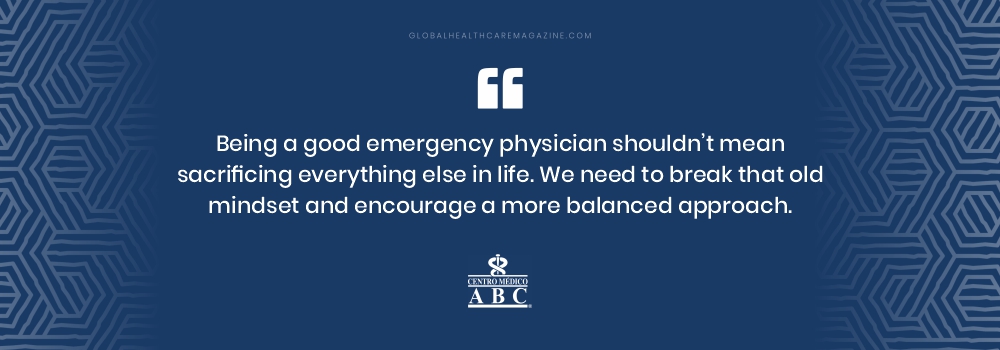
“Being a good emergency physician shouldn’t mean sacrificing everything else in life,” he says. “We need to break that old mindset and encourage a more balanced approach, one that allows doctors to care for their patients while also taking care of themselves, their families, and their personal lives.”
This, too, is a form of leadership. Perhaps one of the most enduring kinds.
The Medicine of the People
There is a phrase Dr. Sánchez Arreola returns to, a sentence spoken by Dr. Judith Tintinalli, a foundational figure in the field. It is this:
“Emergency medicine is the medicine of the people.”
It sounds simple. It carries real weight. It means that emergency medicine does not select its patients. It does not wait for appointments, insurance approvals, or favorable circumstances. It is there for anyone, at any moment, when help is needed most.
For Dr. Sánchez Arreola, this is not an inspirational abstraction. It is a daily responsibility.
“Being there for someone during an emergency and having the chance to change the course of their life is something truly special,” he says.
He has spent his career building the conditions under which that change becomes consistently possible: the systems, the protocols, the trained physicians, the published research, the open-access journals, the international collaborations, the training programs, the dispatch models. The individual moments of care rest on all of it.
“In emergency medicine, no one works alone,” he says, “and it’s that collective effort that truly allows us to change people’s lives.”
It is a straightforward belief, held by a man who has spent decades earning the right to say it with certainty.
Quotes