There is a familiar discomfort in modern medicine. It is the hum of the fluorescent lights at ten p.m., the sterile click of a keyboard, the weight of a thousand charts, and the slow, quiet erosion of a calling. It is the feeling of being “stuck.”
For more than fifteen years, Xunda Gibson, M.D., lived inside that discomfort. She was, by every metric, a success. A graduate of the University of Kansas School of Medicine. An internship at the University of Miami’s Jackson Memorial Hospital. A residency was completed at Santa Barbara Cottage Hospital. Board certification in Internal Medicine. She built a life steeped in the nobility of her profession, culminating in her own private practice.
She had set out, like most, with a pure and simple desire: to help people. She pictured days filled with meaningful patient care, the slow and steady building of relationships, the quiet satisfaction of making a difference.
The reality was a different portrait entirely. It was a canvas painted in the gray tones of long hours, endless charting, and the suffocating pressure of administrative duties. The time for breathing, let alone thinking, was a luxury she could not afford. The person she was serving was no longer the patient; it was the system.
“I almost walked away from clinical practice entirely,” Dr.Gibson says, her voice measured, reflecting on a time that nearly broke her. The pressure was not just emotional; it was mathematical. “Rising cost, decreasing reimbursements put a heavy strain on my solo practice. It came down to a cash flow decision.”
She sold the practice. Burned out, disillusioned, and standing at the edge of a professional cliff, she knew something profound had to change. She had to reclaim her freedom, but it had to be on her terms.
What she found was not an escape from medicine, but a new way into it. It was a path that led her to the U.S. Virgin Islands, to a reboot of her career, and to the discovery of her own “why.” This is the story of how Dr. Xunda Gibson found travel medicine, and in doing so, found the blueprint to give her life back. And now, she is giving that blueprint to every other physician who feels, as she once did, hopelessly stuck.
The Familiar Discomfort
To understand the freedom Dr. Gibson now champions, one must first understand the cage she left behind. The central struggle was not the medicine. “Caring for the patient is the easy part,” she explains. The difficulty was, and is, “Navigating the bureaucracy of health care in the U.S.”
She describes a daily grind that is all too familiar to her colleagues. The primary adversary was the electronic medical record. “I always struggled with completing my electronic medical records charts,” Dr. Gibson admits. “I spent more time typing office notes than face-to-face time with the patient.”
This is the central paradox of modern healthcare: a system designed for efficiency that thieves the very human connection it is supposed to facilitate. The charts, she recalls, would “carry over to the next day.” This created a “perpetual state of being behind,” a Sisyphean task where the digital paperwork was never, ever done.
When she transitioned to hospital-based inpatient care, the setting changed, but the burden did not. “The charts were still there,” she says. “I would often skip lunch and breaks to make sure that all my charts were done by the end of my shift.”
This daily accumulation of stress, this “grind,” is what she identifies as the core engine of burnout. It is not a failure of the physician; it is a failure of the system. Her solution at the time was triage. She became a fierce protector of her personal time. “I made sure to take meaningful time off for true vacations. Even if I only had 10 days off, I would take a trip for seven of those 10 days.”
It was a survival tactic. But survival is not the same as living. After selling her practice, she took time off, a necessary fallow period “to decide what I really wanted to do at this stage of my career.”
That is when she accepted a travel assignment in the U.S. Virgin Islands. The assignment was a lifeline. It was a chance to practice medicine, but it was also a chance to process. “This rebooted my travel doctor career,” Dr. Gibson says. “I had time to mentally process everything with clarity.”
In the space between the mainland and the island, between the old life and the new, she found clarity. And in that clarity, she found her new purpose.
The Rebirth: A Philosophy of “Sol”
For the last ten years, Dr. Gibson has worked as a travel doctor, navigating assignments across the United States and its territories. The shift was transformative. She found she had “more time with my patients, less administrative stress, and more flexibility to actually live… without sacrificing my income or integrity.”
Everywhere she went, a chorus began to follow her. Colleagues, seeing her newfound balance, asked the same question: “How do you do it?”
The question sparked a new mission. She realized that her journey was not just for her. It was a map. In 2023, she founded Sol MD Travel Doctor, a name that is a mission statement in itself.
“Sol MD has many meanings to me,” Dr. Gibson explains, her passion evident. The name is a triptych of her core philosophy.
First, “Sol means sun in Latin. The sun is one of the sustainers of life on earth.” It represents renewal, energy, and the fundamental power of life itself.
Second, “Sol is also a reference to the spiritual ‘soul’ of an individual. It is necessary to keep our souls aligned with a higher power.” This is the part of the physician that the grind attacks first. The part that withers under the fluorescent lights and the weight of the charts.
Finally, “Sol” is a nod to “soul” music. “In American culture, ‘soul’ also refers to a genre of music encompassing gospel, rhythm, and blues rooted in the Black culture,” she says, “with an underlying theme of resilience.”
Life. Spirit. Resilience.
This is the gospel of Sol MD. When Dr. Gibson mentors physicians, she is not just talking about logistics; she is talking about liberation. “I remind them that the way things are currently are not how they have always been,” she states. “Physicians did not spend decades in training and hundreds of thousands of dollars in tuition to become slaves to a system that does not have the patient’s interest at the forefront.”
Her work is a reminder that another way is possible. It is possible to give “excellent, cost-effective care to patients and maintain a personal balance for yourself and your family.”
This balance, she insists, is the key. It is “choosing when and where you offer this medical care.” When those components align, the result is profound: “You have a fulfilled physician that is present in the moment with each patient.”
This is the ultimate service. By saving the physician’s soul, she is, in turn, saving the sanctity of the patient encounter.
The Blueprint for an Unstuck Life
Dr. Gibson is adamant. Sol MD Travel Doctor is “not theory. Not vague advice.” It is “just the real tools, templates, and know-how to make your next move with confidence.” She built the thing she wished she had all those years ago: a clear, step-by-step blueprint.
She finds that this blueprint does more than just provide options; it fundamentally reframes a physician’s mindset. “It opens their eyes to alternatives,” she says. “They do not have to remain with one practice in one city forever. They can move around the country and/or world with job security as a travel doctor.”
But this freedom often comes with its own set of perceived barriers. The most common one? “It is impossible to do if you have a family.”
Dr. Gibson dismantles this misconception with practical, grounded solutions. “I reference numerous colleagues with families who are currently doing it,” she says. “I suggest using an au pair or a sitter who stays at your home with your children on travel weeks for consistency of care.”
She also prepares physicians for the practical, operational side of this new life. She stresses the importance of an “independent contractor business entity setup and management,” which includes “tax planning and asset protection.” She notes that an accountant can manage this, but awareness is key. For those with pets, she advises “utilizing pet and house sitters” to make the lifestyle doable.
Her guidance is not just logistical; it is philosophical. When working in new places, especially across diverse U.S. territories, cultural competence is paramount. “I always respect the local culture,” Dr. Gibson states. “For example, some cultures find it offensive to greet a person by their first name at the initial meeting. If you do not know the local culture, become familiar with it before traveling to the area.”
This is the mark of her leadership: a blend of high-level strategy and granular, respectful, on-the-ground execution.
And what about the bureaucracy that drove her from private practice? It still exists. “There will always be bureaucracy and barriers to access,” she concedes. But her perspective has changed. Her foundation is no longer beholden to the system. “I learned to stand strong in my clinical knowledge and experience. I am always loyal to the individual patient care experience.”
This is the core of physician freedom: to anchor your loyalty not to a corporation or an EMR system, but to the human being in front of you.
The Human Component
In a profession that is systematically stripping away its own humanity, Dr. Gibson is a powerful voice for re-centering it. She believes that personal growth, balance, and self-care are not “soft” skills; they are the bedrock of a competent physician.
“All are necessary and important,” she says with emphasis. “When your life is in balance, you show up as a better leader and doctor. Your diagnostic skills are keener. Your listening skills are better.”
A burned-out, depleted doctor is a less effective one. A fulfilled, balanced human being is the one you want at your bedside. By giving physicians the tools to reclaim their lives, Dr. Gibson is directly improving the quality of patient care.
This mission is more urgent than ever. Looking ahead to 2026 and beyond, she sees a landscape defined by a “physician shortage, especially in non-urban areas.” This shortage means “more hospitals and clinics will use travel medicine services.”
The demand is growing, and physicians who have never considered this path are now looking for a way in. Sol MD Travel Doctor is positioned to meet them at that crossroads.
“I created an app,” Dr. Gibson mentions, “to offer resources on demand regarding the travel doctor process.” This is her scaling solution, a way to provide her hard-won knowledge to as many people as possible.
“The travel doctor companies will match you with an assignment/job. However, there is much to learn between agreeing to the assignment and showing up to the site. What happens after the assignment is over? Sol MD Travel Doctor is positioned to fill this knowledge gap.”
She is not just a guide; she is building the infrastructure for a new, more resilient medical workforce.
The Other Side of the Unknown
Dr. Gibson’s story is a powerful testament to the fact that you do not have to stay stuck. To the physician trapped in a job they know is no longer serving them, her advice is both simple and profound: “Be willing to try travel medicine out. You can consider a shorter, test assignment over a weekend or holiday before committing to this career path and lifestyle.”
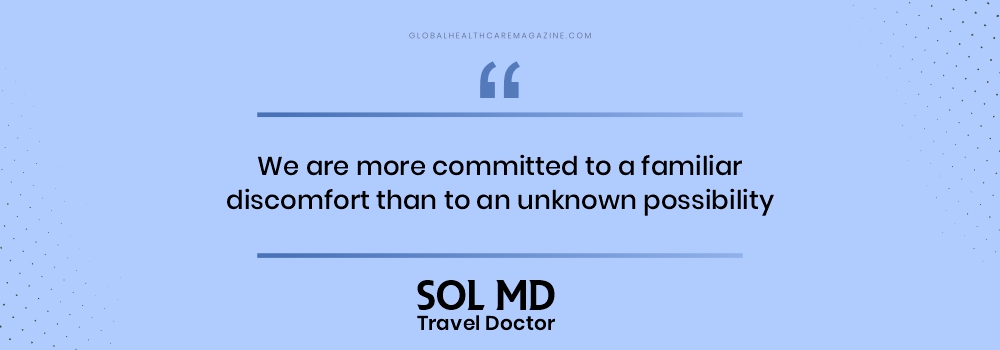
She is asking them to challenge the quote she often thinks of, from author Lisa Nichols: “We are more committed to a familiar discomfort than to an unknown possibility.”
Dr. Xunda Gibson has walked into that unknown possibility and has returned with a map. She has proven that it is possible to reclaim the “why” that started it all. She has traded the grind for a life of purpose, the endless charts for “more time with patients,” and the burnout for a career defined by flexibility and fulfillment.
She is the doctor, the founder, the guide. And she is here to show you that “balance, peace, joy, and freedom are awaiting you on the other side of the unknown possibility.” All you have to do is take the first step.
Quotes