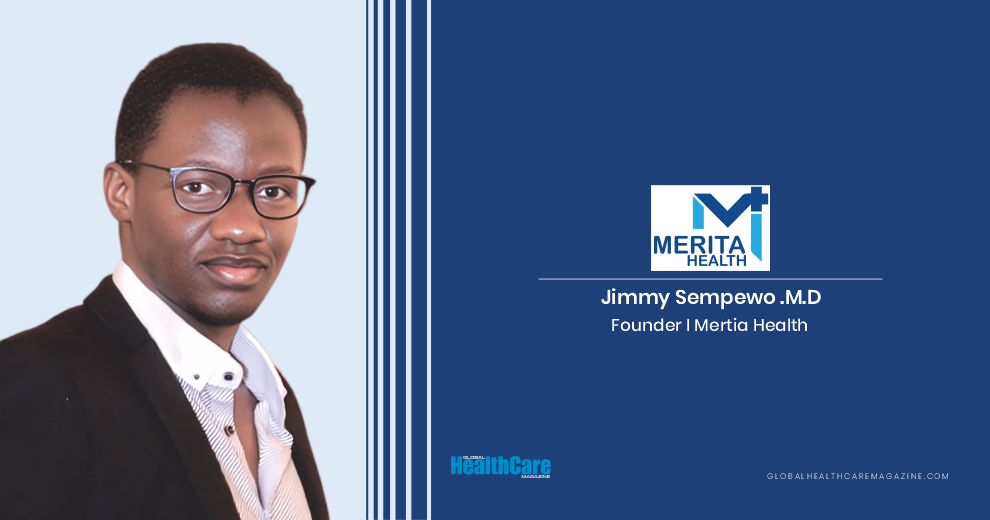
There is a specific kind of silence that fills a library when the world outside has stopped moving. It is not the quiet of study, but the quiet of suspension. In 2020, during the height of the global pandemic, Dr. Jimmy Sempewo sat in such silence, surrounded by books, reading about the economics of survival. The borders were closed. The airports were empty. And in his home country of Uganda, people were dying not just from a virus, but from a geography gap.
On one side of the ledger was the cost of a bone marrow transplant in India: thirty thousand dollars. On the other side was the average income of a family in his native Uganda. The gap between those two numbers wasn’t just a financial discrepancy; it was a death sentence. It was a canyon where thousands of people, children with sickle cell anemia, fathers with heart failure, mothers with kidney disease, disappeared every year.
For decades, the standard operating procedure for critical healthcare in Africa has been a cruel form of export. If you had the money, you would have exported yourself to India, Europe, or America to be saved. If you didn’t, you stayed home and hoped for the best, which usually meant the worst. Dr. Sempewo, a man trained in the rigorous medical academies of Hungary and Lithuania, stared at the paper and realized the entire system was backward. We were exporting the patients to the experts. Why, he wondered, couldn’t we import the experts to the patients?
That quiet moment in the library was the ignition point for Merita Health. It was the moment Dr. Sempewo decided to stop playing by the rules of global healthcare economics and start rewriting them. He is not just a doctor; he is a logistical visionary who is proving that the distance between a patient and their cure shouldn’t be measured in miles, but in the will to bridge the gap.
The Education of an Exile
To understand the sheer ambition of Dr. Sempewo’s project, you have to trace the arc of his own geography. He was born in Uganda, a country of vibrant culture and immense potential, but one plagued by the infrastructural gaps common to the region. After high school, he did what many brilliant young Africans do: he left. He traveled to Hungary to study medicine at the University of Debrecen (Debreceni Egyetem), immersing himself in a world of European efficiency and cutting-edge diagnostics. He earned his Master’s degree in medicine and then moved to the Lithuanian University of Health Sciences for residency training in cardiology.
For many, this is where the story usually ends; a successful career in Europe, sending remittances home, perhaps visiting once a year. But Dr. Sempewo lived in a “dual reality.” In the pristine wards of European hospitals, he saw what was possible. In the back of his mind, he saw what was missing back home. He gained skills not just to practice medicine, but to deconstruct it. He learned the systems, the protocols, and the supply chains. He realized that medicine isn’t just biology; it is logistics.
“With this European exposure, it’s been a big planning process,” Dr. Sempewo says. “I’ve gotten a lot of skills that I can implement in the country, Uganda, and Africa.”
He didn’t just learn how to treat a heart attack; he learned how much it cost to treat one. And he realized that the markup on survival in Africa was artificially high. The equipment, the drugs, the expertise, it was all imported at a premium. The realization was slow-burning but absolute: the current model was unsustainable.
The COVID Catalyst and the Pivot
The pandemic was a global tragedy, but for Dr. Sempewo, it was also a lens that brought the problem into sharp focus. Suddenly, the “export model” of healthcare collapsed. Borders closed. Planes were grounded. The wealthy patients who used to fly to India for surgery were trapped in Uganda. The poor patients were trapped in their homes, unable to access even basic care due to lockdowns.
“The patients could not travel,” Dr. Sempewo recalls. “For example, in Africa, many advanced procedures cannot be performed in Africa….. during COVID, when there was a lockdown, there was no movement.”
In this vacuum, Dr. Sempewo launched his first counter-offensive: MobileMed 247. The concept was simple, driven by the immediate necessity of the lockdown. If the patients couldn’t come to the hospital, the hospital would come to them. It was a “hospital on wheels” concept, a 24/7 service where doctors were dispatched to homes to treat primary care diseases. It was a brilliant stopgap, addressing the immediate crisis of accessibility.
But as the world began to open up, Dr. Sempewo realized that MobileMed 247 was solving the wrong problem. It was treating the symptoms of a broken system: the flu, malaria, the minor infections. However, it wasn’t touching the catastrophic failures. You cannot do a kidney transplant in a patient’s living room. You cannot perform open-heart surgery in a van.
Dr. Sempewo saw that the local hospitals were clogged with primary care cases that could be treated at home, while the critical cases, the ones requiring advanced intervention, had nowhere to go because the borders were still sticky and the costs were still astronomical. The mobile model was good, but it wasn’t enough. It was time for a metamorphosis. MobileMed 247 transformed into Merita Health.
The Merita Model: Importing the Brain Trust
Merita Health is not just a hospital; it is a geopolitical hack. The mission is encapsulated in their slogan: “Souls Patriarchs,” or “Health for the Fatherland.” It is a declaration that the health of the nation is the duty of its sons and daughters.
Dr. Sempewo’s strategy is elegantly simple in theory and ferociously complex in execution. Instead of sending one Ugandan patient to India for $30,000, he flies one Indian specialist to Uganda for $3,000.
“The only way you can use local capacity is actually bringing experts from Europe or India or America to come and do CRMs in Africa,” Dr. Sempewo explains. “Basically, you need to benchmark on their systems.”
This is the economics of empathy in action. By bringing the surgeon to the patient, the cost structure collapses. A bone marrow transplant that would bankrupt a family abroad now costs around $10,000 locally, and they are driving it down to $4,000.
The impact is immediate and visceral. This year alone, Merita Health has facilitated eight bone marrow transplants and numerous cardiac bypasses and valve replacements. These are people who, under the old math, would simply have died.
But the brilliance of the model lies in the “multiplier effect.” Dr. Sempewo doesn’t just fly in a surgeon to operate and leave. That would be a band-aid. He insists on knowledge transfer. Every time a visiting specialist scrubs in, local Ugandan doctors are standing next to them.
“We have done knowledge sharing to more than 60 doctors,” he says with palpable pride. “During the procedures, at least we have eight doctors watching and learning. This, they go back to their local hospitals with proper certification….. They learn how to use their hands, and then they will go on and do these procedures in their hospitals.”
The Robin Hood of Pharmacy
The ecosystem Dr. Sempewo is building extends beyond the operating theater. He looked at the supply chain of medication and saw another inefficiency in extracting value from the sick. In Uganda, as in many parts of the developing world, the cost of drugs can be prohibitive.
So, Merita Health opened its own pharmacy lines. They didn’t just retail drugs; they attacked the margins.
“If you would check the pharmacy, we’re giving our drugs at almost wholesale prices but for retail,” Dr. Sempewo notes. “We have actually cut down the cost of medicine in the whole country. So we have, at least on the dollar sometimes, a medicine on our platform.”
By delivering medication directly to homes and reviewing patients remotely, they stripped out the overhead that bloats prices. It’s a volume game played for the benefit of the consumer. It is a refusal to accept that a lifesaving pill should be a luxury good.
The Architect of Systems
If you spend enough time with Dr. Sempewo, you realize that “doctor” is an insufficient title. He is a systems architect. His mind does not compartmentalize; it integrates. This is evident in his other roles, which might seem unrelated to the casual observer but are integral to his worldview.
His role as the Chairperson of the Board at Henely Educational Group fits this holistic puzzle. Henely offers quality education and training programs. Dr. Sempewo oversees the strategic direction because he knows that the long-term cure for a struggling healthcare system is education. You need literate patients to follow protocols. You need educated students to become the next generation of nurses and technicians.
“I oversee the strategic direction, governance, and performance of the group, ensuring its vision and mission are aligned with the needs and expectations of the stakeholders,” he says.
The Grind and the Glory
Managing this sprawling ecosystem requires a level of energy that borders on the supernatural. Dr. Sempewo’s day is a blur of high-level strategy and granular execution. One minute, he is negotiating with a hospital chain in India; the next, he is dealing with a grieving family who has just lost a child.
He speaks candidly about the emotional toll. “It’s a rollercoaster,” he admits. He recounts a heartbreaking story of fundraising for a pediatric heart patient. The team worked tirelessly, mobilizing funding partners, getting everything ready. And then, just a few days before travel, the patient died.
“It was very devastating to the team,” he says softly. “They put in a lot of work, are highly motivated and then the patient passes on.”
But it is in these moments that his leadership philosophy, built on “persistence, consistency, and integrity,” shines through. He does not let the team spiral. He refocuses them on the mission. He reminds them of the eight bone marrow transplants that did work. He reminds them of the dialysis unit running at under $50 a cycle, giving kidney patients a reason to wake up in the morning.
Dr. Sempewo’s leadership style is not about speeches; it is about presence. He is there, in the trenches. He mentions Elon Musk, not for the billions, but for the timeline. “Few people know that Elon Musk started his company in 2001. He’s consistent, been there, he’s done it, and now he’s living it.”
Dr. Sempewo is playing the long game. He knows that transforming a healthcare system is not a project for the faint of heart. It is a decades-long siege against inefficiency.
The Future of the Fatherland
What does the future look like for a man who has already done so much? It looks like an expansion. It looks like permanence.
Merita Health has moved from a digital platform to a brick-and-mortar reality with 45 doctors and a functional laboratory capable of 250 different panels, a rarity in the region. But Dr. Sempewo is not satisfied.
“We want to start a histology pathology laboratory to deal with oncological investigations,” he outlines. “This is one of our future plans, but also we want to have a cath lab to do the cardiac interventions.”
He is building the infrastructure that will make the “export model” obsolete. He is planning expansions into Nigeria, taking the Merita model to Africa’s most populous nation. He envisions a continent where the flow of medical expertise is fluid, where borders do not determine lifespan, and where “Health for the Fatherland” is not just a slogan, but a statistical reality.
The Hobby is the Work
Perhaps the most revealing thing about Dr. Sempewo is his answer to the question about work-life balance. In a world that fetishizes “unplugging,” Dr. Sempewo confesses that he doesn’t have a life outside of his mission. And he doesn’t want one.
“For me, I can say my hobby is doing medicine,” he says with a genuine laugh. “And when I’m doing medicine, I don’t feel like I’m working….. I don’t find that I should go to play football because it’s a hobby.”
He is fully integrated. His home is his office; his office is his home. He teaches medical students online, he runs the hospital, he manages the board, and he sells the agricultural solutions. It is all one continuous flow of service. He has found that rare state of existence where purpose and profession are indistinguishable.
Dr. Jimmy Sempewo is a man who looked at the ledger of African healthcare and refused to accept the bottom line. He saw the disparity not as a fact of life, but as a logistical error to be corrected. He is the bridge builder, the importer of miracles, the doctor who decided that if the world wouldn’t come to save his people, he would bring the world to them, one specialist, one surgery, and one saved life at a time. He serves the Fatherland not with rhetoric, but with results. And in doing so, he is healing more than just bodies; he is healing the dignity of a nation.
Quote
“My leadership I think is based on one, assistance and consistency. But most importantly, integrity. Because once the third one is not part of them, the other two become irrelevant.”
Also Read: Africa’s Pioneers in Healthcare: Top Visionary Leaders To Watch in 2026