Long before Alzheimer’s disease became a global crisis, it was already shaping quiet, devastating stories inside individual families. Science was fragmented. Treatments were elusive. And for decades, progress moved more slowly than anyone anticipated. For entrepreneurs working in healthcare, the challenge was not just scientific. It was structural. How do you build companies that can operate at scale, attract serious innovation, and still stay grounded in human need?
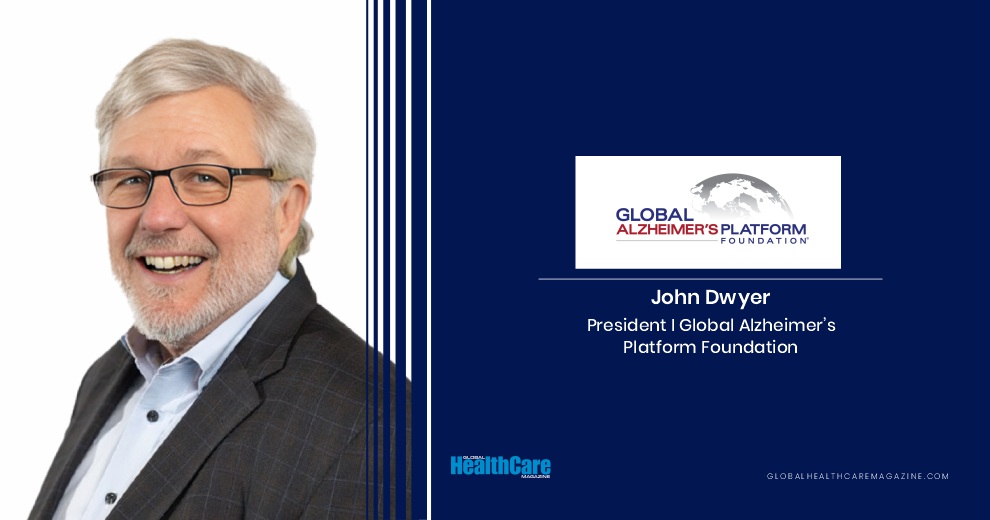
John Dwyer’s career sits at that intersection. His path to healthcare innovation did not begin with neuroscience, but with systems, technology, and execution. After graduating from Cornell Law School, he entered the healthcare industry with a builder’s mindset. He launched Telcare, a high-technology company that developed the first wirelessly enabled blood glucose meter, giving people with diabetes a clearer, more connected way to manage their disease. The company was later sold to Philips. Prior to Telcare, he founded CodeRyte, an early adopter of artificial intelligence that translated physicians’ dictated notes into accurate medical billing. That company was acquired by 3M. At the age of 30, Dwyer was already serving as a CEO and, over time, he would hold C-suite roles in six emerging growth healthcare companies.
Still, none of those roles fully explain what led him to the Global Alzheimer’s Platform Foundation® (GAP). That motivation came from somewhere far more personal. Alzheimer’s and neurological disease had threaded itself through his family for generations. His paternal grandmother died of Alzheimer’s. His father died of Alzheimer’s. Six of his father’s eleven siblings died from Alzheimer’s or Parkinson’s disease. “These diseases were the constant background of my life,” Dwyer says. “They were not abstract problems to solve. They were personal losses.”
After completing his chapter as a venture-backed healthcare entrepreneur, Dwyer began looking to change the trajectory of Alzheimer’s research itself. GAP became that next step. It was not just another company to grow, but an opportunity to contribute to therapies that could alter outcomes for millions of families like his own. For Dwyer, the work now carries both professional weight and personal urgency, rooted in decades of experience and a lifetime of watching what happens when answers come too late.
Reengineering the Alzheimer’s Clinical Trial Model
The idea for GAP took shape in 2014 during a meeting at the New York Academy of Sciences. Leaders from pharmaceutical companies, academic institutions, government agencies, and patient advocates gathered with a shared frustration. Despite heavy investment and strong science, Alzheimer’s clinical trials were moving too slowly and failing too often. When GAP formally launched in 2016, the National Institutes of Health was already the largest funder of biomedical research in the world. Funding was not the biggest problem. Execution was.
Clinical trials were expensive, lengthy, and difficult to scale. Many struggled with poor design, slow enrollment, and limited diversity. “We kept asking ourselves what could be done differently,” Dwyer says. GAP emerged as a focused response to that question. Starting as a two-person operation, the foundation set out to redesign how trials were run, with the goal of faster timelines, better outcomes, and lower costs. Over time, it grew into a global network committed to making Alzheimer’s research more efficient and more inclusive.
Building a Trial-Ready Network That Actually Works
GAP’s model is built around a simple idea: clinical trials improve when research sites are prepared, supported, and held to consistent standards. In 2017, GAP invited sites to join a network designed to operate differently from the start. One of the first changes was consolidating trials under a single institutional review board. Getting sites to agree was not easy, but the payoff was immediate. Reviews moved faster, contracts cleared sooner, and studies launched without the usual bottlenecks. “It signaled that we were serious about changing the system,” Dwyer says.
That operational focus extends through GAP’s Trial Execution Services team, which provides real-time data and hands-on support. Sites in the network achieve randomization rates roughly 26 percent higher than industry averages. GAP also leads large-scale biomarker studies like Bio-Hermes-001, which enrolled more than 1,000 community-based participants and helped advance the first FDA-cleared blood-based Alzheimer’s diagnostic, while prioritizing inclusion from underserved populations.
A Global Network Built on Collaboration
Collaboration is not a side strategy at GAP. It is the operating model. The foundation works across a wide ecosystem that includes nonprofits, industry partners, academic institutions, and its growing global research network, known as GAP-Net. One key partnership is with Gates Ventures through the ADDI Biomarker Data Workbench, which provides open yet secure access to high-value datasets for researchers around the world.
Large studies such as Bio-Hermes-001 and the ongoing Bio-Hermes-002 bring together biotech firms, diagnostics companies, digital health innovators, and traditional assessment groups to test scalable biomarkers against established clinical measures. GAP also convenes governments and academic leaders through initiatives like the Scottish Biomarker Data Challenge, allowing complex datasets to be analyzed faster.
All of this work is anchored by GAP-Net, a network of more than 100 high-performing research sites now expanding across Europe and the United Kingdom, creating shared infrastructure that speeds Alzheimer’s research globally.
Experience that Shows Up in the Work
The strength of GAP’s work begins with its people. Collectively, the team brings more than 436 years of clinical trial experience, spanning nearly every major area of neurology. That includes Alzheimer’s and Parkinson’s disease, epilepsy, mental health, Down syndrome, traumatic brain injury, and stroke. This depth matters because neurodegenerative disease does not fit neatly into one discipline. It demands perspectives that cross research, operations, and patient care.
Dwyer believes progress depends on teams that understand both science and execution. “These trials are complex at every level,” he says. “You need people who have seen what works and what fails.” GAP’s team reflects that philosophy. Many have spent decades designing, running, and fixing trials in real-world settings.
Beyond internal expertise, the foundation works closely with international organizations focused on clinical trial innovation. GAP maintains ongoing dialogue with global partners to share insights, coordinate efforts, and stay aligned with initiatives developing across regions, ensuring the work remains connected and forward-looking.
Leading With Purpose and Precision
As head of the organization, Dwyer’s role spans strategy, operations, and constant collaboration. He focuses on building systems that allow research to move faster without losing rigor or trust. A core priority is strengthening networks like GAP-Net, which bring research sites and sponsors together to improve recruitment and participation across studies. “If trials do not work for all participants, they do not work at all,” he says.
Dwyer approaches leadership as an entrepreneur, favoring practical solutions and shared goals. He works closely with partners such as Biogen, Lilly, Roche, Eisai, Fujirebio, ADDF, and Gates Ventures to improve study design, apply emerging technologies, and reduce the burden on participants. His responsibilities also extend beyond operations.
Dwyer is also active in public advocacy, speaking about how regulatory decisions affect patient access to new therapies. Balancing these roles means staying close to the work while keeping a clear view of where the field needs to go next.
Measuring What Actually Matters
For GAP, impact is measured in outcomes, not intentions. Faster and more reliable trials reduce cost and risk, but they also move science forward in meaningful ways. The foundation tracks execution metrics that reflect real trial readiness, including randomization rates, enrollment speed, and participant diversity.
Across GAP-Net, sites achieve a 26 percent higher randomization rate per site per month than industry benchmarks, averaging 0.49 randomizations compared to 0.39 for a non-GAP-Net site. Recruitment timelines are also nearly four and a half months shorter.
Dwyer sees these numbers as proof that structure matters. “You can feel the difference when a site is truly prepared,” he says. Equity is measured with the same rigor. Bio-Hermes-001 achieved 24 percent participation from traditionally underserved populations, a rare milestone in clinical research. Building on that progress, Bio-Hermes-002, an even broader study, remains open until at least 25 percent of participants come from historically understudied communities, making access a core indicator of success.
Leading Through Uncertainty
Dwyer’s leadership was tested in real time when the COVID-19 pandemic brought clinical research to an abrupt halt. For GAP, the risk was immediate. Trials paused, sites closed their doors, and uncertainty spread across the research community. “We were facing the possibility of losing years of momentum,” he says. The priority became clear: protect people while preserving the integrity of ongoing studies.
Working closely with research sites and study sponsors, GAP helped guide rapid adjustments to trial protocols. Teams explored alternatives that had rarely been used at scale, including remote cognitive assessments and home-based blood tests. These changes required careful coordination and constant communication to ensure data quality remained intact.
The experience reinforced Dwyer’s belief that leadership in healthcare demands flexibility grounded in responsibility. By adapting quickly and thoughtfully, GAP was able to sustain progress during a period when traditional research models struggled, and those lessons continue to inform how trials are designed today.
Milestones that Move the Field Forward
One of GAP’s most meaningful achievements is the role Bio-Hermes-001 played in the FDA’s clearance of Fujirebio’s Lumipulse diagnostic. For Dwyer, the significance goes beyond regulatory success. The test has the potential to change how Alzheimer’s disease is diagnosed, giving physicians a more accurate and accessible way to assess and treat patients earlier in the disease process. “That was always the goal,” he says. “Design a study that could move real tools into real practice.”
Bio-Hermes-001 was built intentionally to push new diagnostic technologies forward, and its impact reflects that focus. More than 1,000 volunteers participated, supported by dedicated clinical trial sites and a wide network of technology companies, pharmaceutical partners, and philanthropic organizations.
Dwyer is quick to credit that collective effort. He sees the study as proof that well-designed collaboration can translate rigorous science into practical advances that empower both clinicians and patients facing Alzheimer’s and related dementias.
Building the Next Generation of Clinical Research
Looking ahead, Dwyer sees GAP moving from network builder to hands-on innovator. A major focus is the expansion of GAP-owned and operated research sites. These centers are designed to function as innovation stations, places where new approaches to trial design and execution can be tested in real time. They will also serve a broader role in the community, giving seniors opportunities to learn about their brain health and take part in person-centered research.
The vision is both practical and ambitious. Dwyer wants to address the growing shortage of capacity in neurological research and treatments by building systems that work at scale. These sites will support studies across Alzheimer’s, multiple sclerosis, Parkinson’s, and other neurodegenerative diseases.
At the core of the effort is a belief that informed patients and better-designed trials lead to better outcomes. “We are trying to build the future infrastructure,” he says, “so discovery does not stall when it is needed most.”
Life Beyond the Work
Dwyer is quick to challenge the idea of a perfect work-life balance. For him, the line between the two has always been fluid. His work at GAP is shaped by personal experience, and at times, life informs the work just as much. “My family’s history with Alzheimer’s is what drives what I do here,” he says. That connection keeps the mission close, even outside the office.
When he steps away, Dwyer centers his time around family. He enjoys traveling with his wife, Susan, their son, Sean, and their golden doodle, Moose. Those moments offer “great memory making” and perspective. He also unwinds playing “ugly” golf and better pickle ball. He is also a devoted sports fan, faithfully following the Green Bay Packers, Chicago Cubs, and Marquette Golden Eagles. These routines may seem simple, but they provide the balance that sustains long, demanding work.
A Mission that Guides Every Decision
When Dwyer reflects on leadership, he returns to one principle that has shaped his career: define the mission and let it guide every decision. Years as a healthcare entrepreneur taught him that strategy only works when it stays anchored to purpose. At GAP, that purpose is personal. He approaches the science and clinical environment from the patient’s point of view, always asking whether the work helps accelerate discovery in ways that matter.
GAP’s expectations are high, and Dwyer is candid about that. The team is small but highly driven, and he believes they operate well beyond what their size suggests. His role is to protect focus while building an environment that feels rewarding and honest. That balance requires discipline. Quality cannot slip, and conventional thinking must be challenged. “We owe it to patients to question how things have always been done,” he says. For Dwyer, leadership means creating space for bold ideas without losing sight of the responsibility that comes with them.
Quotes
Also Read: The 10 Most Impactful Healthcare Leaders to watch in 2026