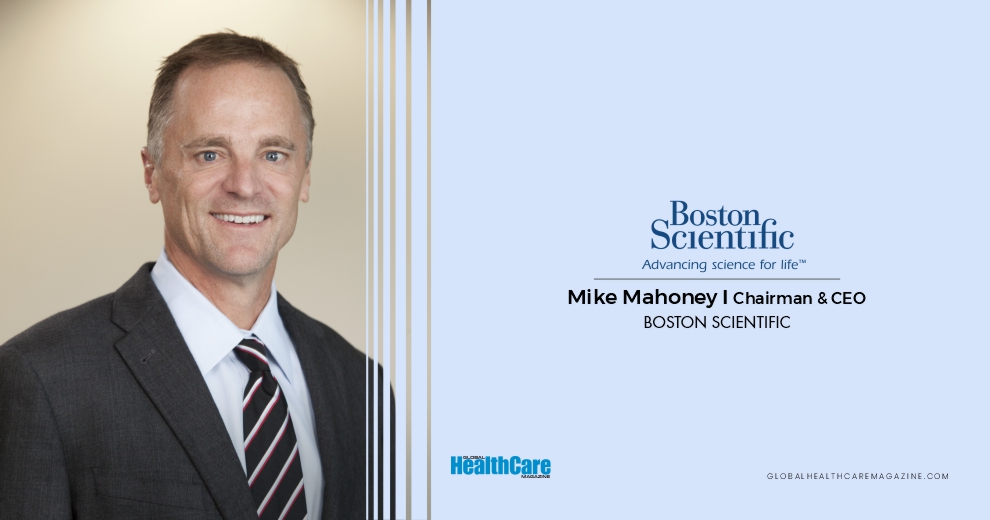
There is a certain kind of leader who begins every conversation about the future by looking very carefully at the present. Mike Mahoney is that kind of leader. As Chairman and CEO of Boston Scientific, Mike occupies one of the most consequential seats in global medical technology. And yet, what defines his approach is not a preoccupation with his own position or the prestige of the institution he leads. What defines it is something far more grounded: a genuine and disciplined commitment to understanding what the healthcare landscape actually needs.
Not what it needed last year. Not what a model projects it will need five years from now. But what it needs today, in its current form, with all of its contradictions and its pressures and its people intact. That is where Mike begins. And it is, by any measure, an uncommonly honest place to start.
Reading a Landscape That Never Holds Still
Healthcare is not a static thing. Anyone who has spent time near it, whether as a patient, a provider, a policymaker, or a manufacturer of the tools that make care possible, knows that it is a system in constant, sometimes disorienting motion.
New science arrives faster than institutions can absorb it. Economic pressures mount in ways that don’t always make the headlines but are felt acutely by the people who show up to deliver care every single day. Patient populations grow more diverse. Geographies that were once considered peripheral become central. And the gap between what medicine can do and what medicine can actually deliver to the people who need it remains one of the most stubborn problems in the field.
“Identifying the needs of the evolving healthcare landscape” is, in Mike’s framing, the essential first act of leadership at Boston Scientific. Not identifying the opportunities. Not identifying the market gaps. “The needs.” That distinction is not semantic. It is philosophical. And it shapes everything that follows.
Innovation That Has Somewhere to Go
The word “innovation” has been used so frequently in healthcare that it has, for many people, begun to lose its texture. It appears in presentations, in press releases, in strategic frameworks, deployed with confidence and often without much specificity.
Mike uses it with intention. For him, innovation is not the endpoint. It is not the thing that gets announced and celebrated and then filed away. “Innovation, to be meaningful, has to have somewhere to go.” It has to reach people. It has to enter the room where care is being delivered, and it has to actually function in that room, under real conditions, for real patients, in the hands of real clinicians operating within real constraints.
Providing access to meaningful innovation is the phrase Mike returns to. And that word, “access,” is doing significant work in that sentence.
Access is not simply a distribution question. It is not only about logistics or supply chains or market reach, though those things matter enormously. Access is also a question of relevance. Of affordability. Whether the innovation in question was designed with an awareness of the full range of environments and systems into which it must eventually land.
An innovation that only works for the best-resourced, most well-equipped corner of the healthcare system is not, in any complete sense of the word, meaningful. Mike understands this. And it shapes how Boston Scientific approaches its work.
The Stakeholders No One Wants to Talk About
There is a part of the healthcare conversation that makes some leaders uncomfortable, and that is the economic part.
Not the revenue side. Not the shareholder side. Those conversations happen readily enough. The uncomfortable part is the economic pressure felt by the people and institutions on the delivery side of healthcare. The hospital administrators are trying to maintain quality while managing costs that seem to grow regardless of what they do. The smaller health systems that cannot leverage the purchasing power of larger networks. The clinicians are working in settings where resources are stretched, and the margin for inefficiency is essentially zero.
These are the diverse stakeholders delivering healthcare that Mike names explicitly as part of his leadership focus. And the fact that he names them matters.
Because it would be easier not to, it would be easier to focus on the headline metrics, the flagship hospital partnerships, and the most visible applications of the most advanced technology. That would still constitute a meaningful business.
But Mike has chosen a wider frame. He has chosen to hold in view the full, complicated, economically varied ecosystem of people and institutions that are, collectively, the ones trying to keep patients healthy. “That is not a small thing to take responsibility for.”
What It Means to Hold Both Seats
Mike is both the Chairman and the CEO of Boston Scientific. That dual role is worth pausing on.
The CEO role is about execution. It is about strategy and operations, and accountability to results. The Chairman’s role is something larger and in some ways more demanding. It is about stewardship. About holding the long view of an organization’s direction and purpose and ensuring that those things remain coherent even as the world around them changes.
To hold both is to be, simultaneously, the person running the organization day to day and the person responsible for its institutional soul. In a company whose work enters operating rooms and changes lives, that is not a small set of things to carry. Mike appears to carry them with clarity.
A Leader Worth Watching in 2026
The medical device industry in 2026 is facing a version of itself that is more demanding, more complex, and more scrutinized than it has ever been. The expectations placed on leaders like Mike are correspondingly higher.
But what makes him one of the most impactful leaders to watch is not just what he has built. It is how he thinks. The questions he asks before he acts. The stakeholders he keeps in view when the easier path would be a narrower focus.
In a field where innovation can become its own justification, Mike Mahoney is a reminder that the most powerful question a leader can ask is not ‘what can we build?’ but ‘what does the landscape actually need, and who are we building it for?’
That question, asked consistently and answered with honesty, is the foundation of everything.
Quotes
“Identifying the needs of the evolving healthcare landscape to provide access to meaningful innovation.”
“Address the economic pressures experienced by diverse stakeholders delivering healthcare.”