Brain Health Center, Miami, FL
For decades, mental healthcare relied primarily on subjective reports and observable behavior to guide assessment and treatment. While these traditional methods remain essential, they do not always capture the full complexity of human distress. Significant physiological contributors to suffering can remain undetected, and symptoms may be interpreted solely through a behavioral lens.
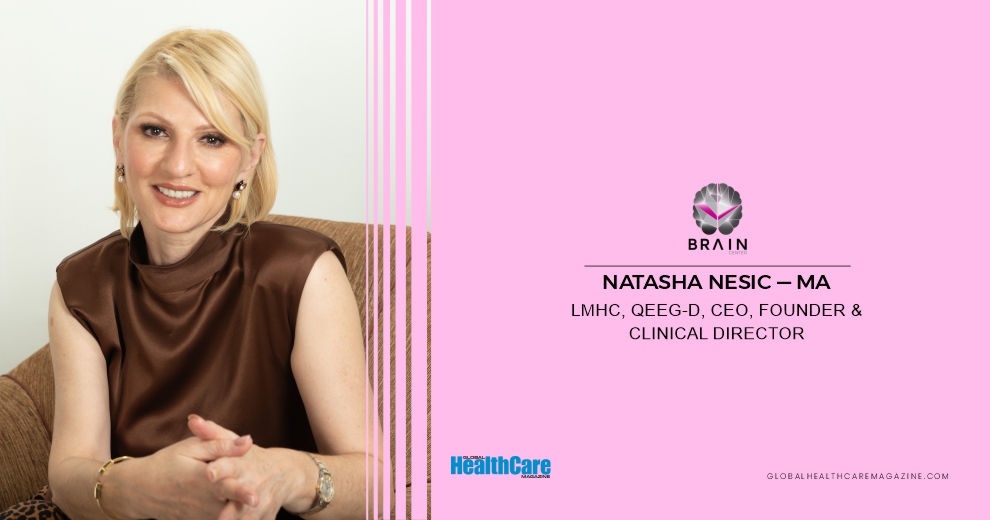
At Brain Health Center Miami, Clinical Director and Founder Natasha Nesic, MA, LMHC, ATR, QEEG-DL, is working with her team to bridge this long-standing gap. By integrating established therapeutic practices with cutting-edge neuroscience tools, they offer a deeper understanding of how the brain and body shape thought, emotion, and behavior—and, ultimately, how people heal.
About the Founder
Natasha serves as Clinical Director and CEO of two complementary organizations: Brain Health Center Miami, which integrates applied neuroscience, psychophysiology, and counseling, and Mental Health and Art Therapy Services LLC, providing mental health services to older adults and medically complex residents across South Florida. Her work is built on a rare combination of clinical rigor, scientific curiosity, and creative insight.
She received her dual Master’s degree in Mental Health Counseling and Expressive Arts Therapy from Lesley University in Cambridge, Massachusetts—a training that emphasized whole-person care and the therapeutic importance of sensory, emotional, and relational experience. After years of working across private and community settings, Natasha cultivated a practice grounded in empathy, connection, and clinical precision.
As her work evolved, she expanded into advanced psychophysiological modalities that offered a clearer view of how the brain and body communicate. She trained extensively in quantitative EEG (QEEG), neurofeedback, and multiple forms of neuromodulation (photobiomodulation (PBM), tDCS, tACS, tPEMF), allowing her to support highly complex clinical presentations. Natasha is now completing her PhD in Clinical Applied Psychophysiology at Saybrook University, where her research focuses on non-invasive PBM interventions for children with Autism Spectrum Disorder. Her scholarship reflects a commitment to uniting science, compassion, and innovative clinical practice.
Advancing the Field of Behavioral Health
Brain Health Center Miami is reshaping the landscape of behavioral healthcare by uniting neuroscience with traditional therapeutic wisdom. The center brings measurable physiological insights into the clinical process, enhancing understanding of behavior, cognition, and emotional regulation. Designed to make advanced neuroscience accessible to the community, the center is guided by core principles of precision, innovation, collaboration, accessibility, and compassion.
A core aspect of the center’s mission is the use of reliable, data-informed methods. Through tools such as QEEG brain mapping, neurocognitive testing, and psychophysiological assessment, the team creates individualized treatment plans that blend scientific accuracy with a deeply human-centered approach.
Natasha’s leadership embodies this vision. She values neurodiversity, honors lived experience, and recognizes that a dynamic interplay of biology, environment, and personal history shapes every person’s story. The center serves a wide range of clients—from children with sensory and emotional regulation needs, to adults navigating trauma and chronic stress, to professionals facing cognitive decline or burnout. Across diagnoses and backgrounds, each individual receives care that is respectful, tailored, and grounded in the latest advancements in mind-body science.
The Integrated Care Model
Brain Health Center Miami’s care model begins with a simple premise: meaningful change starts with insight. Understanding how the brain and body function provides a roadmap for effective, lasting treatment.
1. Measurement
Through QEEG brain mapping and psychophysiological monitoring, the team identifies patterns of neural and autonomic dysregulation. These findings help explain a client’s challenges and guide treatment direction.
2. Neurofeedback
QEEG data inform individualized neurofeedback protocols. During training, clients receive real-time feedback on their brain activity, through operant conditioning, brain networks are reshaped. Over time, the improvements are reflected in more optimal connectivity, coherence, and self-regulation—the foundation for emotional stability and cognitive resilience.
3. Biofeedback
Biofeedback addresses the body’s autonomic responses (such as heart rate, breathing, and muscle tension). Clients learn to shift their physiological state in ways that reduce stress and enhance emotional flexibility. These skills deepen the mind-body connection and support daily resilience.
4. Neuromodulation
Techniques such as transcranial photobiomodulation (pulsed near-infrared stimulation) enhance cellular energy, cerebral blood flow, and neuroplasticity—making it easier for the brain to adopt healthier patterns. When paired with neurofeedback and biofeedback, neuromodulation accelerates progress and strengthens outcomes.
5. Integration
Finally, counseling and expressive arts therapies help clients integrate and strengthen the neurological and physiological gains into real-life improvements. This step ensures that progress is meaningful, sustainable, and reflected in everyday functioning.
“Measure, train, learn, regulate, and integrate,” Natasha says. “When these pieces work together, we can address the mechanisms driving symptoms—not just the symptoms themselves.”
The Leader as Researcher
Natasha remains deeply engaged in clinical work and research. She is developing a double-blind, placebo-controlled PBM study for children with Autism Spectrum Disorder, while simultaneously expanding multi-site collaboration research to explore PBM as a stress-regulation tool for individuals with seizure disorders. She uses clinical challenges as a springboard for research questions, particularly in populations that have not responded well to standard treatments.
Her leadership is grounded in data-informed care supported by neurophysiological markers. She evaluates progress through QEEG outcomes, neurocognitive testing, heart rate variability, sleep quality, metabolic labs, academic performance, and caregiver reports.
“Progress must be measurable, observable, and sustainable,” she emphasizes.
Building a center that unites psychotherapy and applied neuroscience requires determination. Historically, these fields have operated separately, and bringing them together while maintaining accessibility has required strategic partnerships, creative problem-solving, and a team aligned with a shared mission of evidence-based, human-centered care.
Authenticity and Balance
Despite her demanding roles, Natasha remains rooted in authenticity and creativity. A keen sense of humanitarian and environmental responsibility guides her life and work. Outside the clinic, she finds grounding through photography, travel, and engagement with diverse cultures—experiences that restore perspective and spark curiosity.
“Balance comes from living authentically,” she reflects.
Looking ahead, Natasha plans to expand neuromodulation programs, strengthen multi-site research collaborations, and open a second clinical location to meet growing community demand. Her forward-thinking leadership continues to shape not only Brain Health Center Miami, but the evolving future of applied neuroscience.
Also Read: Mental Health Innovators: The Top Business Women Leaders, 2026