There is a specific kind of quiet that settles over a 1700s farmhouse when the work is done for the day. It is the silence of things that have endured. Peter Justen lives in one of these structures, a home that has stood through the birth of a nation, the shifting of borders, and the turning of centuries. He is restoring it by hand. This is not a hobby for him so much as it is a practice of character. He has made a lot of firewood on the way to becoming a decent carpenter, proof that he is willing to tackle something new even when it requires learning through mistakes. Along the way he has learned that you cannot force an old beam to be something it is not, but you can shore it up, clean it off, and make it functional for modern life.
When you speak to Peter, you realize that this farmhouse is the perfect metaphor for his mind. He does not look at a dilapidated structure and see ruin; he sees a system that has lost its way. He sees good bones obscured by years of bad decisions and neglect.
“I build companies that fix broken systems,” he says. It is a simple statement, delivered without the fanfare one usually expects from a CEO in the high-octane world of Government Technology. There is no bluster here. There is only the observant, steady gaze of a man who looks at a car with bad brakes and wonders why everyone else keeps trying to install a louder horn.
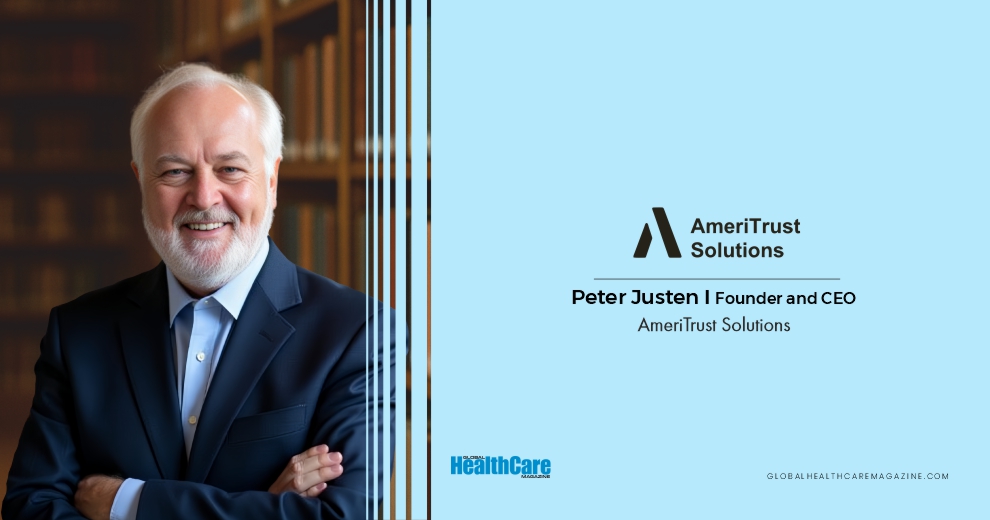
Peter is the Founder and CEO of AmeriTrust Solutions, a company that has quietly undertaken one of the most ambitious renovation projects in American healthcare: fixing the front door to Medicaid. In a world where “disruption” is usually code for breaking things, Peter is interested in mending them. He is driven by a friction that most of us accept as inevitable—the grinding, soul-wearing bureaucracy of poverty.
The Personal is the Professional
The origin of AmeriTrust Solutions does not begin in a boardroom or a server farm. It begins with a son moving his mother.
Peter had moved his mother across state lines to be closer to him. She was elderly, she was fully eligible for Medicaid, and she needed care. In theory, the safety net existed to catch her. In practice, the net was tangled. The application process dragged on for months. It was a descent into a paper purgatory where forms were lost, questions were redundant, and the clock kept ticking.
He watched the anxiety take hold of her. It was a specific, biting fear: the worry about prescriptions running out, the missed doctor’s appointments, the looming shadow of rising costs. The system was designed to help her, yet it was actively generating fear.
“If the process was this overwhelming for someone with my experience and resources,” Peter recalls, “I knew how impossible it must feel for people juggling illness, work, or limited support.”
This was the moment the business became a responsibility. The abstraction of “healthcare policy” dissolved into the reality of his mother’s kitchen table. Peter realized that the complexity of the application process was not a gatekeeper of integrity; it was a barrier to dignity.
Peter did not immediately hire developers. Instead, he did what a reporter might do. He went to the source. He spent months traveling across Virginia. He did not just sit with executives; he sat with eligibility caseworkers. He watched them work. He saw talented, well-meaning people trapped inside workflows that fought them at every turn. He interviewed families in hospital waiting rooms and state leaders in their offices.
The consensus was absolute. The inefficiencies were keeping eligible people out of coverage. They were straining agencies to the breaking point. They were costing states and hospitals billions in uncompensated care and administrative waste. The system wasn’t evil; it was just obsolete. It was a 20th-century engine trying to power a 21st-century vehicle.
The Twelve-Minute Miracle
To understand what Peter has built, you have to understand the sheer weight of what existed before. A typical Medicaid application can involve over 200 questions. It is an interrogation that demands applicants hunt down tax returns, pay stubs, and residency proofs, often asking them to enter the same information multiple times. It is a process that assumes the applicant is hiding something.
AmeriTrust Solutions flips this dynamic entirely.
“Most systems collect everything first and verify later,” Peter explains. “We do the opposite.”
The platform sits in front of existing state eligibility systems. It does not demand that the state rip out its legacy infrastructure, a terrifying prospect for any government agency, but rather acts as a modern lens through which the data flows. Starting with advanced data science, Peter’s team managed to reduce the questions in a typical application by 90 percent. Layered on top of that, the system pulls in verified third-party data to prefill much of the application automatically.
Together, these two capabilities have reimagined the application process. Instead of asking a single mother to find a pay stub from three months ago, the system, using verified, permissioned third-party data, already knows the answer. It fills the blank for her. The applicant simply reviews the data, answers the remaining questions, and submits.
What used to result in incomplete applications and months of back-and-forth to correct missing or inaccurate information now becomes a clean, accurate application completed in about 12 minutes, fully verified and ready for eligibility determination.
This is not just speed; it is accuracy. Prefilling applications with verified data removes the confusion about what information is being asked for and the overly complex documentation steps that cause applicants to submit incomplete or inaccurate details. It reduces the workload for caseworkers and administrative costs by up to 70 percent. It lowers improper payments, ensuring that tax dollars are not leaking out of the system through error or fraud.
“We reduce 200 plus application questions to about 20,” Peter notes. “It makes the experience faster for applicants, more accurate for states, while cutting administrative processing costs by up to 70 percent. Those savings translate into hundreds of millions of dollars each year, and when combined with fewer improper payments, they have a significant impact on a state’s program budget.”
A History of Scale
Peter is not new to the concept of scale. His career is a roadmap of managing massive, data-heavy operations. Before he turned his eyes toward the public sector, he was a force in financial services.
At Countrywide Funding, he launched an internal startup that was nothing short of meteoric. In just 18 months, that unit originated over $1.8 billion in new loans. It was an early lesson in how streamlining a process could unlock massive value. Later, he co-founded a financial services firm in Washington, D.C., growing it to over 1,100 alliance partners before leading a successful exit to a publicly traded company.
Peter has briefed leadership on Capitol Hill, advising them on the intersection of data and commerce. He has worked with the Department of Commerce, the Commonwealth of Virginia, and he has delivered lectures at Federal Reserve Banks across the country. His work has been recognized globally; the Government of Finland singled him out as a “Shining example of US Innovation,” and an Irish research firm named him one of “6 SaaS plays to watch worldwide.”
Yet, despite the accolades, the profiles in Forbes.com, the Wall Street Journal, and Smart CEO Magazine, there is a sense that Peter views his previous successes as training for his current mission. The mortgage industry taught him about verification and trust. The data analytics sector taught him about the power of information. But AmeriTrust Solutions is where those skills met his heart.
Navigating the Leviathan
Innovation in government is rarely welcomed with open arms. The caution is understandable. These agencies manage public dollars and vulnerable lives. One wrong move can have catastrophic consequences.
Peter understands this resistance. He respects it. “Government’s caution is earned,” he says. “The real challenge is showing that innovation can reduce risk, not add to it.”
This is where the servant leadership philosophy becomes evident. A more arrogant leader might have tried to bulldoze the agencies, demanding they adopt the “Silicon Valley way.” Peter took the opposite approach. He designed AmeriTrust Solutions to be a partner, not a disruptor.
The platform follows strict federal and state privacy standards, including SOC 2 and GovRAMP requirements. It stores only what is absolutely necessary. Every action is logged, encrypted, and auditable. Peter knew that if he wanted to save the system, he had to prove he could protect it first.
“We build trust through transparency, rigorous compliance, and working at the agency’s pace,” Peter says. “Partnership, not disruption, has been key.”
The impact of this approach is measurable. AmeriTrust Solutions can sit in front of a state’s eligibility system or be deployed directly inside a hospital, enabling bedside application completion that helps providers recover a meaningful share of the billions they lose each year in uncompensated care. At the state level, the same technology cuts improper payments and saves programs hundreds of millions of dollars annually. Yet the metric Peter seems most proud of is the reduction in anxiety—the simple fact that people who once felt overwhelmed by the process can now complete a clean, accurate application in minutes.
The Guardians of Care
Peter’s immersion in the world of Medicaid went so deep that it birthed a book. Guardians of Care is his exploration of the program’s history, its evolution, and its impact on the hundreds of millions of Americans it has served. Writing it was an act of scholarship that informed his business logic.
“I dug so deeply into the history and operations of Medicaid,” he says. “That journey shaped the foundation of AmeriTrust Solutions and our mission to bring clarity, dignity, and accuracy to the enrollment experience.”
He sees his role as one of alignment. His days are spent guiding product roadmaps and ensuring his team has clarity, but his most critical work happens when he is listening. He spends time with federal, state, and hospital leaders, trying to understand their reality.
“What I’m most passionate about is solving the right problem,” Peter emphasizes. “Not the loudest problem, but the one that makes the greatest difference for families and agencies.”
It is a philosophy that echoes the restoration of his farmhouse. You don’t just paint over the cracks; you find the structural weakness, and you reinforce it. You do the hard, unglamorous work so that the house can stand for another two hundred years.
The View from the Farmhouse
The volatility of the current healthcare landscape is immense. With policy shifts, the unwinding of pandemic-era provisions, and the demands of HR1, the ground is constantly moving. For a lesser leader, this would be a source of panic. For Peter, it is just another complex system to navigate.
“Staying steady through volatility is one of the most important responsibilities of a founder,” he says.
He finds this steadiness in his life outside of the office. He is a man who prioritizes balance, knowing that a burnt-out leader cannot serve anyone. He spends time with his family, which includes a growing roster of nearly thirteen grandchildren. He fly fishes, standing in the current of a river, waiting for the line to pull taut. He reads two to three books a month.
And, of course, there is the carpentry. The firewood was made along the way. The restoration of the old house.
“That time away makes me a better leader when I’m back at work,” Peter notes.
His vision for the future is expansive. He wants AmeriTrust Solutions to become the trusted front door for all public benefits—SNAP, unemployment, and beyond. He envisions a world where the government helps millions of Americans get the help they need faster and with dignity, without the confusion that has plagued the system for decades.
“Every system can be improved. That’s what drives me,” he says.
In the end, Peter’s story is not really about technology. It is about the social contract. It is about the promise that a society makes to its most vulnerable members. He believes that public benefit programs sit at the core of that contract, meant to lift and stabilize people.
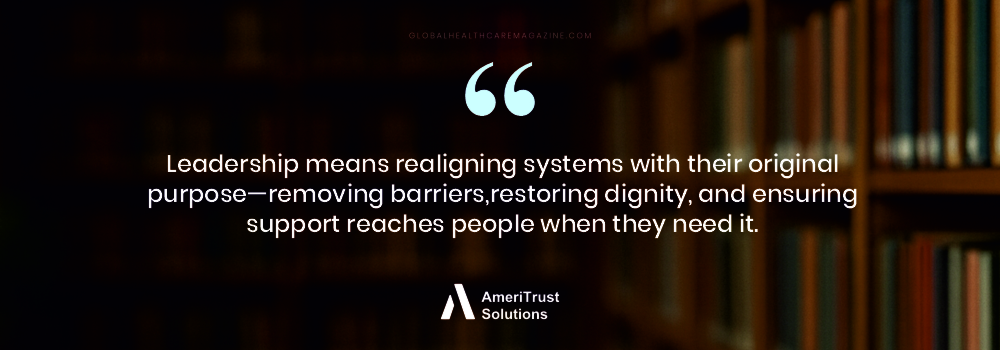
“My philosophy is that leadership means realigning systems with their original purpose,” Peter concludes. “Removing barriers, restoring dignity, and ensuring support reaches people when they need it.”
He is building a company that fixes broken systems, yes. But more importantly, he is fixing the experience of being human within them. He is clearing the path so that when a son moves his mother across state lines, the only thing they have to worry about is unpacking the boxes.
Quote
Also Read: Healthcare Tech Innovators:Top Visionary Leaders To Watch in 2026