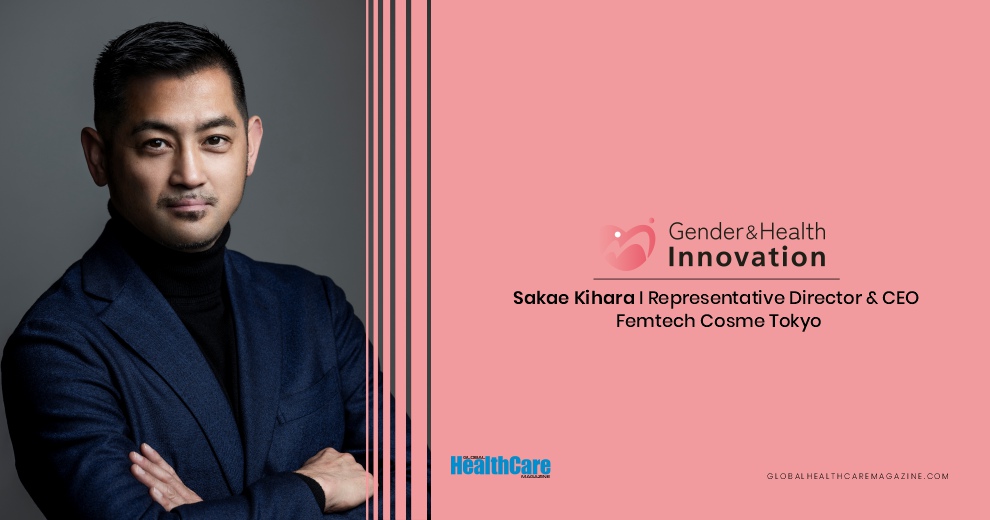
There is a certain kind of person who sees the world not as a collection of objects, but as a series of interlocking systems. They see the invisible pathways that connect a convenience store parcel to a national logistics network, the subtle currents that link a color on a runway to a woman’s purchase months later, and the unspoken barriers that isolate individuals within the grand system of society itself. Sakae Kihara is this kind of person. To look at his career is to see a study in disparate worlds: the rigid bureaucracy of the Japan Post, the ephemeral data streams of high fashion, the vibrant community of a Shinjuku nightspot. On the surface, they share nothing. But beneath, they are all systems waiting to be understood, optimized, and, in some cases, completely rebuilt.
Today, at 53, Sakae stands at the helm of Femtech Cosme Tokyo and the newly formed Pride Medical, two ventures that seem, once again, a world away from his past. He is a man in the business of women’s wellness, of inclusive healthcare, of sexual health and gender equity. He is an influential leader in a field dominated by voices and experiences that are not his own. This is the central, compelling question of Sakae Kihara: How does a cisgender man (gay), a former postal accounts clerk from Kamogawa City, become a pivotal force in femtech? The answer lies not in a single decision, but in a lifetime spent mastering systems, decoding desires, and finally, turning the lens inward to build a new system founded on the most radical principle of all: the dignity and respect of every life. His journey is a testament to the idea that sometimes, the person best equipped to redesign the house is the one who has always felt like an outsider looking in.
From Postmarks to Pathways
In March 1988, having just graduated from high school, Sakae entered a world of accounts, revenue sections, and stamp distribution. For eighteen years, until 2006, he navigated the intricate corridors of the Chiba Central Post Office, the Kanto Postal Bureau, and eventually the headquarters of the Ministry of Posts and Telecommunications. It was a career defined by rules and regulations, a universe of precision and predictability. Yet, within this rigid framework, Sakae saw not limitations, but opportunities for connection.
He was not content to simply process the mail. He looked at the flow of parcels and direct mail (DM) and saw the lifeblood of commerce. Working in corporate sales, he focused on retail and logistics giants like AEON, Ito-Yokado, and Isetan. Sakae saw inefficiency and proposed solutions. It took him seven years of persistent effort, but he helped orchestrate the use of the Yu-Pack parcel service in Ministop and Lawson convenience stores, a move that integrated the national post into the daily fabric of Japanese life. He saw two separate giants, Nippon Express and Yu-Pack, and promoted a collaboration. He convinced the sprawling Lumine station buildings to switch their entire delivery apparatus from a competitor to Yu-Pack.
This was not the work of a simple salesman. It was the work of a systems thinker. Sakae could see the entire board. He proposed same day delivery for AEON stores long before it was the industry standard. He advised luxury brands like L’Occitane and traditional restaurants like Tenpura Tsunahachi on how to use DMs and point cards, segmenting customers to build loyalty. He was so adept at seeing these connections that he was eventually put in charge of instructing corporate sales staff at major post offices across the nation. He had mastered the logic of logistics. His next move would be to master the logic of desire.
The Language of Vogue and Velvet
In February 2015, Sakae stepped into a world that could not have been more different from the post office. He joined the Data Algorithm Team at Fast Retailing, the colossal parent company of Uniqlo. His mission was to help the company solve a perennial problem in fashion: predicting what people will want to wear. The task was monumental. He photographed clothing displays at 2,300 apparel stores and department stores across Japan. He meticulously extracted 3,000 keywords that described the textures, styles, and moods of the garments.
Sakae’s most immersive project was a deep dive into the media that shapes taste. He consumed and cataloged the contents of 50 lifestyle magazines, 60 men’s magazines, and 60 women’s magazines. He didn’t just flip through them; he deconstructed them, extracting data from every article. He went global, analyzing 15 international editions of Vogue. He learned the language of fashion, the subtle nuances of color theory, the specific preferences and characteristics of a female audience, not through intuition, but through an exhaustive analysis of data.
Working with a team in India, this immense dataset was fed into an AI. The goal was practical: eliminate in-store inventory loss, reduce the need for manual inventory management, and predict popular colors and shapes months in advance. The project was a resounding success. Sakae’s reports to the design and planning departments significantly reduced unnecessary inventory, contributing directly to increased sales of key items. In the process of decoding the desires of millions of women to help a corporation sell more clothes, he was inadvertently gathering the knowledge he would one day use for a much deeper purpose. He was learning a language he would need to speak fluently.
A Different Kind of Keyword
Parallel to this methodical professional journey was a deeply personal one. At the age of 25, Sakae came to understand and accept a core part of his identity: he was a cisgender man (gay). This realization was a keyword of a different sort, one that unlocked a new understanding of society’s hidden systems of prejudice and acceptance. This lived experience provided a perspective that no dataset could offer.
Sakae immersed himself in the community, becoming the owner of a food and drink bar in Shinjuku Ni-chome, Tokyo’s vibrant and historic gay district, for four years. This was not a corporate role; it was a front-line position in the business of human connection, of creating a safe space where people could be themselves. He extended this work by organizing events. For twelve years, under the banner “GLAMOROUS TOKYO,” he curated approximately 120 domestic and international LGBTQ+ event parties. He learned how to build community, how to foster belonging. He served as the representative for the Yokohama Rainbow Festa for two years, taking on a formal role in advocating for and celebrating his community.
Sakae’s identity and his work began to merge. He started consulting for wedding venues on diversity training, teaching them how to dismantle the old systems of assumption. He consulted for cosmetic dermatology clinics, understanding that beauty and self-esteem are universal needs that manifest differently across the gender spectrum. He was no longer just analyzing systems from the outside; he was actively redesigning them from within, using his personal truth as his guide.
Building a Barrier-Free World
Everything converged with the founding of Femtech Cosme Tokyo. The name itself signals its focus, yet its mission and its leader defy simple categorization. The company became the sole agent for a popular Taiwanese lubricant in Japan, but its ambitions were far greater than mere distribution. Sakae began developing product planning, manufacturing, and retail businesses squarely in the femtech sector. But he also established support projects for single mothers, low income women, and those experiencing period poverty. He was building a for-profit company with the soul of a social enterprise.
This is where the walls appeared. “In Japanese society, ‘sexual health’ is viewed as taboo, resulting in our work being subjected to discriminatory prejudice,” Sakae explains. The very topic made it difficult for the critical health issues he was addressing to be taken seriously. Investors were wary. The perception that femtech was exclusively a women’s field, combined with a lack of understanding of broader gender issues, created immense barriers. “Focusing on ‘women’s sexual health’ has led to ethical concerns and a lack of understanding of market viability from domestic investors, making business funding extremely difficult,” he states.
Here, Sakae drew on every part of his past. He confronted the prejudice with the same persistence he used to convince Lawson to adopt Yu-Pack. He countered the lack of understanding with data and a global perspective, just as he had at Fast Retailing. “We are building credibility by strongly advocating for inclusive healthcare, grounded in our own perspective as LGBTQ individuals and DE&I values,” he says.
He points to preparations and strong interest from Vietnam, Thailand, Malaysia, Indonesia, South Korea, and other Southeast Asian countries for his online HIV prevention counseling services, which are expected to begin operations around spring next year, to show that his business model is a proven solution to global challenges. He is demonstrating that what some see as a niche or taboo market is, in fact, a universal human need.
The work has expanded with the establishment of Pride Medical in August 2025. This new venture is preparing to launch “Pride Clinic,” what he calls the world’s first gender focused online medical consultation service. The mission is audacious: promoting the spread of HIV prevention medication across Japan and Southeast Asia, aiming to contribute to the UN’s agenda goal of eradicating HIV by 2030. To this end, they are introducing programs that are accessible to high-risk groups and have committed to transparently donating a clear portion of online consultation revenue to each supporting organization.
The Blueprint for Tomorrow
For Sakae, the future is about scaling this vision of a barrier-free society. His goals are not just about market share; they are about social equity. He plans to release a comprehensive line of sexual healthcare products that address the gaps in traditional femtech, catering to diversity in age, sexuality, and life stage. He also sees the crucial link between physical and mental health, with plans to release mental wellness products that support both mind and body.
His regional expansion is focused on establishing healthcare models for “barrier-free” HIV prevention centered on Asia. “We aim to achieve global equity by building critical services like online HIV prevention counseling, robust privacy-protected systems, and marketing focused on high-risk groups, free from economic, geographic, or religious barriers,” he emphasizes.
And Sakae knows he cannot do it alone. His strategy hinges on collaboration. He has a strong desire to collaborate with the United Nations, UNAIDS, and related organizations. He is building partnerships with universities to implement awareness programs, dispelling misconceptions about gender. He is forging large-scale alliances with global corporations and international charities to expand support for single parents and address period poverty. His work extends to his role as a Director of the Japan Trans Beauty Association and a member of the Bangkok New Sky Rotary Club, weaving his mission into the fabric of multiple organizations.
The man who once provided free volunteer support to 550 individuals during the COVID-19 pandemic and now provides free support to Filipinos living in poverty has encoded this generosity into his corporate DNA. His life’s creed is his business plan: “To enhance brand power, prioritize the dignity of life, strive to create products society needs, and realize a way of living filled with kindness and warmth toward others.”
Looking at Sakae Kihara, you see the culmination of a remarkable journey. You see the postal worker who can map the logistics of delivering preventative medicine to rural Asia. You see the fashion analyst who can identify the unmet needs in sexual wellness. And you see the cisgender man who understands, in his bones, what it means to be bothered by a system, and who has dedicated his life to rebuilding it for everyone.
“Loving yourself leads to true happiness,” he says, a simple message that is the core of his complex work. “We will continue working toward a society where everyone can shine without discrimination or barriers. Always listen to your own voice.” In a world that so often asks us to conform, Sakae Kihara has built his life, and his business, on the powerful truth that our unique perspectives are not liabilities to be hidden, but assets to be leveraged in the essential work of building a better, more inclusive world.
Quotes