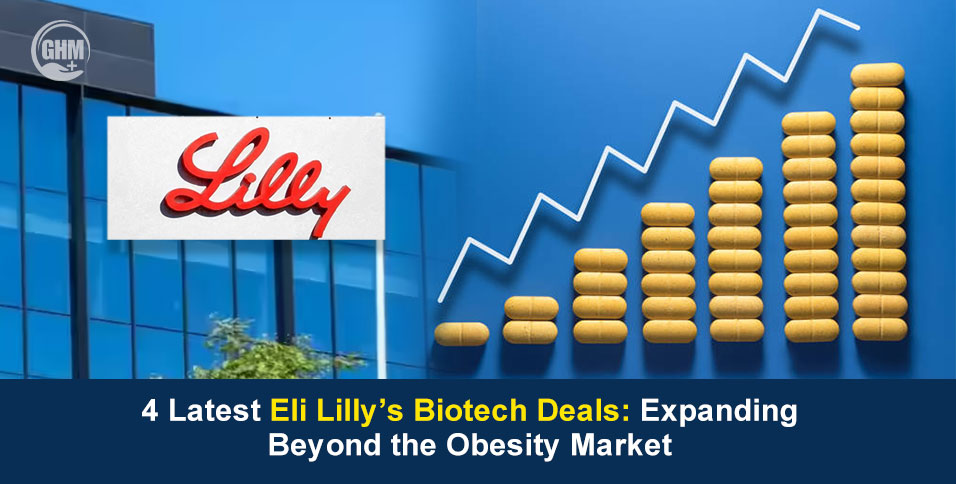
Global pharmaceutical leader Eli Lilly’s biotech deals are rapidly broadening its scientific and commercial reach through a series of bold, high-value collaborations and investments.
The investments in RNA therapeutics, AI drug discovery, gene therapy, and European manufacturing signal a major shift in focus beyond obesity drugs like Mounjaro and Zepbound.
The company’s strategy shows that Lilly isn’t just betting on weight-loss drugs; it’s building a diversified biotech powerhouse.
A Look At Eli Lilly’s Biotech Deals
1. $1.2 Billion Sanegene Partnership
Eli Lilly’s biotech deals kicked off with a major research pact worth up to $1.2 billion with SanegeneBio, a Chinese RNA-focused biotech company.
The partnership aims to develop RNA interference (RNAi) medicines that can silence genes linked to metabolic diseases. These are the conditions, like obesity and diabetes, that involve how the body processes energy.
Using Sanegene’s Ligand and Enhancer Assisted Delivery (LEAD) platform, the collaboration seeks to improve the precision and durability of RNA drugs.
The deal could result in treatments requiring as few as two injections per year, a major convenience leap for patients managing chronic conditions.
This partnership with Sanegene underscores Lilly’s commitment to pushing the boundaries of RNA therapeutics, a field revolutionising medicine by targeting disease at the genetic level.
“By investing in RNA technology, Lilly is moving toward therapies that work from the inside out, addressing disease causes, not just symptoms,” stated a biotech analyst.
2. Over $100 Million Insilico Pact For AI Drug Discovery
Continuing its innovation streak, Eli Lilly’s recent deals also include a $100 million-plus partnership with Insilico Medicine, a leader in AI-powered drug discovery.
The collaboration uses Insilico’s Pharma.AI platform to accelerate the identification and optimisation of potential drug candidates.
AI systems like this can analyse massive datasets, such as genomic, chemical, and clinical, to predict how drugs will behave before human trials. For a pharmaceutical giant like Lilly, this means faster, cheaper, and smarter drug development.
As part of the deal, Lilly gains access to advanced computational models that can reduce discovery timelines from years to months. The company’s continued investment in AI follows similar initiatives with other machine-learning platforms, showing that digital innovation is now core to its strategy.
3. MeiraGTx Collaboration For Ophthalmology Medications
Adding another dimension to its $pipeline, Lilly announced a gene therapy deal with MeiraGTx Holdings, focusing on severe inherited eye diseases. According to reports, the agreement includes $75 million upfront and potential milestones exceeding $400 million.
The partnership centres on MeiraGTx’s AAV-AIPL1 gene therapy, designed to treat Leber congenital amaurosis type 4, a rare genetic eye disorder that causes early blindness. Gene therapy replaces faulty genes with functional ones, potentially offering one-time, curative treatments.
This move shows that Eli Lilly’s biotech deals are expanding beyond its traditional metabolic stronghold into ophthalmology, a new frontier for the company.
The collaboration builds on Lilly’s growing reputation as a partner of choice for emerging biotechs with novel platforms, offering them both funding and development expertise.
4. $3 Billion Dutch Manufacturing Hub Strengthens Supply Chains
Eli Lilly’s biotech deals are not limited to R&D. The company also unveiled a $3 billion investment to build a cutting-edge manufacturing facility in Leiden, the Netherlands. It is Eli Lilly’s largest European expansion to date.
This plant will produce oral and injectable medicines using automated, energy-efficient systems and spray-dried dispersion technology, supporting faster scale-up of future drugs.
This investment will create over 1,000 jobs and reinforce Lilly’s ability to meet global demand for its expanding pipeline. It’s also a signal to European regulators and policymakers that Lilly is committed to long-term local production, reducing dependence on overseas supply chains.
“This site represents the future of pharmaceutical manufacturing—automated, sustainable, and globally connected,” said a Lilly spokesperson during the investment announcement.
Strategic Picture of Eli Lily’s New Era
Taken together, these deals reveal a coordinated push by Lilly to build a multi-technology portfolio.
- It is integrating AI, RNA, and gene therapy capabilities into its traditional strengths in endocrinology and immunology.
- The synergy between these technologies could dramatically reshape how drugs are discovered, tested, and delivered.
- RNA platforms may fuel early discovery, AI could speed up design and optimisation, and gene therapy might provide curative outcomes, all under one corporate roof.
- Analysts note that such breadth also protects Lilly’s stock price stability and investor confidence amid the competitive obesity drug race.
- With Novo Nordisk and Pfizer pursuing similar targets, Lilly’s diversified bets help reduce over-reliance on a single product category.
Implications on Global Health
These recently cut Eli Lilly’s biotech deals have implications far beyond Wall Street. They highlight how major pharmaceutical companies are embracing collaboration over competition, partnering with smaller innovators to accelerate treatments for diseases previously deemed untreatable.
From metabolic disorders to eye diseases, these Eli Lilly partnerships promise personalised, efficient, and accessible healthcare, supported by cutting-edge science.
The future of medicine lies in strategic collaboration, local manufacturing, and technological convergence.
Conclusion
Industry watchers expect Lilly to continue acquiring or partnering with biotech startups specialising in AI modelling, rare diseases, and RNA delivery.
Its recent acquisition of Adverum Biotechnologies, reported by Yahoo Finance, supports this prediction, suggesting more integration across gene and RNA pipelines.
As Eli Lilly’s biotech deals multiply, the company appears to be evolving from a pharmaceutical manufacturer into a technology-driven life sciences innovator.