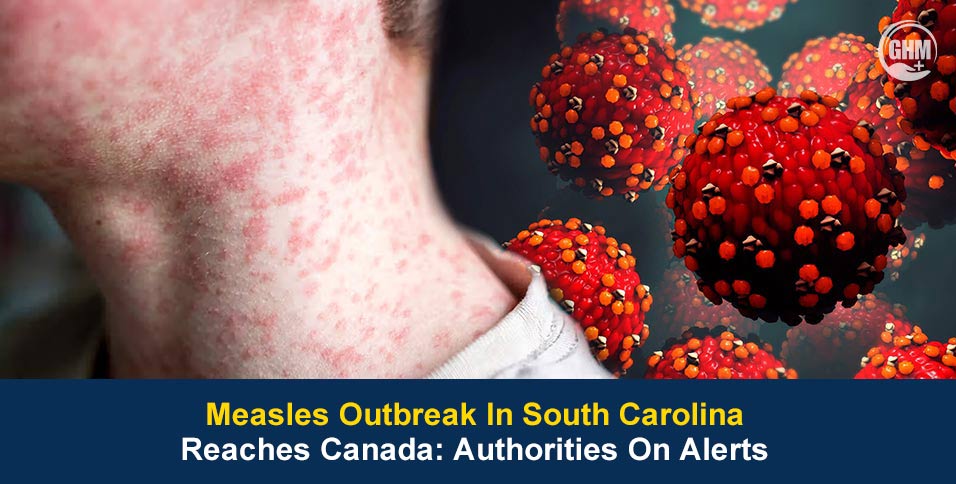
The measles outbreak in South Carolina has escalated dramatically in early 2026, becoming the largest measles surge in the United States in decades. Health officials now report that statewide cases have surpassed 900 since the outbreak began in 2025, signaling a significant public health challenge.
The outbreak, largely centered in Spartanburg County, has expanded beyond local clusters and is now part of a broader resurgence of measles across North America, with new exposure alerts in multiple U.S. states and Canadian provinces.
Public health authorities warn that interconnected outbreaks, mass gatherings, and pockets of low vaccination coverage are enabling measles to spread across borders and communities at an alarming pace.
What’s The Status Of The Measles Outbreak in South Carolina
Recent public health data show that South Carolina’s outbreak has continued to accelerate into February 2026, with totals reaching more than 900 confirmed cases since last fall. The surge represents the largest state-level measles outbreak in the U.S. since the disease was declared eliminated in 2000.
Earlier reports indicated the outbreak had already reached nearly 800 cases by late January, with hundreds of individuals quarantined due to exposure.
Health authorities say the outbreak remains concentrated in the northwest region of the state, particularly Spartanburg County, where most infections have occurred among unvaccinated populations.
Approximately 95% of those infected are unvaccinated, highlighting a strong correlation between immunization gaps and rapid transmission.
The outbreak’s trajectory has alarmed epidemiologists, who warn that sustained community transmission could continue for weeks or even months if vaccination uptake does not improve.
What Are The Measels Transmission Patterns
Measles is extremely contagious. A person can spread the virus from four days before the rash appears to four days after. That means individuals may infect others even before they realise they are sick.
Data from public health surveillance indicate that children and adolescents represent the majority of infections, consistent with school-based and household transmission patterns seen in prior measles outbreaks.
Officials note that the virus spreads easily in close-contact environments such as schools, religious gatherings, and community events. Because measles can linger in the air for up to two hours after an infected person leaves, even brief exposure can result in infection among susceptible individuals.
Although hospitalizations remain limited relative to case totals, some severe complications have been reported, including pneumonia and encephalitis risks associated with measles infection.
Measles Outbreak Beyond SC: Exposure Alerts Across US
The outbreak is no longer isolated to South Carolina. Early 2026 has seen new measles exposure alerts in multiple U.S. states.
In North Carolina, Wake County Public Health identified several public locations in Raleigh where a confirmed measles case may have exposed residents. Officials urged individuals who visited those locations during specified timeframes to monitor symptoms and verify vaccination status.
Meanwhile, California health authorities issued a measles exposure in Disneyland after an infected visitor attended it in January 2026, raising concerns about transmission in high-density tourist environments.
These alerts reinforce a consistent pattern that measles spreads efficiently through travel, large gatherings, and settings with incomplete immunization coverage.
Measles Concerns Amid Rising Cases In Canada
Health officials in Manitoba reported approximately 74 measles cases in January 2026 alone—the highest monthly total since the current outbreak began in early 2025. Many of these cases were linked to a large agricultural event, Manitoba Ag Days, attended by roughly 35,000 people, where exposure likely occurred across event venues, hotels, and nearby businesses.
Public health authorities warned that attendees may have unknowingly spread the virus after returning to their communities, potentially fueling secondary outbreaks. They emphasize that even a single infected traveler can trigger multiple exposure chains in highly populated venues.
Provincial officials also confirmed that southern Manitoba has been experiencing particularly high transmission levels, largely in areas with comparatively lower vaccination uptake.
Vaccination Gaps Driving the Measles Outbreak
The measles outbreak in South Carolina, which later spread to North Carolina, California, and Manitoba, reflects a wider resurgence of measles across North America following years of declining vaccination rates.
Epidemiological data show that the vast majority of confirmed infections occurred among individuals who were unvaccinated or had unknown immunization status.
Experts say that herd immunity requires approximately 95% vaccination coverage to prevent sustained measles transmission. However, some local school and community vaccination rates have fallen below this threshold, creating vulnerability pockets where the virus spreads rapidly.
The consequences of such immunity gaps are evident: once measles enters a susceptible population, case counts can grow exponentially within weeks.
Public Health Response Efforts
Authorities in the US and other affected regions have intensified containment strategies, including:
- Expanded contact tracing and exposure notification systems
- Quarantine requirements for unvaccinated exposed individuals
- Vaccination campaigns and community outreach
- Public advisories for healthcare providers and schools
Health officials also report a significant increase in vaccine uptake following the outbreak, with thousands of additional MMR doses administered statewide in January alone.
Medical experts continue to stress that vaccination remains the most effective method to prevent measles infection and severe complications.
Conclusion
The measles outbreak in South Carolina in 2025 has evolved into a record-breaking public health event, with cases continuing to rise into 2026. The outbreak’s spread beyond state borders and parallel exposure alerts in Manitoba, Canada, illustrate how measles can rapidly transcend regional boundaries when immunity gaps persist.
Despite intensified containment measures, experts warn that long-term control will depend heavily on restoring high vaccination coverage and maintaining strong public health surveillance systems.
The outbreak serves as a stark reminder that measles remains one of the most contagious human viruses and that sustained vigilance, vaccination, and rapid response remain critical to preventing further escalation.