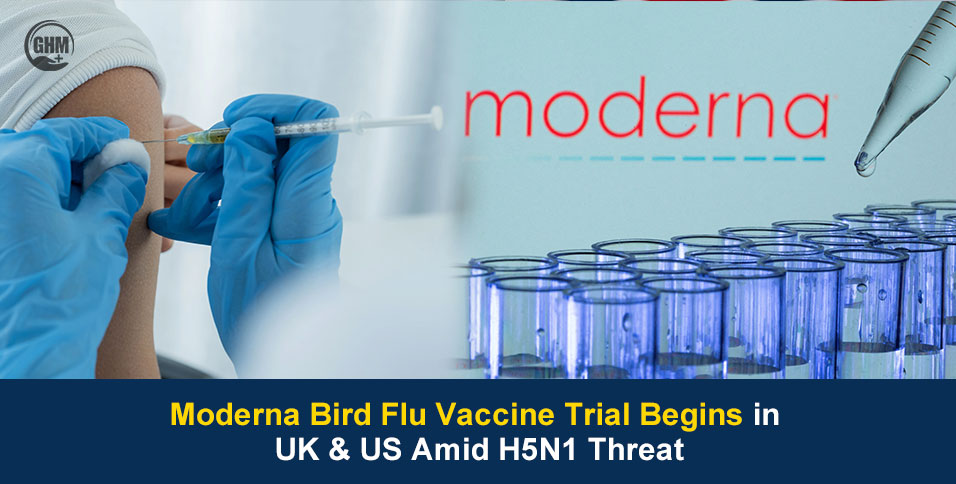
The Moderna bird flu vaccine trial has officially started in the United Kingdom and the United States, marking an important step in preparing for future influenza pandemics. Moderna announced that its late-stage clinical study will test an experimental vaccine called mRNA-1018, designed to protect against the H5N1 avian influenza virus, commonly known as bird flu.
Health experts say the current risk to the public remains low, but growing flu outbreaks in birds and mammals have raised concern worldwide. The new Moderna bird flu vaccine trial aims to determine whether this vaccine can safely create a strong immune response before the virus has a chance to spread more easily among humans.
What Happens In The Moderna Bird Flu Vaccine Trial?
The Moderna bird flu vaccine trial is a Phase 3 study involving around 4,000 healthy adults aged 18 and older across the UK and US. It is the first known human bird flu vaccine trial using mRNA technology to reach this advanced stage.
Participants for the bird flu vaccine trial will receive two doses of the vaccine to evaluate safety and immune response. If results are positive, Moderna could later seek regulatory approval.
The vaccine candidate, known as the Moderna mRNA-1018 vaccine, uses the same messenger RNA platform that helped Moderna rapidly develop its COVID-19 vaccine during the pandemic.
The company has continued expanding its respiratory vaccine pipeline, although recently, the FDA rejected the review application for its seasonal flu shot candidate, mRNA-1010.
Why Is Bird Flu Getting So Much Attention?
Bird flu, especially the H5N1 strain, has caused widespread infections in poultry and wild birds for years. More recently, the virus has also been found in mammals, including dairy cows in the United States, foxes, seals, and mink.
While most human infections remain rare and linked to close contact with infected animals, experts are watching carefully for any sign the virus could adapt to spread more easily between people.
According to reports, since 2024, more than 100 confirmed human cases have been recorded globally, nearly all involving direct exposure to infected animals.
Dr. Rebecca Clark, one of the investigators involved in the UK study, said the strain is “evolving and spreading across animal species,” adding that human-to-human transmission must be treated as “a real possibility.”
Why mRNA Technology Could Change Bird Flu Response
A key reason the Moderna bird flu vaccine trial is drawing attention is the use of mRNA technology. Traditional flu vaccines are often made by growing viruses in eggs, which can take months. That process may also face challenges with highly aggressive avian flu strains.
The mRNA approach works differently. Instead of using the virus itself, it gives the body instructions to recognize part of the virus and build immunity. This allows vaccines to be designed and updated much faster.
That speed could be critical during a pandemic. During COVID-19, mRNA vaccines were developed in record time, showing how quickly the technology can respond to emerging threats.
For policymakers and healthcare planners, the Moderna H5N1 vaccine trial may offer a model for faster future outbreak responses.
Who Is Being Recruited for the Bird Flu Vaccine Trial?
Moderna is looking for volunteers in both countries for the Bird Flu Vaccine Trial. In the UK, around 3,000 participants are expected to join at 26 research sites across England and Scotland.
Researchers are especially encouraging the following groups to participate:
- Poultry workers
- Farmers
- Adults over age 65
- People with regular contact with birds
These groups may face higher exposure risks or greater health complications from flu infections.
One of the first UK volunteers, Clare Howard from Hampshire, said the vaccination process was simple and that it could prove “incredibly important.”
Who is Funding Moderna’s Vaccine Trial?
The Coalition for Epidemic Preparedness Innovations (CEPI) is backing the Moderna bird flu vaccine trial. CEPI is an international organization focused on vaccine development for epidemic threats that has committed $54 million to support the program.
This funding came after earlier US government contracts related to bird flu vaccine development were canceled.
Moderna has also recently reduced legal uncertainty through the Covid vaccine patent settlement, a deal worth up to $2.25 billion that resolved long-running intellectual property disputes tied to its mRNA platform. Industry analysts say this could allow the company to focus more resources on pipeline innovation, including pandemic vaccines.
What Happens Next in the Phase 3 Bird Flu Vaccine Study?
This Phase 3 bird flu vaccine study will monitor participants over several months. Researchers will focus on three major questions:
- Is the vaccine safe?
- Does it trigger a strong immune response?
- How long does protection appear to last?
Because human bird flu cases are still uncommon, scientists may rely heavily on antibody levels and immune markers rather than waiting for large numbers of infections.
If successful, the Moderna bird flu vaccine trial could move toward regulatory review in multiple countries.
The partnership also includes a commitment to global access. Moderna said that if the vaccine is approved and a flu pandemic is declared, it would reserve 20% of manufacturing capacity for low- and middle-income countries at affordable prices.
Conclusion
The Moderna bird flu vaccine trial represents a major development in pandemic preparedness. By testing the mRNA-1018 vaccine across thousands of volunteers in the UK and US, researchers hope to stay ahead of a virus that continues to evolve in animals.
No immediate crisis has been declared, and public health agencies say the current risk remains low. Still, history shows that early preparation saves lives. If successful, this Moderna bird flu vaccine trial could become one of the most important vaccine efforts of the decade.