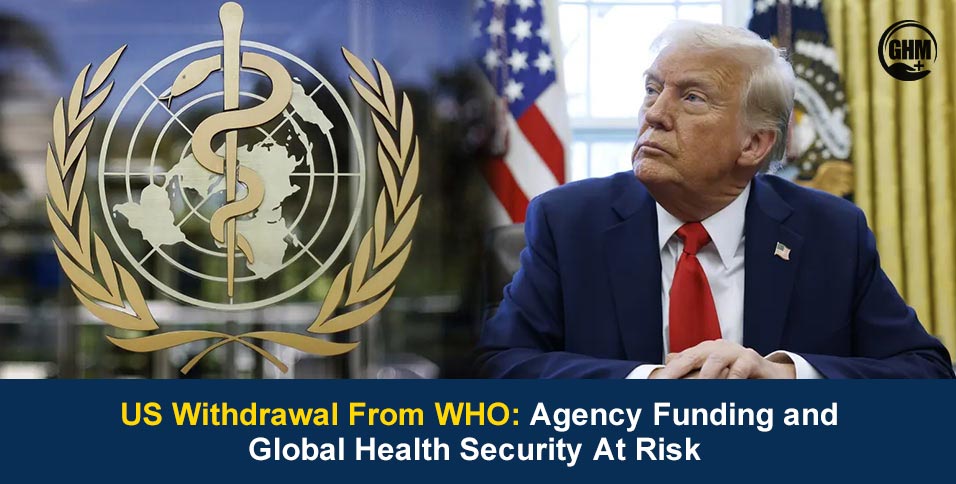
After years of criticism, the United States has officially ended its membership with the World Health Organization (WHO), initiating a new era in how the country engages with international health systems. The US Withdrawal from WHO marks one of the most consequential shifts in global health governance of the 21st century.
It is a turning point that raises urgent concerns for global funding disruptions, power dynamics, and global pandemic preparedness.
Why the US Exited the World Health Organization
The move to exit the World Health Organization was initiated by President Donald Trump, who signed Executive Order 14155 on January 20, 2025. According to the order, the agency’s handling of the COVID-19 pandemic, lack of reform, and perceived political influence were the core reasons for the United States’ departure.
Over the following year, the U.S. government halted funding, withdrew personnel from WHO offices worldwide, and formally finalized its exit on January 22, 2026. This officially ended decades of involvement by the U.S., which had been a founding partner and historically the agency’s largest contributor.
How the US Withdrawal from WHO Affects the Agency Funding
One of the most immediate impacts of the US Withdrawal from WHO has been a significant funding shock to the organization. For decades, the United States provided both mandatory dues and voluntary contributions that together accounted for roughly 18% of total WHO funding.
Financial Withdrawal
- U.S. funding for WHO has been completely terminated.
- Washington has withdrawn all personnel and ended participation in key WHO governance bodies.
- The United States left behind roughly $260 million in unpaid dues, creating a further budgetary strain.
Immediate WHO Budget Impacts
The withdrawal has forced the World Health Organization to make difficult financial decisions:
- The management team has been cut by half.
- A planned reduction of about 25 percent of staff by mid-2026 is underway.
- Program budgets across departments have been scaled back, weakening the WHO’s operational capacity.
These cuts risk slowing crucial international disease surveillance and outbreak responses, which depend heavily on consistent funding and global coordination.
Can the US Exit Shift The Global Influence
The US Withdrawal from WHO not only affects funding but also reshapes global influence in health diplomacy, strengthening the role of other major players.
- Loss of a Leadership Seat
With the exit, the United States no longer participates in WHO assemblies, committees, or leadership votes, including the upcoming director-general election. This means the U.S. loses a formal voice in setting policies that guide global responses to public health emergencies.
- Rise of Other Influences
Countries such as China have increased their voluntary contributions and influence in WHO operations, narrowing the leadership gap left by the U.S. departure. External actors and regional alliances are also stepping in to reshape priorities in areas like disease control, vaccine distribution, and emergency response.
Some experts view this geopolitical shift as a broader realignment of global governance, where health, which was once a platform for U.S. soft power, now becomes a contested terrain of influence among competing global actors.
“Withdrawing from WHO not only cuts crucial funding from the agency, but it also surrenders our role as a global health leader,” said Dr. Tom Frieden, a U.S. public health expert, to Sky News.
Others argue that reforming multilateral institutions might strengthen them in the long run, provided that new governance approaches emerge.
Will America’s WHO Exit Change The Global Pandemic Scenario
Perhaps the most worrying consequence of the US Withdrawal from WHO centers on the global pandemic.
- Weakened Disease Surveillance
WHO plays a critical role in coordinating data and intelligence from health agencies around the world. U.S. withdrawal means diminished access for American health experts to real-time global outbreak data and crucial early warnings, such as those for influenza strain changes that guide annual vaccine compositions.
- Coordination Challenges
Public health experts warn that the fragmentation of international cooperation could create gaps in outbreak responses. Without a central hub like the WHO coordinating efforts, bilateral agreements alone may not be sufficient for globally synchronized responses to cross-border health threats.
- Industry and Research Impacts
The breakdown in multilateral data sharing might slow the work of researchers and pharmaceutical companies that depend on WHO-facilitated networks to develop vaccines and treatments swiftly during emerging epidemics.
What Comes Next For A Fragile Global Health Landscape
The US Withdrawal from WHO has set in motion complex ripples across global health, diplomacy, and epidemic preparedness.
While the U.S. government has stated its intent to pursue direct bilateral partnerships for disease surveillance and response, many experts caution that fragmented approaches may fall short of the comprehensive, cooperative strategies needed to manage future outbreaks. The recent decision of the US to exit from several UN Agencies also indicates where the country now stands.
As global health systems adapt to this new landscape, the international community faces critical choices: build stronger multilateral mechanisms without the United States at the table, or find pathways to reengage in collaborative frameworks that balance national interests with global health security.